






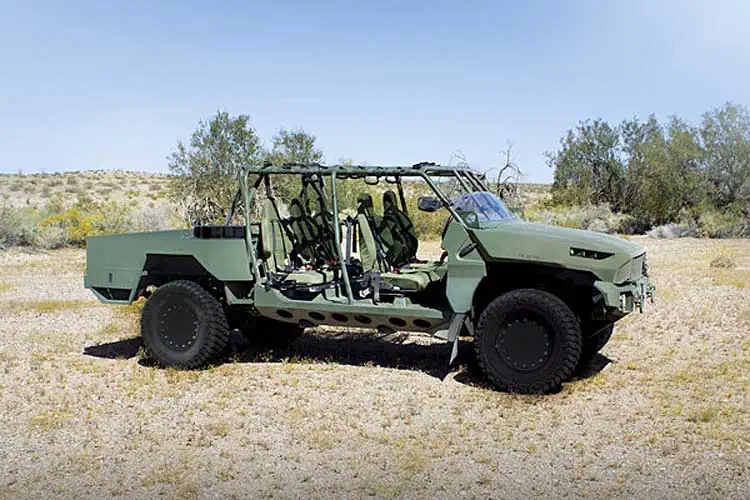
Automotive Parts Association President Flavio Volpe and Oshawa Regional Councillor Tiito-Dante Marimpietri testing military vehicles in Oshawa
With Canada and its NATO allies expected to invest trillions in national security projects over the next few years, the Ontario government is preparing to secure a significant portion of that business, with the City of Oshawa eager to contribute its expertise for future opportunities.
Canada has announced it will allocate $81 billion over five years to support its defence commitments, including meeting NATO’s target of spending five per cent of GDP by 2035.
In response, Queen’s Park has declared its aim to create its first-ever Ontario Defence Industrial Strategy, ensuring that workers and businesses in the province are ready to support Canada and its allies in securing defence while boosting production and creating long-term economic benefits like job growth.
Oshawa Mayor Dan Carter called this provincial strategy a “decisive step” toward enhancing Canada’s sovereign defence capabilities, ensuring resilient supply chains, and promoting domestic innovation to meet both national and allied needs.
The city “welcomes” this announcement and reaffirmed its commitment to collaborating with provincial and federal partners, industry players, and educational institutions to “turn policy into tangible capability.”
Oshawa Mayor Dan Carter
“Oshawa is uniquely positioned to support and accelerate the province’s defence industrial goals through our Integrated National Defence Innovation Corridor,” Carter stated. This initiative was launched last year to connect defence manufacturing, distribution, R & D, training, and border security in an integrated corridor.
“Our strategic corridor brings together advanced manufacturing capacity, multimodal logistics, concentrated R& D facilities, and a growing talent pool in cybersecurity, artificial intelligence, and systems engineering. These resources are bolstered by GM Canada’s long-standing presence in Oshawa along with cutting-edge advancements at the GM Canadian Technical Centre and CTC Mc Laughlin Advanced Technology Track.”
“These strengths align directly with the framework’s priorities for expanding domestic production, speeding up procurement timelines, and enhancing industrial collaboration across the defence ecosystem.”
According to the new NATO Defence Investment Pledge guidelines, governments can invest 1.5 per cent of their five per cent commitment into infrastructure projects such as cyber defence initiatives or military base construction which would benefit Ontario’s wider economy.
The remaining 3.5 per cent-approximately $150 billion annually-will focus on core defence expenses like equipment procurement or personnel costs. This allows Canadian firms to bid on large-scale projects supported by loans up to $244 billion for EU member states.
“This represents an unprecedented opportunity for Canada that hasn’t been seen since World War II,” Carter said. “The City of Oshawa is well-equipped with talent, assets, resources, and capacity needed for Canada’s response.”
Oshawa along with other communities already active within the GTA’s defence sector are just part of Ontario’s broader response. The Ring of Fire region in northern Ontario along with Waterloo Region’s expertise in cybersecurity will also play critical roles moving forward.
This global shift offers a “generational opportunity” for driving industrial development while capturing high-value jobs. It strengthens Ontario’s position as a trusted partner within both domestic and allied defense supply chains,” stated Premier Doug Ford during a global trade show organized by the Canadian Association of Defence and Security Industries on Thursday.
The first-ever Ontario Defence Industrial Strategy aims at ensuring workers from across the province are “proactively positioned” so they can help secure defense efforts while fostering production that generates lasting economic gains including job creation.
The province plans on generating 43 thousand new jobs over ten years through retooling factories as well as reskilling workers from sectors affected by trade disruptions-all aimed at spreading valuable skills throughout various economies while assisting businesses pivot towards dual-use applications for defense production purposes.
If successful meeting these objectives could add more than $6 billion towards provincial GDP alongside around $400 million annually collected through taxes by 2035.
Carter emphasized how Oshawa stands ready take advantage when it comes time engaging heavily here.
“Oshawa has always backed industrial development offering attractive incentives creating robust local employment opportunities,” he noted pointing out exemptions made on development charges led directly into providing over seven thousand new jobs since twenty eighteen alone.
“Alongside land already designated specifically for use related activities plus available shovel-ready sites-it highlights commitment toward fast-paced growth essential not only maintaining but strengthening national security efforts overall.” p >
Infrastructure presently established within Oshawa should facilitate getting ahead whenever future contracts arise:
Advanced testing & R& D: Oshawa hosts ACE Wind Tunnel-a NATO DIANA-capable facility able simulate Arctic conditions crucial aerospace/system-testing thus validating cold weather research efforts recently boosted via five-million-dollar investment from Fed Dev Ontario transforming ACE hub focused solely tech developments concerning defense Integrated multimodal logistics/manufacturing: Its location near major highways/railways deep seaport granting access international markets means strong foundation underpinning resilience among supply chain dynamics suited specifically tailored around quick deployment strategies linked back ground Talent/innovation pipeline: Accessing vast pipeline comprised thirty-five thousand enrolled students spread across four post-secondary institutions/training centers/private-sector partnerships ensures skilled workforce ready tackle demands stemming large-scale defense project operations taking place continuously Investment-friendly development initiatives exist such zero charges attached required towards commencing any ongoing developments guaranteeing lower start-up costs thereby speeding up project timelines necessary fulfill urgent capabilities needed urgently
“Oshawa is open for business stands prepared partnering alongside procurement/joint R&D programs/workforce developments/infrastructure investments delivering secured innovative solutions made right here serving armed forces allied partners alike.” p >
p >
p >INsauga’s Editorial Standards and Policies
Last 30 Days :48 ,851 Votes p >
All Time :1 ,370 ,280 Votes p >118 VOTES
Source link