



Severe thunderstorms that swept through southwestern Ontario on Saturday afternoon led to Canada’s first recorded microburst and tornado of the year, according to tornado researchers at Western University.
The storm system moved through around 4 p. m., prompting Environment Canada to issue a red tornado warning for London and Middlesex County, as well as triggering Western’s emergency weather siren, which could be heard throughout the city.
Researchers from the university’s Northern Tornadoes Project (NTP) were sent out on Sunday to investigate reports of storm damage located about 30 km north of London, confirming that some of it was caused by a weak EF0-rated tornado.
The tornado touched down at 4:05 p. m. and traveled approximately 1 kilometer east-southeast across Hwy. 7, south of Granton, with estimated peak wind speeds reaching 110 km/h, said David Sills, NTP’s executive director, on Wednesday.
A large solar panel array south of Granton was toppled during Saturday’s storms by what researchers at the Northern Tornadoes Project later confirmed was a weak, EF0-rated tornado. (Northern Tornadoes Project)
“There was a pickup truck pulling a recreational trailer, and that was pushed off the highway. There was a big solar panel array that got pushed over. And then just a bit further to the east of that, there were some trees that experienced damage,” Sills said.
“It was very localized damage, and that’s typically what you expect with microbursts and tornadoes. And it did take us a while to figure out exactly what happened here.”
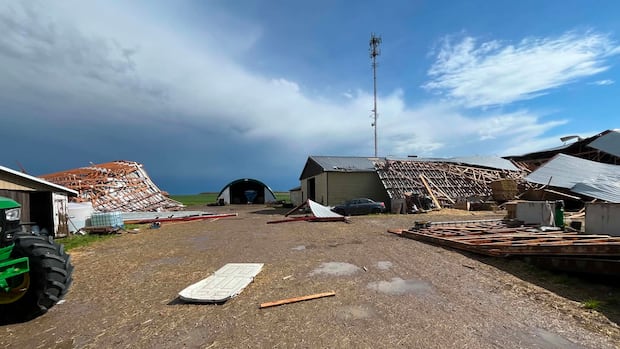
Just five minutes before the tornado touched down, Sills noted that the storm produced an EF0-rated microburst just south of Lucan with maximum sustained winds reaching 130 km/h. The microburst damaged a farm building along Sixteen Mile Road east of Wonderland Road.
In an interview on Sunday, farm owner Jason O’Neil mentioned he had been working at a nearby farm when the storm hit and told his wife to make sure their shed and workshop doors were closed.
O’Neil’s wife had just started closing the workshop doors when suddenly the storm lifted off part of their shed roof right in front of her, he reported. Thankfully, no injuries were reported.
“I’ve never seen weather that localized. To the east, there are a few branches on the ground, but to the west there’s nothing,” he said.
The system also created a line of thunderstorms stretching across southwestern Ontario; Sills added that researchers received reports about hailstones as big as toonies near Leamington. The hail destroyed around 350,000 tulips at a popular Blenheim tulip farm, abruptly ending their season.
Most wind damage occurred north of London according to Sills. “It was good to see the tornado warnings come out because definitely there was potential there.”
Even though observers didn’t visually confirm seeing a tornado from ground level, what they observed in nature along with weather radar information justified issuing a warning said Steven Flisfeder from Environment Canada.
“Rotation on radar doesn’t always mean that a tornado is present. The rotation can just be within the cloud itself; it doesn’t necessarily make its way all the way to the surface,” Flisfeder explained.
A drone image taken on Sunday by researchers with the Northern Tornadoes Project showing damage to Jason O’Neil’s farm along Sixteen Mile Road east of Wonderland Road. The research team later confirmed that this damage resulted from an EF0-rated microburst during the previous day’s events. (Northern Tornadoes Project)
In addition to reports regarding damages investigated by NTP , Flisfeder stated they also received numerous accounts about downed trees near London , Strathroy , and Metcalfe. “Reports about downed trees were primarily what we got concerning damages.” P >
According to Sills , these occurrences marked Canada ’ s first recorded microburst and tornado for this season , leaving uncertainty surrounding how active this season might turn out. P >
“We know it has been quite an active tornado season just south in U. S. , thankfully due cold Great Lakes preventing all such activity from crossing into our area affecting us. That’s something we witness every year ,” Sills remarked. P >
“But once those lakes begin warming up together generally warmer temperatures start rising too ; we start observing increased activity then. We’ve already witnessed these initial events but surely many more will follow.” P >
Source link