




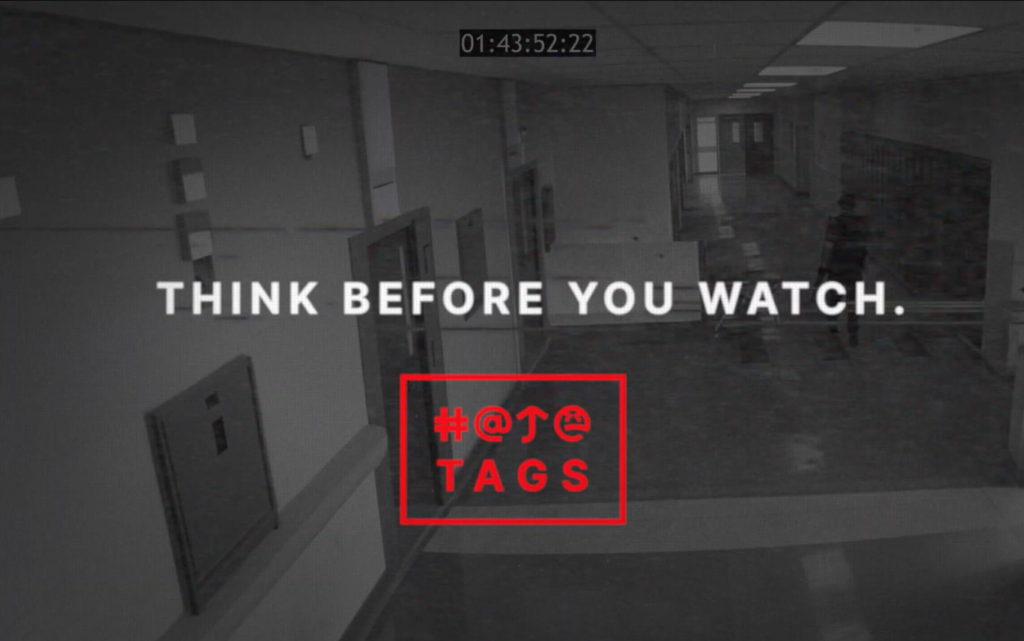
The Toronto Holocaust Museum has begun testing a new advertising initiative aimed at fighting harmful online content.
On May 12, the museum introduced a You Tube account called “Hate Tags,” featuring videos that appear as brief paid ads before material identified as hateful, misleading, or promoting violence. These five-second spots display a bright red warning sign next to shocking images, like a school shooter in a hallway or a building with a Star of David and shattered windows, reminding viewers: “Think before you watch.”
Dara Solomon, the executive director of the Toronto Holocaust Museum, explains that these ads serve a similar purpose to warning labels found on cigarette packs but for “addictive” social media content.
“The videos really do catch your attention if you see them,” Solomon notes, adding that she believes cigarette warnings were effective when they showed graphic images like infected lungs.
Solomon is optimistic that this effort will motivate social media platforms to start marking content that incites violence and push the federal government to more clearly define hate speech and misinformation. The museum also launched a Change. org petition towards this goal, gathering around 1,300 signatures by early June.
Hate Tags is also an effort to connect with 18-to-24-year-olds who Solomon mentions visit the museum less frequently compared to younger students. Given that Holocaust and Nazi propaganda stem from “misinformation that fueled so much hatred,” she felt they had valuable insights to share with young adults about the dangers of antisemitism and other forms of hate.
“We realized we needed to extend our reach beyond the museum’s walls to directly engage this group in an impactful way, meeting them where they are-online,” Solomon states.
As of now, the seven Hate Tags ads have garnered approximately 1.78 million views on You Tube. Solomon indicates they’re “on track to surpass seven million by the end of the campaign due to recent expansion across Canada.”
This isn’t the first time the Toronto Holocaust Museum has tackled misinformation online. In 2024, they received a $375,000 grant from the Ministry of Heritage aimed at providing guidance on identifying misinformation and finding reliable news sources.
Solomon mentions that their initial campaign ran from January through March 2025, attracted over three million impressions, and helped refine their social media strategies for the Hate Tags project-funded by this same grant as its second phase.
“Our goal was just to encourage people to think critically about what they consume online. One post said ‘Your aunt Sheila is not a verified news source,’ so we got a bit cheeky with it,” Solomon remarks.
Unlike their previous campaign which spread organically through their own networks, Solomon points out they collaborated with advertising firm Diamond and media agency Epitaph for placing Hate Tags ads on hateful videos across various political viewpoints.
This included blatant hatred such as “homophobic” or anti-immigrant right-wing videos from manosphere figures like Andrew Tate as well as subtler discussions within left-wing academic settings.
“We can’t focus solely on hate coming from one side; we must address it wherever it arises-even when it’s more nuanced,” says Solomon. “Holocaust denial presented in an academic context or minimizing its significance-that’s some of the hate emerging from the left.”
Jordan Cohen and Mark Holden are creative directors at Diamond responsible for developing the Hate Tags campaign. They state they “reverse engineered” Silverpush’s AI-powered software typically used by brands seeking to avoid undesirable associations with objectionable content.
“Rather than steering clear of hate, we actively sought it out. The ads were contextually targeted based on visuals, audio cues, text copy, comments made by users, and hashtags spanning various categories of hate and misinformation,” Cohen and Holden explained in an email statement.
The Diamond team utilized keywords such as “demographic replacement” and “white extinction” targeting videos discussing The Great Replacement theory-a conspiracy claim suggesting immigrants are intentionally displacing white populations in Europe and North America. They also focused on terms pushing young men toward increasingly radical beliefs related to misogyny such as “incel,” “red pill,” “alpha male,” along with notions surrounding “female hypergamy.”
Jaimie Weisberg is an influencer who promotes body positivity while sharing uplifting narratives about Jewish life with her over 1.7 million followers online. She worked alongside Toronto Holocaust Museum by posting promotional material regarding Hate Tags on Tiktok.