



Last year in Leamington, Ontario, one of North America’s most troublesome aquatic species was spotted for the first time in Canada. Hydrilla verticillata (hydrilla) was discovered in Hillman Marsh near Point Pelee National Park by Biology Professor Dr. Rebecca Rooney and her research team while conducting a wetland survey. Now, her Waterloo Wetland Laboratory at the University of Waterloo is taking the lead to eliminate the plant before it spreads throughout Ontario.
A key player in this research is Master of Science in Biology student Kayla Martin, who is observing the marsh’s native plants, water quality and benthic invertebrates (the small organisms that live at the bottom of lakes and rivers) to grasp how hydrilla is affecting the ecosystem. This work contributes to the University of Waterloo’s mission to protect ecosystems and ensure a sustainable future.
Hydrilla is an aquatic plant that forms extremely dense mats, so thick that it’s hard to see any water between them. These mats harm water quality, prompting Essex Region Conservation Authority (ERCA) to hire licensed applicators for herbicide treatments aimed at eradicating it, while the Waterloo Wetland Lab monitors how effective those treatments are. The objective is to get rid of it before it can spread further, which might take several years.
“Invasive hydrilla can throw an entire ecosystem off balance,” says Martin. “If there aren’t invertebrates, fish don’t have food, which then impacts the animals that rely on fish. It can also reduce the presence of native plants that animals depend on.”
The good news is that Hillman Marsh has two separate wetland cells, both cut off from Lake Erie. Hydrilla exists in the west cell, while the east cell remains clear of this invasive species, allowing Martin a chance to study its effects comparatively. The west cell is hydrologically controlled, enabling ERCA to lower the risk of hydrilla spreading further.
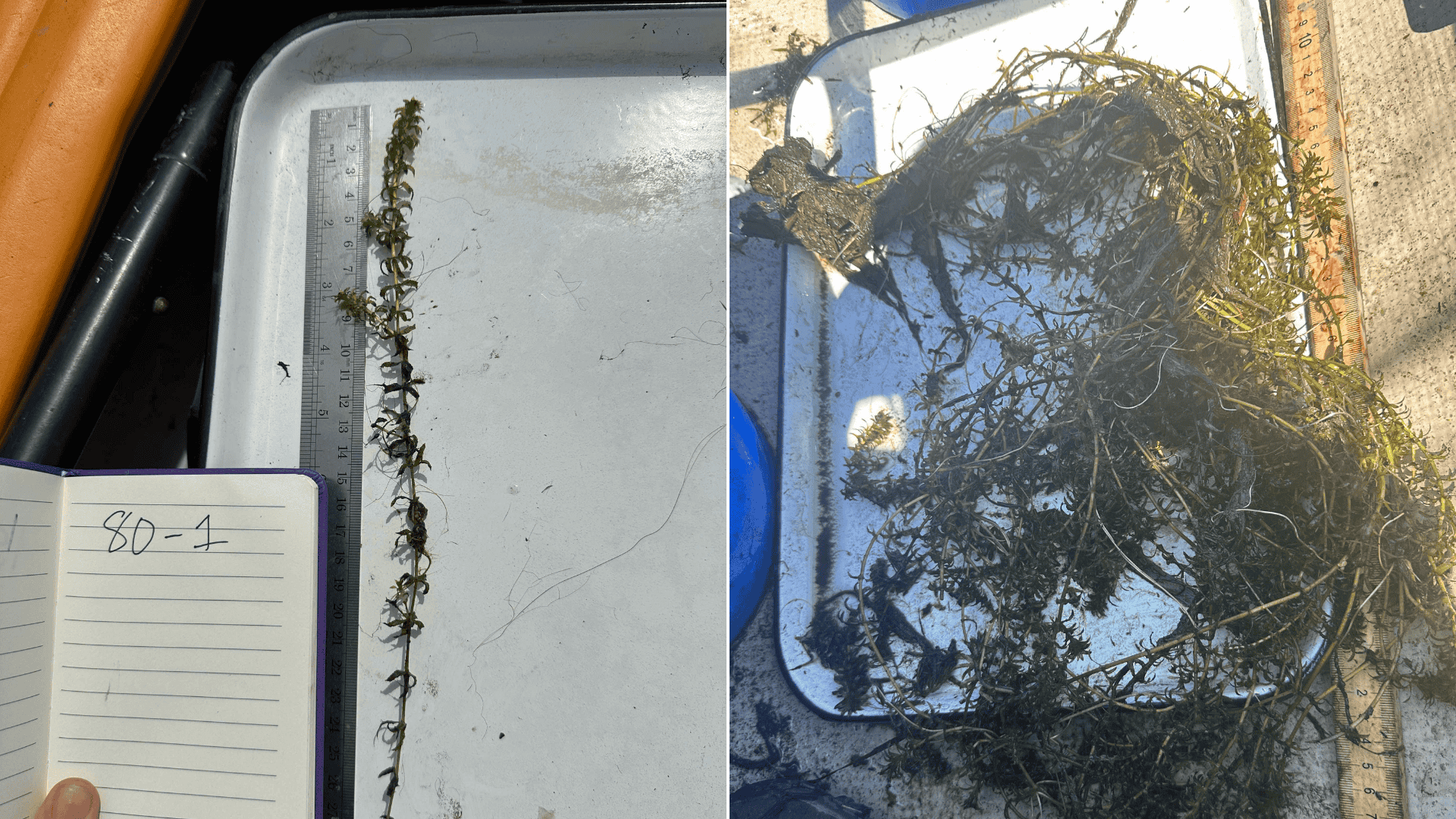
On the left: Young hydrilla plant. On the right: Mature hydrilla plant.
“Along with halting all activities around the West Cell, ERCA continues extensive outreach and education efforts to prevent invasive hydrilla’s spread,” said Kevin Money, ERCA’s Director of Conservation Services. “We’re very thankful for all our partners who are working together on this vital task.”
When spring arrives, Martin will evaluate how well different treatments against hydrilla have worked out. The lab aims to create a reliable treatment plan so if this invasive plant pops up elsewhere, there’ll be a proven way to remove it effectively.
Martin’s passion for aquatic ecology stems from her love for nature. Growing up she often volunteered for environmental cleanups and tree planting events at school. In her free time she enjoys scuba diving and has witnessed firsthand how much damage invasive species can do-making this project particularly meaningful for her. When choosing where to pursue her master’s degree, she found University of Waterloo’s strong reputation in water science appealing and made it an easy choice.
“I am proud to be part of a group of Waterloo researchers contributing to a sustainable future,” says Martin. “I am excited about working on a project that will have lasting positive effects on our environment.”
With hydrilla poised to spread across Ontario, that impact couldn’t be more pressing; and the Faculty of Science at the University of Waterloo stands proud as leaders in combating this issue.
Source link