





Local News
Jun 01, 2020 • Last updated 6 years ago •
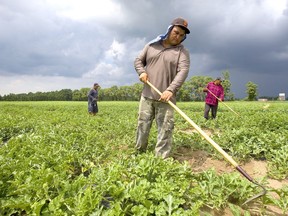
A Norfolk County farmer is taking a stand against a health regulation that limits migrant workers to just three per bunkhouse. Mike Hensen/Postmedia Network jpg, DN
A group of migrant farm workers who arrived in the Delhi area were housed together for up to two days in Jamaica, crammed into an airplane and then bused together to the area.
This has not loaded yet, but your article continues below.
However, a local public health directive required them to split into groups of three and isolate in separate bunkhouses that typically could hold up to 34 men in one building.
This was the situation described by Jason Ryder, president of Ryder Farms, who on May 26 spoke out against a contentious Haldimand-Norfolk public health order regarding the quarantine of migrant workers.
Ryder oversees crops like ginseng, asparagus, tobacco and specialty vegetables for clients such as Loblaws, Sobeys and Costco. He was the first witness in an online appeal presented to the provincial Health Services Appeal and Review Board hearing.
Ryder, fellow farmer Brett Schulyer, and lawyer Andrea Plumb from Schuyler Farms Ltd., were challenging the Section 22 order issued by Dr. Shanker Nesathurai, Haldimand-Norfolk’s medical officer of health. This order restricts isolation to three farm workers per dwelling.
“Even the workers out of isolation have zero interaction with the community,” said Ryder, referring to his long-time employees as the “lifeblood” of his operations.
This has not loaded yet, but your article continues below.
“We arranged banking online for them to send money back home and set up a ‘grocery store’ right on site. Our guys haven’t left the farm since being out of isolation except to move between (farming) operations.”
No outbreaks of COVID-19 have occurred at any Ryder farms so far.
However, Ryder noted that this three-person rule has already had a serious impact on his farming business, cutting down production of asparagus, green onions and even jeopardizing future sweet potato yields.
On Monday and early Tuesday, Plumb and health unit attorney Jill Dougherty presented their arguments while the review board considered whether or not to suspend the order. Instead of making an immediate decision, they chose to gather more evidence from witnesses including Brett Schulyer and Nesathurai himself.
Ryder pointed out that some of his seven bunkhouses have two kitchens and five bathrooms available which can easily accommodate more than three workers while still maintaining proper physical distancing guidelines.
The workers – all regulars at Ryder Farms over several years – voiced concerns about staying in motels. He didn’t want to add any stress by forcing that option upon them.
This has not loaded yet, but your article continues below.
“These folks are leaving their families for eight months to come here and provide food and when I talked to them about options – a motel or three per bunkhouse versus not coming at all – their attitude was totally against going into a motel,” said Ryder. He added he tried hard to fill as many positions locally as he could for his workforce needs.
Ryder explained that timing is crucial for certain crops since asparagus and ginseng depend heavily on weather conditions; workers must be ready at all times for harvest or crop maintenance tasks without delays due to isolating rules affecting their availability.
Earlier in proceedings Jill Dougherty representing Haldimand-Norfolk’s board stated hosting more than three individuals together within one bunkhouse-even if spacious-amplifies consequences following just one positive COVID-19 case.
“If three people are isolating together but one falls sick on Day 13 then they all need another two weeks’ quarantine-that leads us into losing up till 81 working days altogether! But if twenty people stay packed together? That equals around five hundred forty lost workdays! Therefore cramming large groups inside shared accommodation isn’t really beneficial economically nor helpful toward public wellness resources.”
“The farmers contesting this mandate argue needing extra funds spent towards feeding isolated staff members staying remotely will drastically cut profits gained through crops produced normally hence harming both livelihoods overall while adding pressure onto food availability across our province.”
Your friends may want share this story through social networks: p>
Source link