




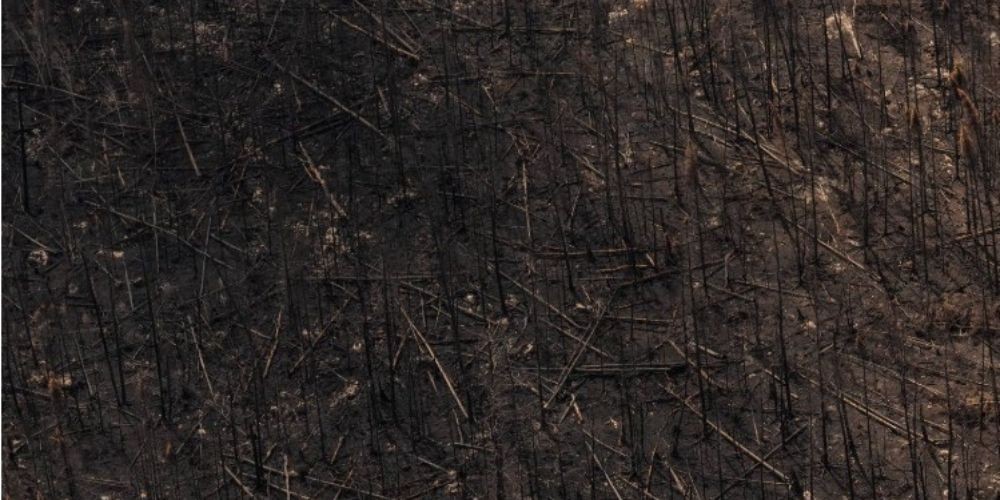
Wildfire damage is pictured from the air in the immediate area surrounding Collins First Nation, a small, remote Ojibwa community located in northwestern Ontario, about 250 km north of Thunder Bay, Ont., on Wednesday, July 22, 2026. THE CANADIAN PRESS/Chris Young
A new report released Thursday states that human-caused climate change has made the conditions for intense wildfires in Ontario and Northwest Territories about twice as likely.
The report from an international team of scientists indicates that conditions which were once rare are becoming more frequent due to climate change driven by fossil fuel combustion.
“The geographic spread of these fires is scary and shows that despite preparedness from wildfire governance, adaptation alone is not enough,” said Theodore Keeping, a co-author and Imperial College London research associate.
“We need to rapidly move away from fossil fuels to avoid events like this becoming even more of a reality.”
🎧 Local news stories that matter most to you
Subscribe on Spotify, Apple Podcasts and wherever you get your podcasts to get notified of new episodes every day.
According to the World Weather Attribution report, early observations suggest that hot, dry, and windy conditions fueling fires in Northwest Territories could now be expected every two to six years and every six to 15 years in Ontario.
In a scenario without human-induced climate change, those conditions would have been far less common-less than once every 40 years.
Initial estimates indicate this could be the worst wildfire season on record for Ontario and among the top ten for Northwest Territories regarding area burned.
The study caught the attention of the United Nations climate chief, who noted that it supports “what the people on the front lines already know.”
“Humanity’s addiction to burning massive amounts of coal, oil and gas is heating our planet, turning more of Canada’s vast forests into tinderboxes, and spreading dangerous smoke far beyond the flames,” said Simon Stiell, the UN Climate Change Executive Secretary.
Most wildfires in Ontario ignited during several extreme days in July following a heat wave coupled with intense lightning along a roughly 500-kilometre storm front over northern boreal forest regions.
Thousands had to evacuate from over a dozen mostly First Nations communities while smoke plumes affected air quality for millions stretching from Thunder Bay down into northeastern United States.
Barrie’s News Delivered To Your Inbox
Stay up to date with what Barrie’s talking about. Get the latest local news delivered right to your inbox every day. Never miss out on what’s going on..
Consent Info
By submitting this form, you are consenting to receive marketing emails from: Central Ontario Broadcasting, 431 Huronia Rd, Barrie, Ontario, CA, https://www. cobroadcasting. com. You can revoke your consent to receive emails at any time by using the Safe Unsubscribe® link found at the bottom of every email. Emails are serviced by Constant Contact
Extreme fire weather has been particularly persistent in Northwest Territories where fires have continued over longer periods instead of being fueled by just one week of explosive growth.
Thursday’s report included contributions from multiple scientists across federal public service highlighting how disproportionately impacted First Nations communities are during wildfire seasons while emphasizing their involvement in risk assessments and preparedness plans.
Chief Russell Wesley of Cat Lake First Nation in northwestern Ontario mentioned that this year’s fires serve as a “warning” indicating current approaches taken by both provincial and federal governments aren’t sufficient.
Wesley urged action addressing eleven priorities including forming a First Nations wildfire authority along with expanding Indigenous fire stewardship programs. Traditional burning practices which involve low-intensity fires informed by ancestral knowledge were excluded for decades but proved effective at maintaining diverse landscapes resistant to fire while clearing debris that could otherwise intensify flames.
“Maintaining healthy forests is not only an environmental responsibility; it is essential to our survival as First Nations peoples,” said Wesley.
“Without healthy forests our communities cultures and future generations are at risk.”
To reach findings outlined in Thursday’s report scientists used observations alongside climate models focusing on periods with extreme fire weather spanning seven days or thirty days across both regions then compared against scenarios absent fossil fuel emissions impact.
For those extreme periods within Ontario alone climate change was shown making such conditions about twice as likely according their results. In N. W. T., likelihood surged five-fold for severe seven-day spans while doubling overall during thirty-day stretches reported findings suggested.
Adapting t o f u t u r e w i t h m o r e i n t e n s e w i l d f i r e s c o u l d i n c l u d e s u p p o r t i n g m o r e f i r e – r e s i s t a n t t r e e s p e c i e s , strengthening early warning systems , steering new development away f r o m high-risk areas , b u t adaptation c an only go so far. Fire remains natural part boreal ecosystem ; however increasing frequency larger intensity blazes caused by changing climate means management becomes less effective harder control , according reports conclusions. p >
C anada has experienced three consecutive severe fire seasons starting back with record-breaking season year prior ; similar group responsible earlier Thursday analogous analysis Quebec’s situation revealing it was rendered seven times likelier through impacts induced via climactic shifts also. p >
“This time we studied Canada second time three years ago ; just last week looked France Spain couple months past Chile Argentina ,” stated co-author Friederike Otto professor studying climatology at Imperial College London co-founder initiative dedicated analyzing meteorological extremes World Weather Attribution. p >
What’s next?” p >
This report produced Canadian Press first appeared August sixth twenty twenty-sixth. p >
What do you think of this article? p >
Source link