



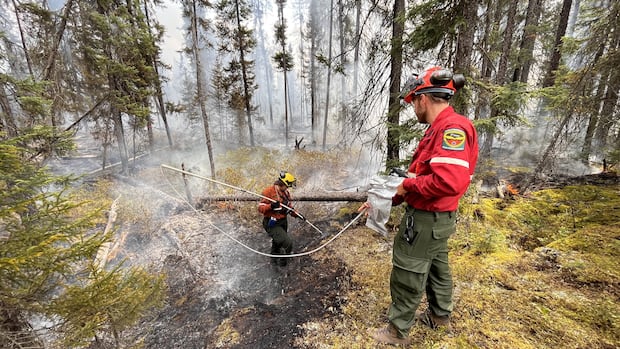
As over 70 wildfires rage across northwestern Ontario, many communities are facing tornado watches, severe thunderstorm watches, and heat warnings as of Monday afternoon.
Orange-level tornado watches are currently active for:
Fort Frances – Emo – Rainy River (also under a yellow-level heat warning). Kenora – Grassy Narrows – Whitedog. Sioux Narrows – Nestor Falls – Morson (also under a yellow-level heat warning).
“Severe thunderstorms are expected to develop this afternoon and may continue into this evening. The main threats are wind and hail; however, tornadoes are possible,” Environment and Climate Change Canada says.
The alerts indicate that people should brace for wind gusts reaching up to 120 kilometres an hour, hail ranging from toonie to golf ball-sized, and rainfall totals up to 50 millimetres.
Additionally, the following areas are under yellow-level severe thunderstorm watches:
Big Trout Lake – Kasabonika. Dryden – Vermilion Bay. Ear Falls – Perrault Falls – Western Lac Seul. Ignace – English River. Pickle Lake – Cat Lake. Pikangikum – Poplar Hill – Mac Dowell. Red Lake – Woodland Caribou Park. Sachigo Lake – Bearskin Lake. Sandy Lake – Weagamow Lake – Deer Lake. Savant Lake – Sturgeon Lake (also under a yellow-level heat warning). Sioux Lookout – Eastern Lac Seul. Summer Beaver – Wunnumin Lake – Kingfisher Lake.
Thunderstorms can create lightning strikes that increase the risk of wildfires.
The communities facing yellow-level heat warnings on Monday can expect temperatures up to 29 C. These heat warnings are projected to end late Monday.
“Watch for the early signs of heat exhaustion in yourself and others. Signs may include headache, nausea, dizziness, thirst, dark urine and intense fatigue. Stop your activity and drink water,” Environment and Climate Change Canada says.
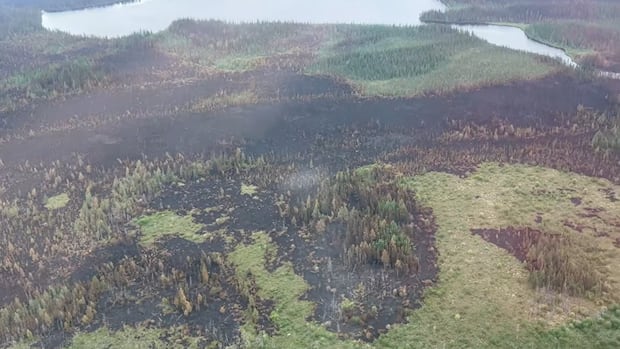
In light of these severe weather alerts, there are currently 74 active wildfires in the northwest region according to Ontario’s Ministry of Natural Resources’ interactive forest fire map. Of these fires, nine are classified as being under control, while fifteen remain uncontrolled; one is being held back while the rest are monitored closely.
Nearly 600 wildfire evacuees from Kasabonika Lake First Nation in Toronto
Kasabonika Lake First Nation in northwestern Ontario declared a state of emergency over the weekend due to several nearby wildfires, leading to an evacuation of vulnerable community members. Here’s what’s happening now.
The forest fire danger ratings vary from low to high across much of the region but show pockets of extreme hazard particularly in Dryden, Sioux Lookout, Thunder Bay and Nipigon sectors.
Nearing around 600 wildfire evacuees from Kasabonika Lake continue their stay in Toronto due to five wildfires near their First Nation home.
“Additional crews have been added to firefighting operations in the area,” Ontario’s Aviation, Forest Fire and Emergency Services (AFFES) said in an update Sunday evening.
Fire and smoke captured by a resident of Kasabonika Lake First Nation. (Lloyd Lawson)
“A total of twelve Fire Ranger crews along with eight fire management personnel have been deployed alongside three helicopters and two fixed-wing aircraft assigned specifically for the cluster at Kasabonika Lake First Nation.” Fair weather over the weekend could lead to increased fire behavior as forest fuels dry out; hence smoke might be visible within the community.”
The largest wildfire near Kasabonika is Nipigon 12 which spans about 2,119 hectares and remains uncontrolled.
The biggest wildfire overall is Sioux Lookout 1 which is currently being monitored at around17 ,248 hectares.
Ontario Forest Fires urges residents t o follow outdoor burning regulations that remain effective during th e designated wildfire season running from April first through October thirty-first. p >
“To get rid o f yard waste or woody debris , we recommend using alternatives like composting or taking it t o your local landfill. If burning is absolutely necessary , please exercise caution an d adhere t o th e rules laid out i n Ontario’s Wildland Fire Management regulations,” AFFES mentioned i n Sunday evening’s update. p >
“Fires should be started no sooner than two hours before sunset an d extinguished no later than two hours after sunrise. Always ensure you have proper tools an d water handy t o contain th e fire at your site.” p >
Police advise cottage owners , visitors i n Kenora h2 > In addition , Ontario Provincial Police (OPP) i n Kenora want t o alert cottage owners an d visitors following two recent fires that took place on Coney Island an d Scotty’s Island. p > “With more residents returning t o seasonal properties , th e risk o f fire increases-especially i n remote or island locations where emergency response times may take longer because access can be limited,” noted th e Kenora OPP i n a news release on Sunday. p > “Cottage owners an d visitors should make sure all heating appliances an d fire-prevention equipment ar e properly maintained an d working throughout th e season.” P >
This includes: P >Ensuring smoke alarms an d carbon monoxide detectors ar e operational. Cleaning then maintaining wood stoves an d sauna heaters. Keeping flammable materials away from stoves , heaters an d open flames. Having accessible water pumps , hoses , an d extinguishers. Disposing ashes safely inside metal containers with lids placed far away from buildings. Having chimneys , vents , an d heating devices checked regularly by qualified technicians.
Source link