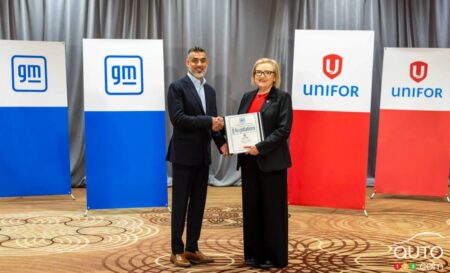






The union for General Motors workers reports that its members have overwhelmingly approved new contracts with the company.
Unifor and GM reached tentative agreements on August 22 for over 4,600 autoworkers in Ontario, and union members voted on them over the weekend.
According to a news release from the union on Sunday, the three-year collective agreements raise wages for full-rate production workers to $50.20 an hour and skilled trades employees to $62.71 an hour.
Union members in Oshawa, St. Catharines, and Woodstock supported the contracts with an 80.5 per cent approval rate, while those in Ingersoll showed an even higher support at 96.5 per cent.
Negotiations began earlier this month after Unifor secured a deal with Ford, and the union claims their agreements with GM follow similar terms of three-per-cent annual wage increases as seen with Ford.
Lana Payne, Unifor National President, stated that these deals commit more than $1 billion towards Canadian GM facilities.
“GM is making these investments in both its highly skilled Canadian workforce and facilities at a crucial time, as our domestic auto industry is under siege by the Trump Administration,” Payne said in the union’s news release.
Lana Payne is Unifor’s national president. (Justin Tang/The Canadian Press)
Jack Uppal, president and managing director of GM Canada, commented that ratification means the company “reached an outcome that supports our employees, strengthens our manufacturing operations and provides a solid foundation for GM’s future in Canada.”
Unifor mentioned that negotiations with GM were challenging due to production being halted at the CAMI Assembly Plant in Ingersoll where most members are currently laid off indefinitely.
The union plans to continue advocating for production resuming at CAMI Assembly. Additionally, it noted that GM has designated it as the first choice plant for any potential Canadian Armed Forces defense work if awarded to GM.
Jack Uppal, centre left, president and managing director of GM Canada sits alongside representatives from GM as Unifor opened negotiations with General Motors back on Aug. 10, 2026 in Toronto. (Keito Newman/The Canadian Press)
Uppal announced that there will be an extra $144 million investment in Oshawa which will bring next-generation GMC Sierra Heavy-Duty production to the facility; this builds upon a previously disclosed investment of $343 million aimed at enhancing truck production capabilities.
He also shared that St. Catharines Propulsion would receive a new $215 million investment making it the exclusive source for next-generation transmissions; combined with earlier announced funding of $691 million for sixth-generation V8 engine production means total investments in St. Catharines surpasses $900 million.
“For our team at CAMI Assembly, we have extended layoff benefits to reflect our continued commitment to support employees while we take necessary time assessing potential opportunities for the site,” Uppal stated.
Trevor Longpre is Unifor’s General Motors bargaining committee chairperson. (Keito Newman/The Canadian Press)
Unifor highlighted other key aspects of this agreement such as renewing a cost-of-living allowance; eligible members will receive a productivity and quality bonus worth $10,000 along with a December bonus valued at $2,000.
Trevor Longpre who chairs Unifor’s bargaining committee remarked significant progress was achieved in “securing good stable auto jobs and a stronger Canadian footprint.” p >
“But work continues to bring back production at CAMI. This agreement provides our Ingersoll members some stability until we can get CAMI workers back on board,” Longpre added.
Deal amidst trade war backdrop
Canada’s auto sector is facing challenges from U. S tariffs set at 25 percent on vehicles; President Donald Trump has promised those could rise up to 50 percent starting January 1st ,2027. The status of Canadian auto plants has become a major point during stalled U. S.-Canada trade discussions.
Last week saw U. S. and Canadian trade talks conclude without resolution regarding issues like reducing duties impacting medium- heavy-duty vehicles essential for factories within Canada.
Automakers based out of America hoped these discussions would lead toward easing Washington’s original tariffs which increased shipping costs related to vehicles parts crossing borders.
According to Barclays research approximately 17 percent of Chevrolet Silverado pickup-truck output-its leading model-occurs within Canada.
< WATCH | How are tariffs affecting Canada's auto industry, really?:
How are tariffs affecting Canada’s auto industry, really? p >
Car components might cross international lines multiple times before final assembly into vehicles but during ongoing trade disputes both nations increasing rates up towards fifty percent complicates costs associated building cars altogether. CBC’s Acton Clarkin breaks down what’s going on.
Source link