


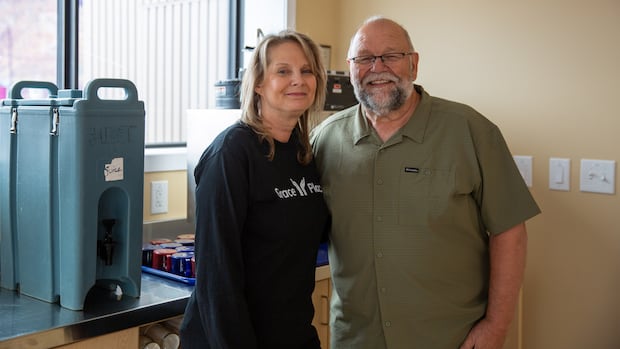
Melody Macsemchuk emphasizes the importance of continuing support for individuals after they move out of homelessness and into stable housing, which is why it’s essential for Thunder Bay, Ont., to have a variety of shelter options available.
This morning, Rob Flack, the province’s minister of municipal affairs and housing, revealed that $10.7 million will be allocated to the northwestern Ontario city.
The funding comes from the Homelessness Prevention Program (HPP) and Encampment Response Initiative (ERI).
For Grace Place, this means just over $1 million towards an expansion at their facility located on the south side of the city, enabling them to increase their seasonal Out of the Cold emergency shelter program from 25 to 40 beds.
“It’s 1,400 square feet and we’re able to have a lot of extra storage, which we never had in the past,” said Macsemchuk, Grace Place’s co-founder and operations manager.
“It really helps us with our overnight program because we will have our mats in this area and as well during the day, during our drop-in, we’ll have an expanded space for our eating area.”
![]() Construction at the temporary shelter village in Thunder Bay, Ont., is seen in this April 9, 2026 file photo. The village will contain 80 modular units and on-site supports for unhoused individuals. (Marc Doucette/CBC)
The provincial funding is being distributed through the Thunder Bay District Social Services Administration Board (TBDSSAB). Overall, it includes support for 66 transitional housing units and 120 emergency shelter spaces:
Urban Abbey: 46 transitional housing units at the former Adanac Hotel on Simpson Street ($3.7 million). People Advocating for Change Through Empowerment (PACE): 13 transitional housing units on George Street ($1.9 million). Teen Challenge: seven transitional housing units on Johnson Avenue ($1.2 million). City of Thunder Bay: 80 modular units at a temporary shelter village on Alloy Drive ($2.7 million). Grace Place: 40 overnight emergency shelter beds on Simpson Street ($1 million).
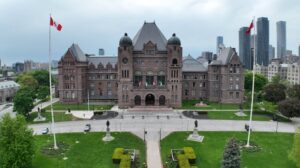
“We are working with our municipal partners to get more emergency and supportive housing built across the province, including in northern communities like Thunder Bay, to help prevent and alleviate homelessness,” Flack said in a news release Thursday.
“A key part of our plan to protect Ontario is giving vulnerable people the support they need to secure safe, stable housing.”
Thunder Bay-Atikokan MPP Kevin Holland mentioned that the province’s funding aims not only to provide shelter but also facilitate longer-term solutions.
“It’s not just about building space to get them out of the cold and into a safe space. It’s really the start of that transitional piece as we move them towards more sustainable, permanent housing,” he said.
Construction at the temporary shelter village in Thunder Bay, Ont., is seen in this April 9, 2026 file photo. The village will contain 80 modular units and on-site supports for unhoused individuals. (Marc Doucette/CBC)
The provincial funding is being distributed through the Thunder Bay District Social Services Administration Board (TBDSSAB). Overall, it includes support for 66 transitional housing units and 120 emergency shelter spaces:
Urban Abbey: 46 transitional housing units at the former Adanac Hotel on Simpson Street ($3.7 million). People Advocating for Change Through Empowerment (PACE): 13 transitional housing units on George Street ($1.9 million). Teen Challenge: seven transitional housing units on Johnson Avenue ($1.2 million). City of Thunder Bay: 80 modular units at a temporary shelter village on Alloy Drive ($2.7 million). Grace Place: 40 overnight emergency shelter beds on Simpson Street ($1 million).
“We are working with our municipal partners to get more emergency and supportive housing built across the province, including in northern communities like Thunder Bay, to help prevent and alleviate homelessness,” Flack said in a news release Thursday.
“A key part of our plan to protect Ontario is giving vulnerable people the support they need to secure safe, stable housing.”
Thunder Bay-Atikokan MPP Kevin Holland mentioned that the province’s funding aims not only to provide shelter but also facilitate longer-term solutions.
“It’s not just about building space to get them out of the cold and into a safe space. It’s really the start of that transitional piece as we move them towards more sustainable, permanent housing,” he said.
![]() Posters about homeless encampments are seen at Elevate NWO in Thunder Bay, Ont., in this December 2025 file photo. The latest point-in-time count conducted in October reported that there are currently 652 people experiencing homelessness in the city; advocates suggest that actual numbers could be double that amount. (Sarah Law/CBC)
With construction underway for both a temporary shelter village and new transitional units in place, she believes things are moving forward positively.
Posters about homeless encampments are seen at Elevate NWO in Thunder Bay, Ont., in this December 2025 file photo. The latest point-in-time count conducted in October reported that there are currently 652 people experiencing homelessness in the city; advocates suggest that actual numbers could be double that amount. (Sarah Law/CBC)
With construction underway for both a temporary shelter village and new transitional units in place, she believes things are moving forward positively.
However , while getting people into homes is significant progress , keeping them housed can pose challenges. “ Sometimes it takes time for them actually wanting inside and making it feel like home , so it ‘s definitely a work in progress , ” Macsemchuk stated. “ For some individuals , it’s tough because they might feel alone without knowing how deal with that. ” Grace Place has three navigators who assist individuals transitioning from their emergency shelter program into permanent homes by offering help with daily needs as well as establishing routines aligned with their goals. “ That seems very successful , ” she remarked. “ We’ve learned since COVID how crucial navigation really is. ” Although Grace Place’s emergency shelter program wraps up at end-April , free meals continue Monday through Friday from 1 p. m. to4 p. m. Macsemchuk noted donations primarily requested include protein-rich foods , meat, and milk.
Source link
‘Not every organization will fit each person’
This past February, Thunder Bay city council declared homelessness a humanitarian crisis. “There’s many different things that we have to do to solve homelessness,” Macsemchuk said. “Everybody is different; not every organization will fit each person – so I’m glad that we have a variety of places for people to go.”However , while getting people into homes is significant progress , keeping them housed can pose challenges. “ Sometimes it takes time for them actually wanting inside and making it feel like home , so it ‘s definitely a work in progress , ” Macsemchuk stated. “ For some individuals , it’s tough because they might feel alone without knowing how deal with that. ” Grace Place has three navigators who assist individuals transitioning from their emergency shelter program into permanent homes by offering help with daily needs as well as establishing routines aligned with their goals. “ That seems very successful , ” she remarked. “ We’ve learned since COVID how crucial navigation really is. ” Although Grace Place’s emergency shelter program wraps up at end-April , free meals continue Monday through Friday from 1 p. m. to4 p. m. Macsemchuk noted donations primarily requested include protein-rich foods , meat, and milk.
Source link