



Students throughout the province are demonstrating against recent modifications to the Ontario Student Assistance Program (OSAP) – starting next school year, the financial aid system will shift from primarily grants to mostly loans.
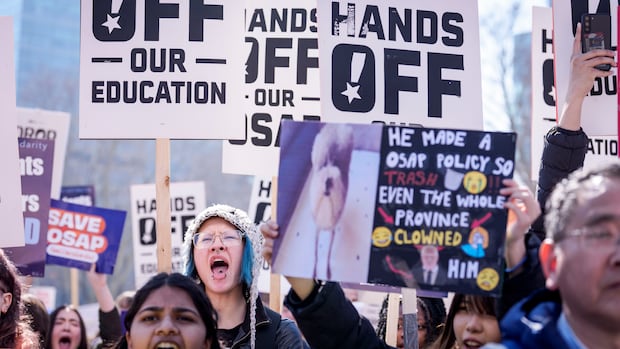
Hundreds gathered outside Queen’s Park in Toronto, while many others walked out of classes in Waterloo and Ottawa to protest. Earlier this week, high school students in Oshawa also staged a walkout.
Over 200 individuals, including high school and university students, protested in St. Catharines, Ont., outside Brock University and at the office of local NDP MPP Jennie Stevens, who joined them in solidarity.
The Toronto protesters chanted and played drums together, demanding Premier Doug Ford and Colleges and University Minister Nolan Quinn resign while calling for an end to government interference with post-secondary education.
“No cuts, no fees, no corporate universities,” shouted demonstrators in Toronto.
“We are distraught, but we refuse to accept the conditions that this government has imposed,” said Omar Mousa with the Canadian Federation of Students-Ontario (CFS-Ontario) during the rally.
Education shouldn’t add financial stress for students already grappling with rising costs of living such as food and rent, stated Cyrielle Ngeleka with CFS-Ontario.
“Education should be a means to escape instability, not just another expense students have to bear,” she added, noting that teachers, community workers, and parents had also come out to support student protesters in Toronto.
Last month, Quinn revealed a new $6.4-billion funding model over four years which ended a long-standing tuition freeze along with changes to OSAP.
WATCH | High school students in Oshawa walked out to ‘save OSAP’:
‘Save OSAP’: Oshawa high school students protest Ford’s cut
Students from more than 20 schools across Durham Region held walkouts on Monday protesting changes made to the Ontario Student Assistance Program. CBC’s Christian D’Avino spoke with students expressing concern that grant reductions jeopardize their futures.
Currently, students can receive up to 85 percent as grants – money they don’t have to repay – while loans make up at least 15 percent of their funding.
This coming year will see OSAP funding for eligible students drop down so that only a maximum of 25 percent is available as grants; meanwhile loans will increase significantly to at least 75 percent. “Like many young Ontarians, I feel let down and powerless about what decisions the Ford government is making regarding OSAP,” shared University of Toronto student Naicey Portus on CBC Radio’s Metro Morning.![]()
![]() She mentioned she plans on joining her fellow students outside Queen’s Park at the “Hands Off Our Education!” protest.
Apart from exams and assignments already weighing heavily on her shoulders, Portus now faces added financial worries which mean working more hours due these changes.
“This impacts those who are already facing challenges; it’s really disheartening seeing these barriers raised even higher,” she said.
A video recorded by showed some tension between protesting students and Toronto police during Wednesday’s demonstration. At one point during it all , someone yelled toward an officer before being pushed back into nearby crowd.
Toronto police spokesperson Amy Davey remarked that although things started peacefully earlier Wednesday afternoon , two arrests were made later on concerning mischief along assault charges.
The police claimed via news release Thursday that one individual aged twenty-two vandalized property using spray paint , then when authorities tried arresting them another twenty-one-year-old spat on an officer.
She mentioned she plans on joining her fellow students outside Queen’s Park at the “Hands Off Our Education!” protest.
Apart from exams and assignments already weighing heavily on her shoulders, Portus now faces added financial worries which mean working more hours due these changes.
“This impacts those who are already facing challenges; it’s really disheartening seeing these barriers raised even higher,” she said.
A video recorded by showed some tension between protesting students and Toronto police during Wednesday’s demonstration. At one point during it all , someone yelled toward an officer before being pushed back into nearby crowd.
Toronto police spokesperson Amy Davey remarked that although things started peacefully earlier Wednesday afternoon , two arrests were made later on concerning mischief along assault charges.
The police claimed via news release Thursday that one individual aged twenty-two vandalized property using spray paint , then when authorities tried arresting them another twenty-one-year-old spat on an officer.![]()
![]() In upcoming academic year Giacoboni indicated approximately $1.7 billion will go towards granting support aimed specifically assisting473 thousand enrolledstudents ; figures rise rapidly reaching $2.$ billionby2025-26
In upcoming academic year Giacoboni indicated approximately $1.7 billion will go towards granting support aimed specifically assisting473 thousand enrolledstudents ; figures rise rapidly reaching $2.$ billionby2025-26![]()
Mistaken Assumptions Regarding Cuts By QuinnThe discussion around protests taking place whether any outcome may result or not remains unclear accordingto Quinn commented during interview held w ith clarifying existing programs aren’t being terminated but will still continue aiding eligibleindividuals come fall semester time. He highlighted prior structures anticipated distributing upwards towards$4billionin grantsby2028-29which auditor general reported backin2018wouldn’t remain feasible following implementation established underprevious premier Kathleen Wynne backin2017. It’s critical both taxpayers&students be wise choices made keeping existing labor market demands articulated clearly present across Canada ” He mentioned numerous resources designed providing guidance concerning possible career paths yielding returns significantly exceeding investments typically required pursuing post-secondary studies.
This coming year will see OSAP funding for eligible students drop down so that only a maximum of 25 percent is available as grants; meanwhile loans will increase significantly to at least 75 percent. “Like many young Ontarians, I feel let down and powerless about what decisions the Ford government is making regarding OSAP,” shared University of Toronto student Naicey Portus on CBC Radio’s Metro Morning.