

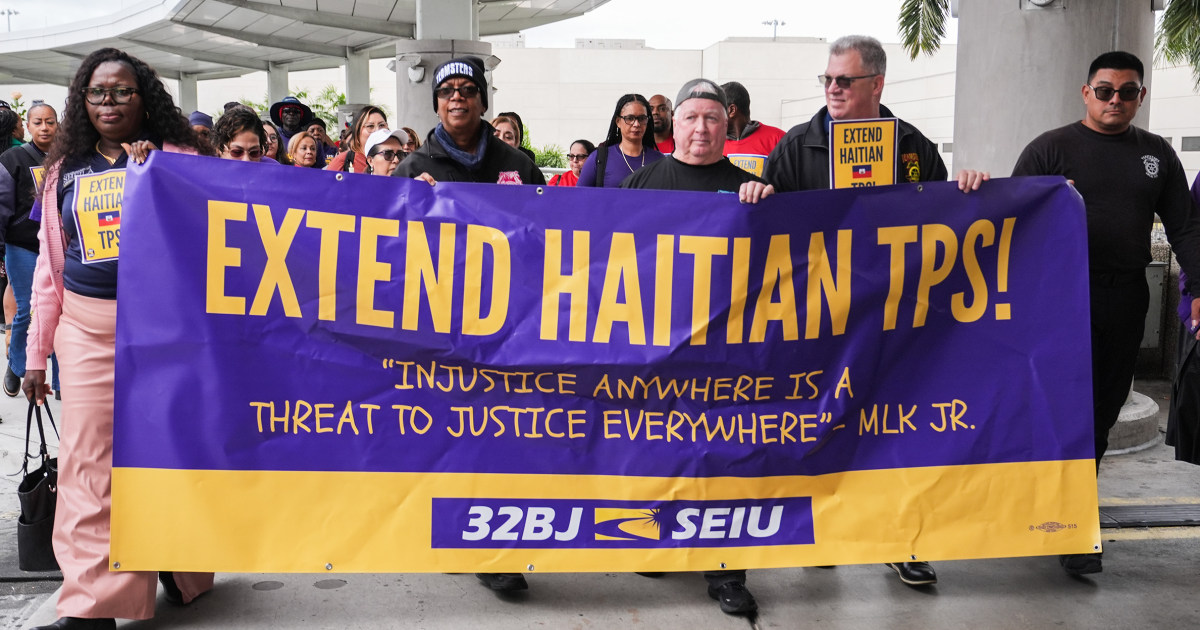
WASHINGTON – On Thursday, the Supreme Court allowed the Trump administration to eliminate legal protections for thousands of Haitian and Syrian immigrants living in the United States, which puts them at risk of deportation.
Limited time: Save 25% on NBC News subscription
Get exclusive reporting, live Q& As and ad-free reading.

The court voted 6-3 along ideological lines, siding with the administration that aimed to move forward with its plan to revoke Temporary Protected Status from around 350,000 Haitians and 6,000 Syrians.
This ruling could also support efforts by the administration to take away similar protections from individuals from other nations as part of President Donald Trump’s strict immigration policies.
“This is a tremendous win for the Trump Administration. Today, the Supreme Court affirmed what President Trump has always maintained: temporary protected status is, by definition, temporary,” White House spokeswoman Abigail Jackson said in a statement.
Justice Samuel Alito wrote for the majority opinion, stating that judges exceeded their authority by questioning the administration’s choices. The court also dismissed claims that removing protections for Haitians was discriminatory.
The law “expressly restricts” courts from reviewing decisions made by the Department of Homeland Security regarding whether to end or extend TPS protections, he noted.
Regarding discrimination allegations against Haitians, Alito remarked that statements cited by plaintiffs were not “overtly racial” and didn’t sufficiently demonstrate that ending Haiti’s TPS designation was based on race.
In dissent, liberal Justice Elena Kagan criticized the majority for downplaying Trump’s comments about Haitians.
“The statements fairly shout, in their racial undertones and overtones alike, that race entered into the president’s resolve to remove Haitians from this country,” she wrote.
Kagan quoted Trump extensively, including his 2018 remark describing Haiti as a “shithole country” and his comments during the 2024 election where he baselessly claimed that Haitians in Springfield, Ohio were eating people’s pets.
Without protected status, those affected face deportation through standard legal channels. However, they can explore other options to stay in the U. S., such as applying for asylum.
Geoff Pipoly and Andy Tauber, who served as lead counsel in this case before the Supreme Court stated in a joint statement that “simply put, the Supreme Court’s ruling will directly result in thousands of innocent people dying violent, needless deaths.”
“This decision will endanger Haitian TPS holders who fled their homeland in pursuit of what generations of immigrants yearned for when they made the painful decision to leave all they have known: to live in safety,” they said. p >
Dahlia Doe , a Syrian TPS recipient and lead plaintiff , said this ruling is a “devastating blow to me and thousands of TPS holders and our families who built our lives in this country in good faith.” p >
“We are real people whose futures now hang in the balance. This is not simply a legal outcome ; for us it is loss of stability , fear of separation from our families , uncertainty about what comes next ,” she added. p >
Last year , two separate decisions by the Supreme Court allowed Trump’s administration to withdraw similar legal status from 600 ,000 Venezuelans living in America. The Trump administration argued these actions set a precedent applicable to both Haitian and Syrian immigrants. p >
The TPS program has been active since 1990 , providing humanitarian aid to individuals from countries suffering due to war , natural disasters or other crises. Recipients hold legal status within U. S. borders and may apply for work authorization lasting up to 18 months with possible extensions. p >< p id =" anchor-7487b4"class=