




Gordo, an Eastern Massasauga rattlesnake, might have lost his life on Matchett Road last summer – but that doesn’t mean his genetic legacy is over.
A local reptile conservation expert mentioned that Gordo successfully mated before his passing, and now his young – seven baby rattlesnakes – are being cared for until they can be released back into the wild.
“I think it’s great. It’s certainly symbolic,” said Jonathan Choquette, a Ph D biologist who heads the Ojibway Prairie Reptile Recovery program of Wildlife Preservation Canada.
“[Those babies] definitely have Ojibway genetics in their blood.”
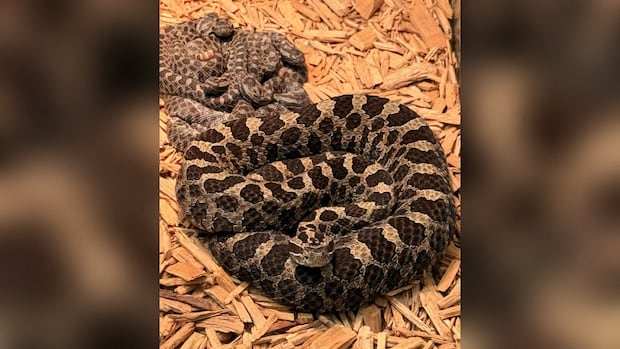
A closer look at the seven offspring of Gordo and Ashley, a mating pair of Eastern Massasauga Rattlesnakes. (Toronto Zoo)
Eastern Massasauga rattlers are nearly extinct in Windsor-Essex, even though they are native to this area. Local populations might be fewer than 10.
They’re the only venomous snake species in Ontario and are critically endangered throughout the province. According to Ontario Nature, these snakes often go unnoticed; if they feel threatened, they will rattle or move away but will only bite as a last resort.
Gordo was a prime male brought to the Ojibway Prairie Complex with hopes of boosting the population there. He was given a nickname and tracked by Choquette’s team.
Even though Gordo grew up at Toronto Zoo, his lineage traces back to Eastern Massasauga rattlesnakes rescued in La Salle over 25 years ago.
Gordo, an Eastern Massasauga Rattlesnake, following his release in the Ojibway Prairie Complex. (Jonathan Choquette/Wildlife Preservation Canada)
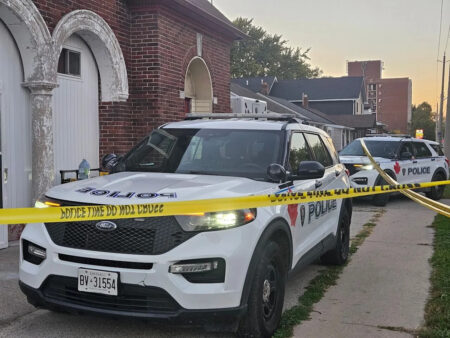
However, in September 2025, Gordo’s crushed body was discovered on Matchett Road after presumably being run over by a vehicle.
He was identifiable due to his electronic transmitter implant.
“Massasaugas are on the brink of extirpation (local disappearance) in Windsor-Essex,” Choquette stated. “The population is not viable unless we actually do the work to augment them.”
Choquette and his team were aware that before Gordo’s unfortunate death, he had mated with a female specimen named Ashley.
Jonathan Choquette of Wildlife Preservation Canada, lead biologist of the Ojibway Prairie Reptile Recovery program, stands next to a stretch of Matchett Road. (Dalson Chen/CBC)
But according to Choquette, they didn’t confirm Ashley was pregnant until earlier this year when she was sent to Toronto Zoo for her transmitter implant replacement: An X-ray showed she was carrying eggs.
Like all rattlesnake species, Eastern Massasauga rattlers give birth through ovoviviparity; their eggs hatch inside them before giving live birth – which happened for Ashley earlier this spring at the zoo.
Choquette mentioned that Gordo and Ashley’s young will stay in captivity until they reach yearling status. The hope is that by next summer they’ll be ready for release into Ojibway Prairie Complex so that Gordo’s line continues in Windsor-Essex.
“It’s worth pointing out that this is the only tallgrass prairie population of Massasauga rattlesnakes in Canada,” Choquette noted. “It’s a very unique element of our Canadian natural heritage.”
Ashley and her young Eastern Massasauga Rattlesnakes at Toronto Zoo. (Toronto Zoo)
Source link