





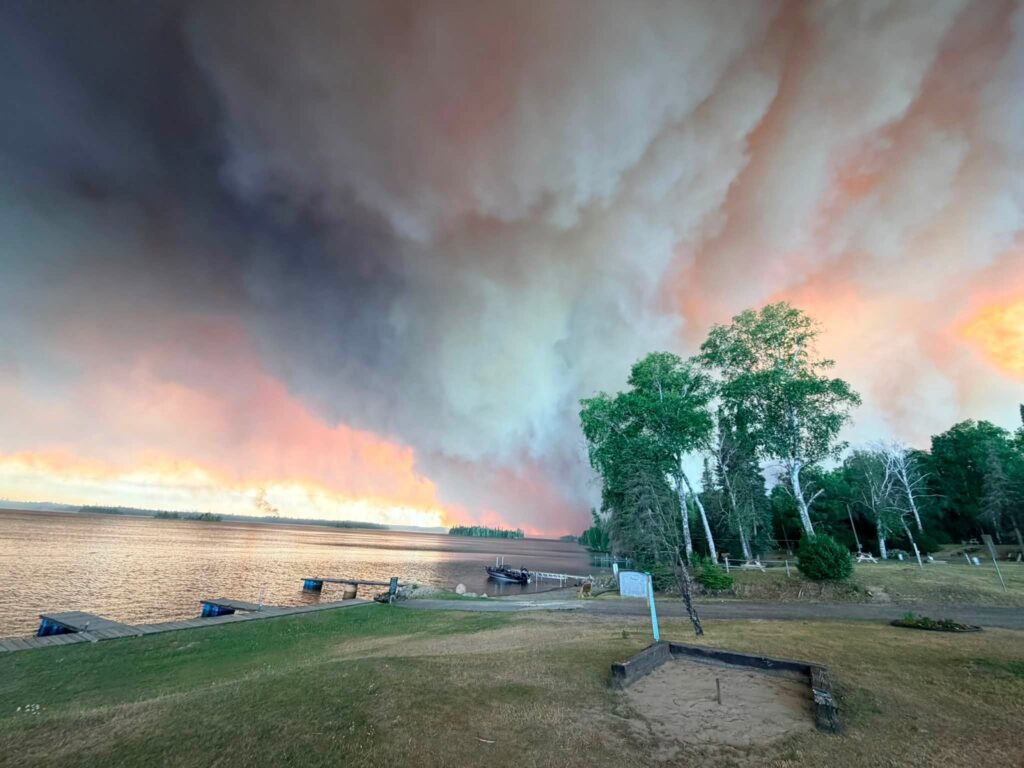
Northwestern Ontario is still experiencing wildfires, but the Ministry of Natural Resources has seen a slight decrease in new incidents.
Only eight new wildland fires were reported on Wednesday.
According to the Ministry of Natural Resources, one of the fires is near the remote community of Fort Hope.
The latest fires as of late Wednesday night are as follows;
Sioux Lookout 97 (SLK097) is located on an island on Pashkokogan Lake. The 0.1-hectare fire is not under control. Nipigon 57 (NIP057) is situated near the northeast end of Lower Twin Lake. The 1.0-hectare fire remains uncontrolled. Nipigon 58 (NIP058) is found near Triangular Lake, about 10.5 kilometres southwest of Fort Hope. The 0.6-hectare fire is not controlled. Nipigon 59 (NIP059) is located west of Puppet Lake, roughly 6 kilometres north of Highway 584. The area has a fire covering 9.0 hectares that is out of control. Nipigon 60 (NIP060) can be found about 9 kilometres southwest of Burrows Lake. This fire spans approximately 4.5 hectares and remains uncontrolled. Nipigon 61 (NIP061) lies about 2 kilometres east of Kellow Lake, with a significant size of approximately 36.0 hectares that isn’t under control. Nipigon 62 (NIP062) sits north of Jefferies Lake, with a small fire covering just 0.1 hectares that remains uncontrolled. Kenora 17 (KEN017), previously located on an island in Lake of the Woods, has been declared extinguished after burning for some time at just 0.1 hectares.
As it stands Wednesday night, there are currently a total of 136 active fires.
The Ministry successfully declared four earlier blazes as extinguished.
Out of these, sixty-three are classified as uncontrolled, including a massive blaze in the Lac Des Mille Lacs region which continues to be one of the largest threats.
That particular fire now covers over an area exceeding 55,000 hectares.
To ensure public safety, the MNR has implemented an order restricting access around this large fire zone.
Several nearby areas have been placed under evacuation notice, which includes the village of Upsala.
Meanwhile, suppression efforts have ceased for another major fire located within Quetico Provincial Park.
This particular blaze has expanded to over 30,000 hectares; however, campers had already been evacuated from the park earlier in the week and campgrounds were closed to reduce any risks to visitors.
Additionally, several smaller fires within Wabakimi Provincial Park have combined into one larger incident now covering more than350,000 hectares.
With so many active incidents ongoing right now, suppression efforts remain focused on regions where success seems most achievable while prioritizing both public safety and protecting critical infrastructure alongside firefighting personnel.
A restricted fire zone continues to be enforced across all parts of northwestern Ontario to help prevent any new human-caused fires from igniting.
Local municipalities throughout the region have also issued their own specific fire bans as precautionary measures.
Randy Thoms is a veteran news broadcaster with over 40 years’ experience. He is based in Fort Frances and covers stories across northwestern Ontario. Contact Randy at thoms. randy@radioabl. ca.
View all posts
Source link