



Ontario Construction news staff writer
A large, car-focused federal work area in the center of the nation’s capital is about to undergo a significant change into a dense, transit-friendly community over the next 25 years.
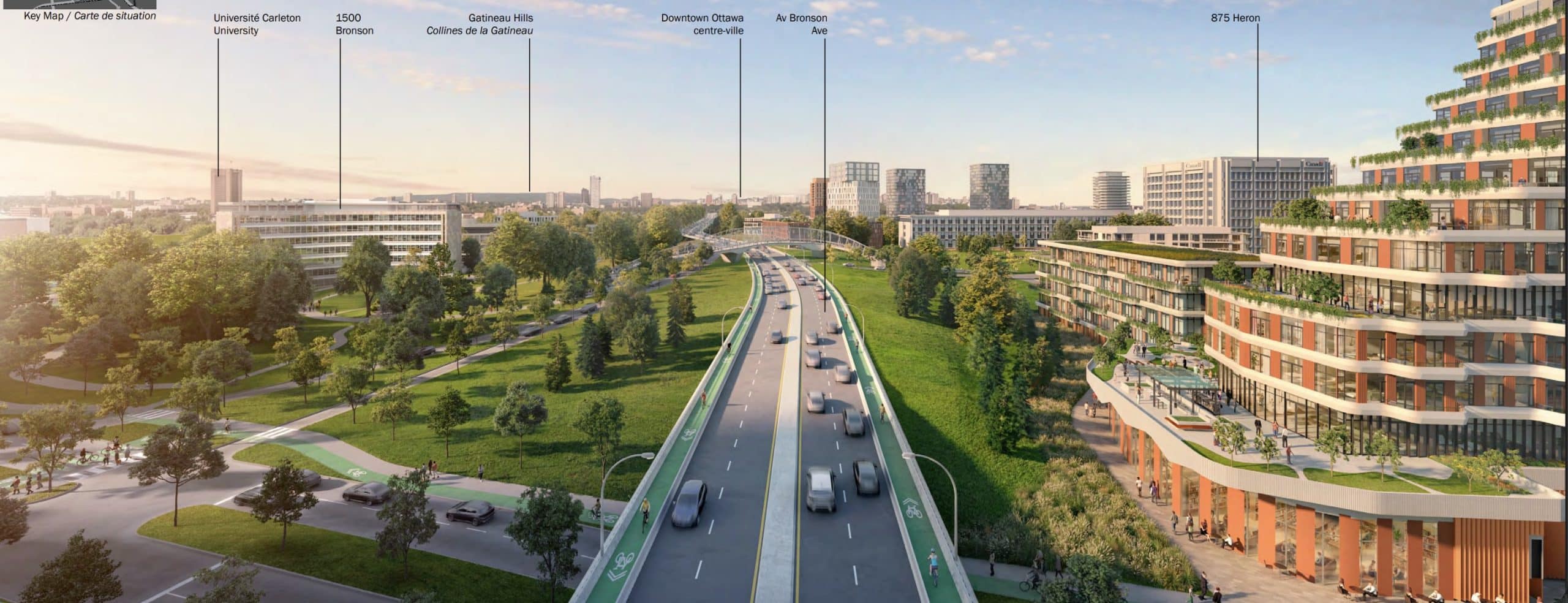
The master plan for redeveloping Confederation Heights, led by Build Canada Homes along with the City of Ottawa, outlines an ambitious transformation for the 104-hectare site. For those in architecture and construction, this project signals decades of ongoing development, shifting away from surface parking and isolated mid-century office buildings towards a sustainable community featuring compact designs and diverse housing options.
In an article behind a paywall in October, The Ottawa Business Journal highlighted: “RA Centre eyes $100M plan to build new facility with affordable housing.”
“The RA Centre wants to replace its aging facility on Riverside Drive with a new building that would include affordable housing as part of a $100-million redevelopment project, its chief (Ian Fraser) executive says,” reported the business outlet in the lead section of the article accessible outside the paywall.
The final draft of the Master Plan was shared at a public open house at the Hellenic Event Centre in January 2026, followed by an “As We Heard It” report released in March. The City of Ottawa’s related Secondary Plan is expected to be reviewed by the Planning and Housing Committee in May 2026, aiming for City Council approval by June.
The site has been largely influenced by Jacques Gréber’s 1950 vision to decentralize federal public services and is bordered by Rideau River, Data Centre Road, and Brookfield Road. The new development strategy prioritizes low-carbon design, green infrastructure, and pedestrian-friendly layouts.
According to earlier planning concepts created by Queen’s University’s School of Urban and Regional Planning, focusing employment and institutional density near transit stations will free up surrounding lands for residential use and redevelopment.
Capital Ward Coun. Shawn Menard has expressed his support for integrating residential areas seamlessly with commercial spaces within what was once a separated government hub.
“It would be great to see mixed-use housing with businesses intermingled,” Menard said in comments shared by the Riverside Park Community Association. “Obviously, a not-for-profit affordable housing component is important.”
A significant proposed infrastructure update includes altering or removing the existing road interchange system that currently directs vehicle traffic from Bronson Avenue to Riverside Drive. The master plan strongly promotes active transportation options, including plans for a new active transportation bridge over Bronson Avenue intended as a landmark feature while preserving views of nearby historical buildings.
“There’s so much space in Confederation Heights that will be made much more accessible to many other people while still maintaining ample green space,” Menard added.
The RA Centre, an 80-year-old recreation facility located within this area at 2451 Riverside Dr., sees this redevelopment as an opportunity for strategic adjustment.
After reviewing conceptual planning documents, RA Centre CEO Ian Fraser addressed the master plan in an open letter to the community dated January 2026. He pointed out that this redevelopment offers a chance to rethink how their organization provides services.
“Instead of concentrating everything on one large parcel, the future may allow for more RA in more places with programs, activities, and community presence woven throughout the campus area and beyond into the broader National Capital Region,” Fraser stated.
He suggested this “distributed model” could bring programming closer to where people live while creating new partnerships for shared-use spaces.
If municipal approvals are obtained as expected around mid-2026, plans will move forward towards phased implementation involving regulatory approvals, site servicing efforts, and construction aimed at transforming urban core into a climate-resilient complete community by 2050.
Source link