




Markham Mayor Roger Agpawa seems to have a unique take on how democracy functions.
When a few residents and an alderman expressed worries about the lack of public involvement in the ward remapping process for this small suburban city, Agpawa responded that their opinions wouldn’t have made a difference anyway.
“We’d be here for eons trying to get everyone to agree on something,” Agpawa stated Wednesday at a Markham City Council public meeting. “This is democracy at its best.”
The council voted 3-1 to approve a new ward map reflecting the 2020 census data. Markham should have updated its ward map every decade, but the current one was based on the 1990 census.
“The problem is Markham hasn’t redistricted since 1998, based on 1990 numbers,” municipal attorney Burt Odelson noted. “We’re basically 30 years behind in redistricting.”
You might expect that a representative government would approach redrawing district lines for elected officials with care, giving citizens enough notice, welcoming their input, and including their feedback.
However, not in Markham. The council majority approved a new map just two weeks after it was first shown publicly and without making any adjustments from the original proposal.
This decision frustrated many residents. A group of six citizens gathered outside Markham City Hall at 6 p. m. Wednesday, waiting by the locked front doors until they were let in by a police officer at 6:53 p. m.
They arrived early because some had been barred from attending the Aug. 7 council meeting. The council is still following emergency protocols set during the pandemic, which limited capacity in council chambers.
“This governing body limited participation to only 26 attendees at the last meeting,” resident Patricia Mc Kinney shared during public comment at the end of the session, after the council had already voted to adopt the new map.
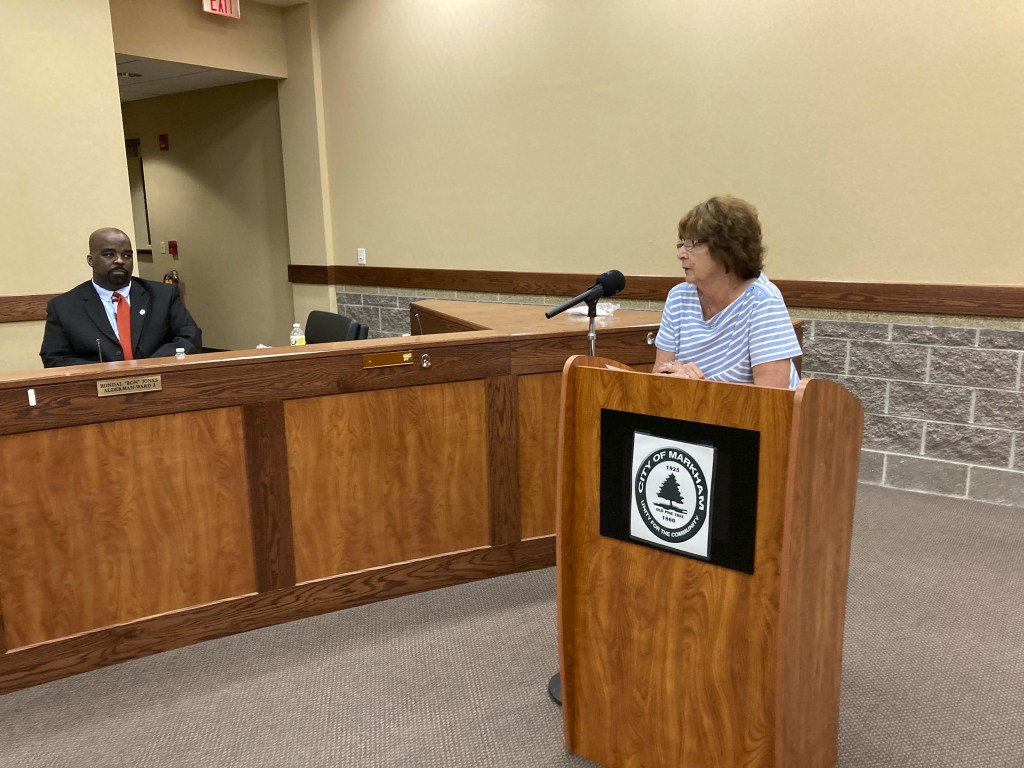
Markham Ald. Rondal Jones, left, listens as resident Patricia Mc Kinney speaks during public comment Wednesday at the City Council meeeting.
Mc Kinney had looked into the remap process and pointed out guidelines suggesting that Markham could have done more to encourage public feedback.
“To the extent possible, governing bodies should seek to provide more than one platform to submit input,” Mc Kinney said. “Adequate notice should be given to invite participants.”
No one questions that Markham needed to update its four wards. In village governance, there are no districts; every elected board member serves all community members. However, cities do have defined wards represented by aldermen. Ward boundaries need adjustment every ten years if population distribution changes.
The fact that Markham’s ward boundaries hadn’t shifted for so long means that currently, 44% of the town’s population lives in the 4th Ward when ideally each ward should contain around 25% of city residents.
“That’s why we see such disparity with overpopulation in the 4th Ward and underpopulation in the 1st Ward,” Odelson explained.
The shift in population shouldn’t come as a shocker. In 2016, Markham assisted a developer in acquiring an entire neighborhood within the 1st Ward area. Homes were torn down, trees removed, and roads along with utilities were eliminated from what became an Amazon fulfillment center located south of 159th Street between Tri-State Tollway and Dixie Highway.
Federal law mandates that population discrepancies must not exceed 10% across representative districts.
“The deviation back in ’98 was an astonishing 91%,” Odelson pointed out. “Now it stands at just 9.7%.”
Alderman Rondal Jones has served as representative for Markham’s 1st Ward for sixteen years and cast his vote against adopting this new map. During discussions at council meeting Jones and Agpawa frequently interrupted each other while speaking.
“This is not transparent,” Jones remarked.
“Nothing is going to be good enough for you,” Agpawa countered. “We listened to you two weeks ago.”
This brings to mind someone who once said: “But I fed the baby yesterday.” In Agpawa’s innovative view of democracy it seems dissenting opinions only need consideration once; there’s no time for repetition when there’s decades’ worth of noncompliance with federal regulations needing attention it appears.
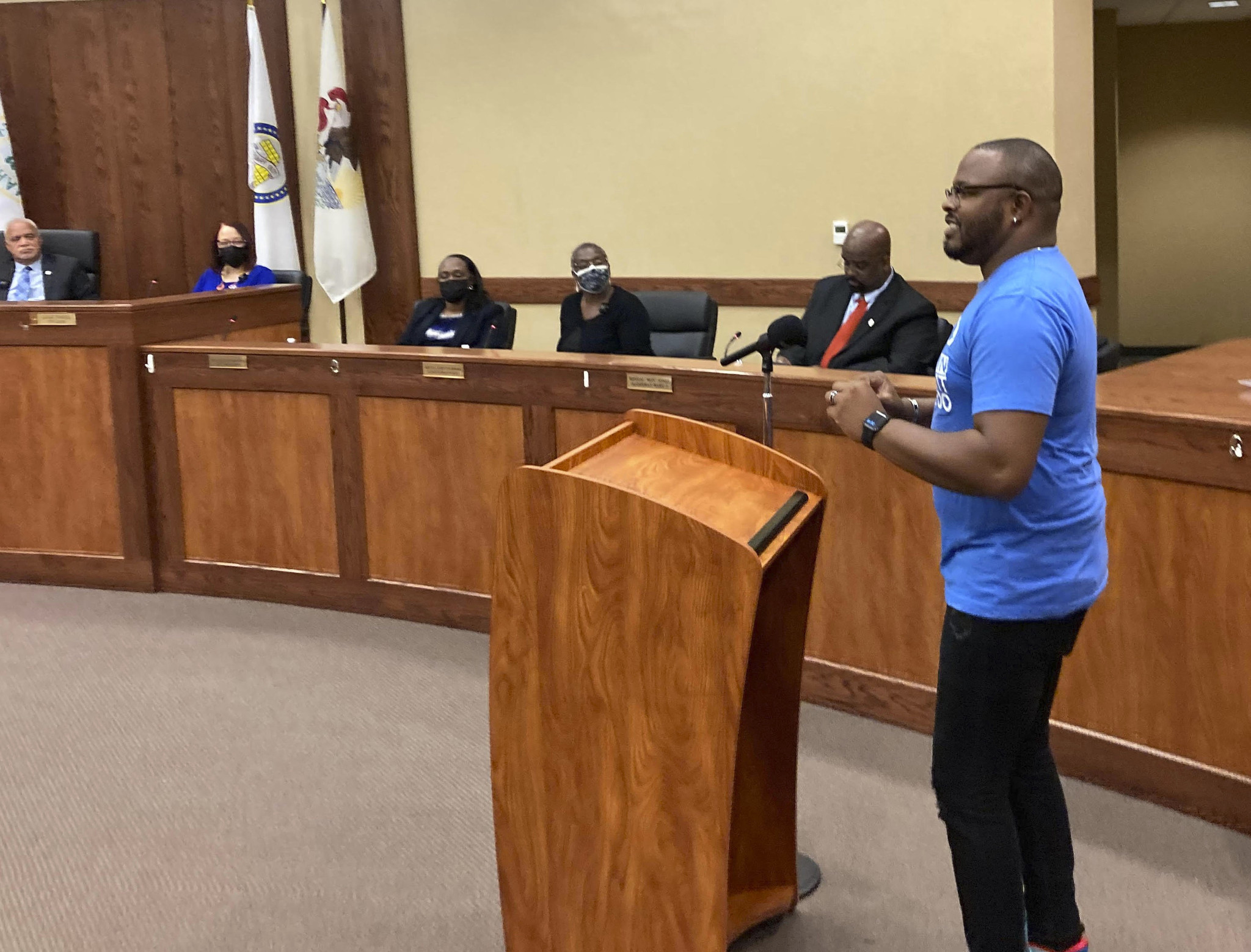
Markham Mayor Roger Ag Pawa listens as Laurence Patterson II speaks.
Prior to this exchange Jones attempted to delay adoption of this new map but his motion failed due lack of support from others present.
“There isn’t enough information,” he argued insisting they needed additional time consider everything properly.”
The newly drawn map will change representation for thousands living in Markham which saw its population drop by eight hundred sixty-six people from twelve thousand five hundred twenty-seven down to eleven thousand six hundred sixty-one between twenty ten and twenty twenty according city records presented during redistricting discussion.
“This will confuse residents eight months before an election,”Jones added.
“This will confuse residents eight months before an election.”.
Source link