




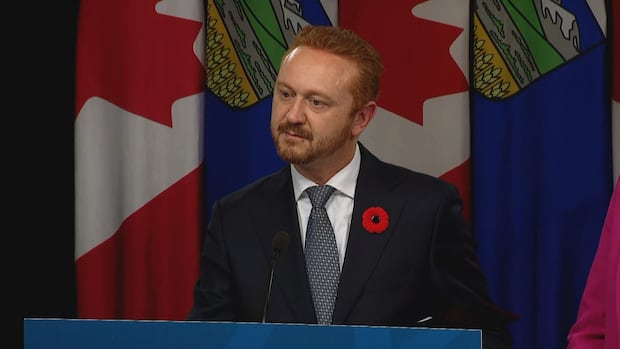
Alberta’s justice minister states that Elections Alberta must be prepared for the upcoming provincial election, turning down a request to either keep the existing electoral boundaries or delay the date when Albertans will vote.
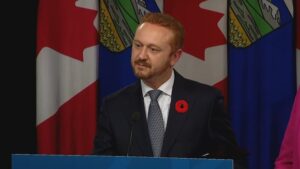
In a letter shared on social media Sunday afternoon, Justice Minister Mickey Amery dismissed concerns expressed by Elections Alberta chief electoral officer Gordon Mc Clure regarding anticipated modifications to Alberta’s electoral boundaries before the 2027 provincial election.
Amery was replying to a letter from Mc Clure sent to all Alberta MLAs that was made public by the Alberta NDP on Oct. 30. In his correspondence, Mc Clure requested that the government consider “several operational realities” he believed needed addressing for a successful election, which is currently set for Oct. 18, 2027.
The main issue at hand is an advisory panel report about electoral boundaries that is expected to be presented in the legislature Monday.
This isn’t the first time discussions have been sparked over that upcoming report.
It became a topic of intense debate between Premier Danielle Smith and Opposition NDP Leader Naheed Nenshi in the legislature last week.
In his letter, Mc Clure pointed out that creating new electoral boundaries is just one aspect contributing to the time constraints facing his organization.
“The delivery of a provincial general election with new maps requires establishing the electoral geography, developing and validating electoral maps, updating electoral information systems, preparing the infrastructure required to administer the election, and co-ordinating the operational activities necessary to deliver a province-wide vote,” he wrote.
In response, Amery mentioned that he expects final boundaries will be ready before fall sitting ends, giving Elections Alberta almost 11 months to prepare for the next election.
“It should also be noted that Alberta law does not guarantee Elections Alberta lengthy advance notice of a general election, and election readiness is a core part of Elections Alberta’s statutory mandate,” he wrote.
Alberta’s chief electoral officer, Gordon Mc Clure, mentioned in his letter that his organization is stretched thin after handling recent events like the referendum. (Emmanuel Prince-Thauvette/Radio-Canada)
Mc Clure noted that preparing for an average provincial vote usually takes up to 18 months and pointed out that their agency has been under strain lately due in part to last month’s separation referendum.
Amery stood firm in his reply.
“While Elections Alberta operates independently of government, that independence carries significant responsibilities and corresponding expectations of accountability,” Amery wrote.
“Independence does not diminish the duty to administer elections in accordance with the law, nor does it relieve the chief electoral officer of responsibility for effective management and performance of the organization entrusted to his leadership.”
reached out to Elections Alberta and the premier’s office on Friday but did not hear back over the weekend.
Smith Denies Claims of Gerrymandering
Nenshi stated after being briefed on it that according to him, there are signs gerrymandering has occurred in two southern cities – Lethbridge and Calgary.
Gerrymanderingrefers to manipulating voting districts so they don’t reflect real geographic or population patterns but rather serve specific political interests by clustering or dispersing voters favorably toward one party. Two members from all-party legislative committee involved with this report suggested these proposed ridings create divisions between urban and rural voters.
Recent provincial elections have shownUCP winning mainly in rural areas while smaller cities lean towards NDP control primarily focused around Edmonton; both parties compete heavily within Calgary’s borders as well.
Nenshi claimed if those new lines are drawn following legislative approval, it would dilute support for NDP enhancing UCP’s advantages instead; thus indicating potential legal challenges against these riding changes on constitutional grounds could arise from his party soon after.
The Constitution safeguards voters’ rights ensuring effective representation occurs. During discussions held at legislature last week , Smith refuted allegations raised by NDP asserting her government aims at orchestrating outcomes skewed towards its own benefit. p >
Journey To Current Boundary Committee
This independent advisory panel ‘s report arrives several months post-UCP declining acceptance upon recommendations offered through earlier commission concerning changing voting district borders.
Commission presented their findings back in March consisting both majority & minority opinions ; however , minority members appointed by UCP strayed away from consensus found within interim reports leading them submit alternative maps & suggestions instead.
How Alber ta’s new boundary maps could impact election outcomes
The Calgary-Shaw byelection surprised many when th e NDP took th e conservative stronghold. But riding maps could look very different come next year’s provincial elect ion. The CBC’s Andrew Jeffrey breaks down how boundary redrawing could impact results depending on how th e riding i s altered.
Initial objective defined within commission’s mandate aimed at increasing total seats available inside house fr om eighty-seven up towards eighty-nine.