





By Kevin Page
June 3, 2026
On May 29th, Statistics Canada shared the latest figures on Canada’s Gross Domestic Product (GDP) for the first quarter of 2026.
GDP represents the total monetary value of all finished goods and services produced in a country. It’s a key measure of how big and healthy an economy is. The recent data shows that the Canadian economy has stagnated.
There was no growth in the first quarter of 2026, following a slight decrease (0.2%) in the last quarter of 2025.
The term “technical” recession refers to two back-to-back quarters of negative growth, so with Canada seeing its second consecutive quarter without growth – especially just after Prime Minister Mark Carney’s speech to the Economic Club of New York highlighting Canada’s stability as an investment choice – this has sparked significant debate about GDP news.
There’s now an ongoing conversation about whether Canada is experiencing a (technical) recession. The results from the first quarter caught many economic analysts and institutions (like the Bank of Canada) off guard. Some believe these outcomes reflect unexpected changes, such as rising imports or decreased government spending on goods and services and capital.
The bottom line is that the Canadian economy is struggling.
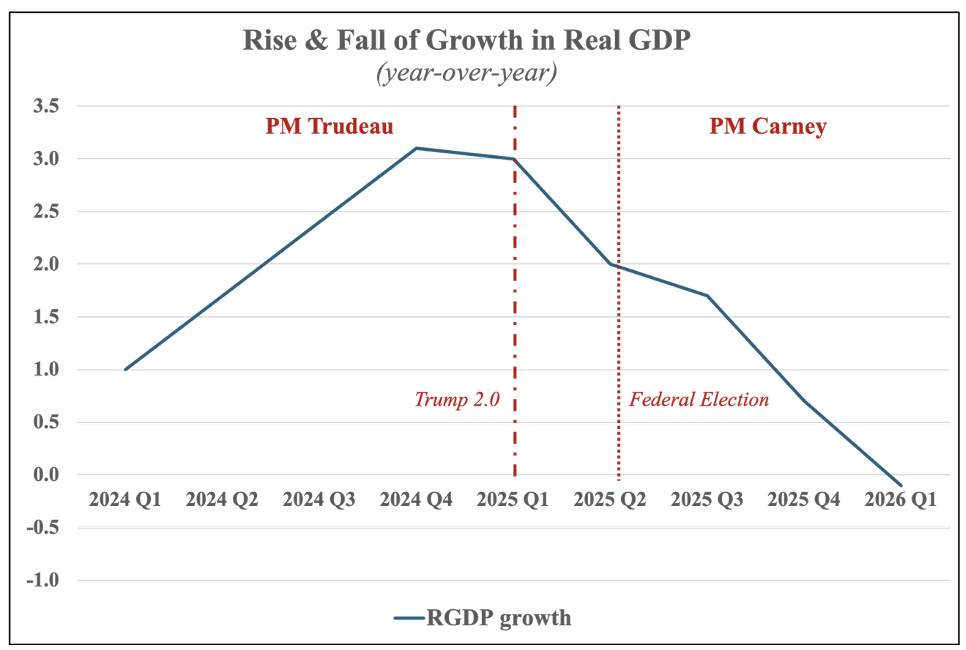
Chart 1: Growth
Source: Haver Analytics, Statistics Canada
Chart 1 shows that there was no year-over-year growth in the Canadian economy. The GDP growth rate peaked at a healthy 3% through 2024 but began to decline after President Trump took office in January 2025 and during Canada’s federal election in April 2025, largely due to Trump’s ongoing trade war which continues to impact things today.
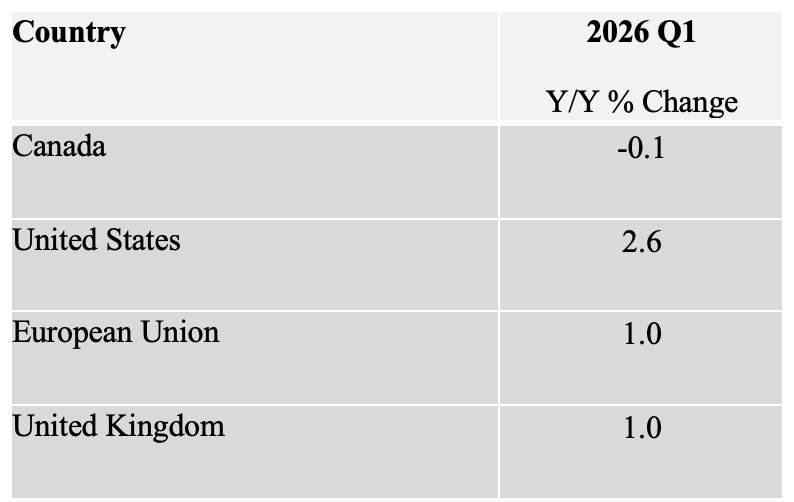
Table 1 illustrates that Canada’s current economic performance is quite weak compared to both the US and Europe.
Table 1: International Comparisons of Real GDP Growth
Source: Haver Analytics
The US economy has been showing strong growth driven by extensive fiscal expansion (with its budget deficit about three times larger than Canada’s relative to GDP) alongside heavy investments in AI technology. Meanwhile, Europe has demonstrated resilience thanks to solid labor markets supporting domestic demand even with weaker export conditions.
So why is Canada’s economy stagnant?
In response to questions from reporters about this disappointing economic performance, Prime Minister Carney mentioned that we are currently going through a transitional period.
“This government’s been in the process of laying the foundations for a stronger, more resilient, more independent Canadian economy. That process is settling in as we make major investments, major changes to how the government operates, how we do major projects, how we have new trade agreements with other countries.”
The data indicates two main factors contributing to this stagnation over the past year-weak capital formation and sluggish exports. Personal consumption has remained relatively stable due to federal support aimed at affordability and consumers managing their debts (higher interest costs on mortgages balanced by cautious credit card usage).
Chart 2: The Economy (Real GDP)
Source: Haver Analytics, Statistics Canada
Chart 2 provides an overview of what’s happened with our economy over the last two years based on real GDP measured using constant dollars from 2017. It shows that real GDP started flattening out from Q1 of 2025-around when President Trump was inaugurated (2.0)-and coincided with his America First trade policy which involved frequent tariff adjustments and comments undermining Canadian sovereignty. No nation is more economically tied to the U. S. than Canada.
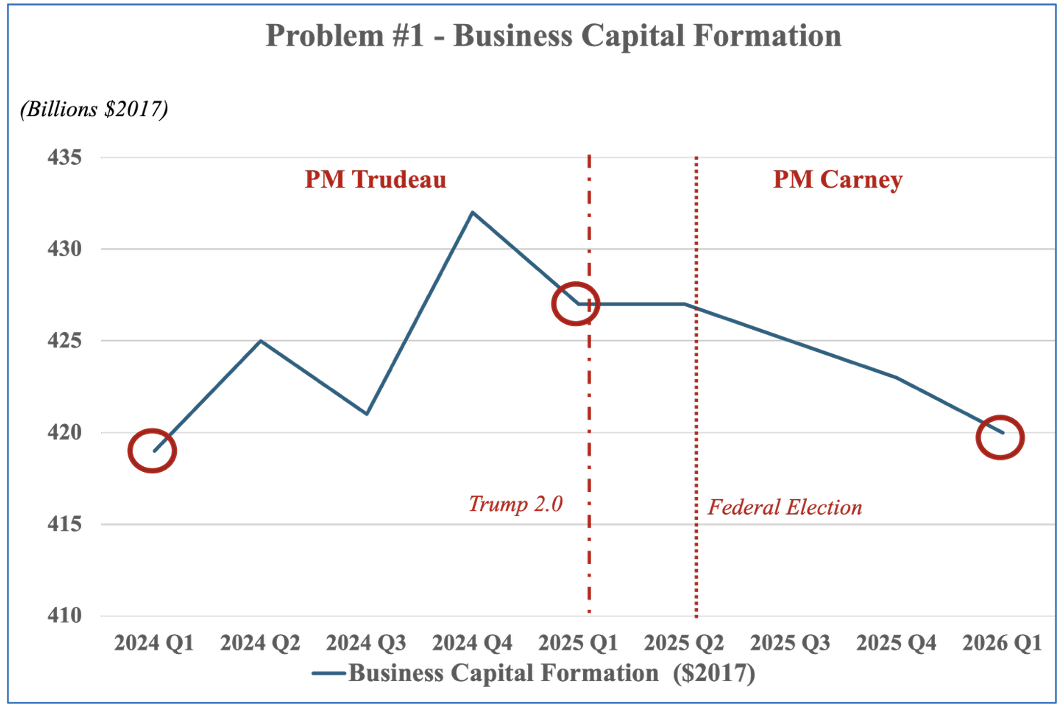
Chart 3: Investment
Source: Haver Analytics, Statistics Canada
Chart 3 displays trends regarding business fixed capital investment measured in constant dollars from 2017. Spending rose throughout most of 2024 before starting downwards again; as of Q1 in 2026 it’s nearly at levels seen two years prior. This weak business investment puts pressure on both current and future prospects for our economy.
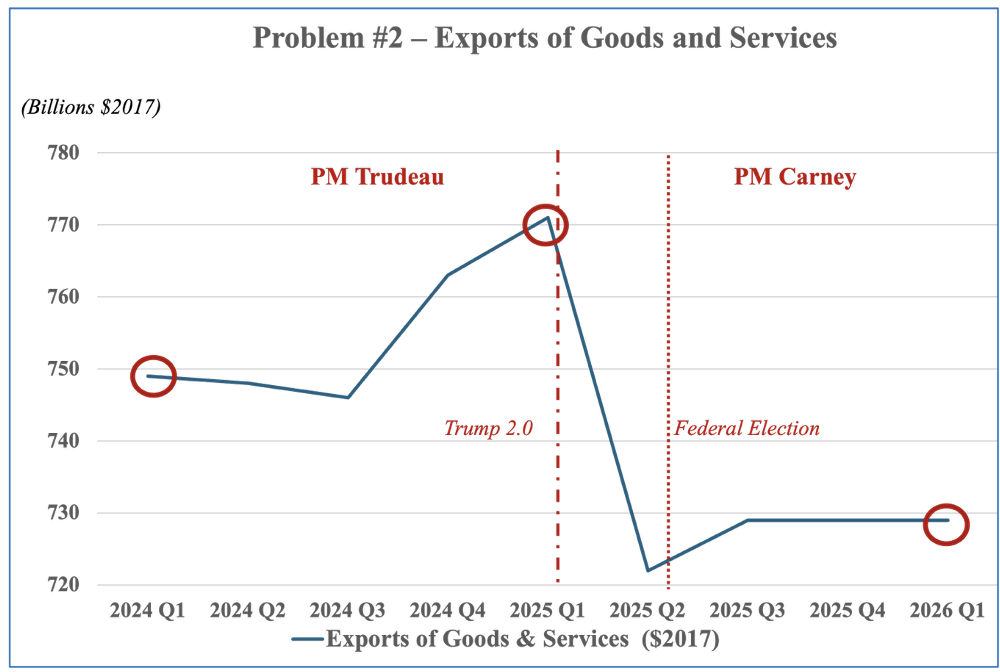
Chart 4: Trade
Source: Haver Analytics, Statistics Canada
Chart 4 reflects a decline in real exports for goods and services valued using constant dollars from back in ’17; this drop coincides with President Trump’s inauguration along with his announced trade policies affecting tariffs significantly impacting our export levels which still remain below those seen two years ago despite stabilizing recently.
So what does all this mean for understanding why our economy struggles right now-and where we go from here? p >
When my colleague Sahir Khan reviews these charts he notes two thoughts come immediately into focus.
First , he thinks about Pink Floyd’s song Comfortably Numb. Businesses along with investors seem stuck waiting around ; those lyrics resonate : “I can’t explain. You would not understand. This is not how I am ; I have become comfortably numb.”
Second , Mr. Khan envisions scenes from Apollo13 where Chief Flight Director Gene Kranz played by Ed Harris expresses urgency while they lose control over spaceship : “Let’s workthe problem. Let’s not make it worse by guessing ”.
Data reveals that stagnation stems directlyfrom reduced business investment coupledwith declining trade opportunities. Thus , Government’s Canada Strongplan aimsat boostinginvestmentandtrade opportunities movingforward.
To quote Robert Frost’s poem A Servantto Servant , “the best way outis alwaysthrough”. Challenges ahead will be execution-related alongwith maintaining public trustand confidence duringthis journey.
Kevin Page servesas Presidentofthe Instituteof Fiscal Studiesand Democracy(IFSD)locatedatthe Universityof Ottawa, aformer Parliamentary Budget Officer, andalsoa Contributing Writerfor Policy Magazine.
Source link