




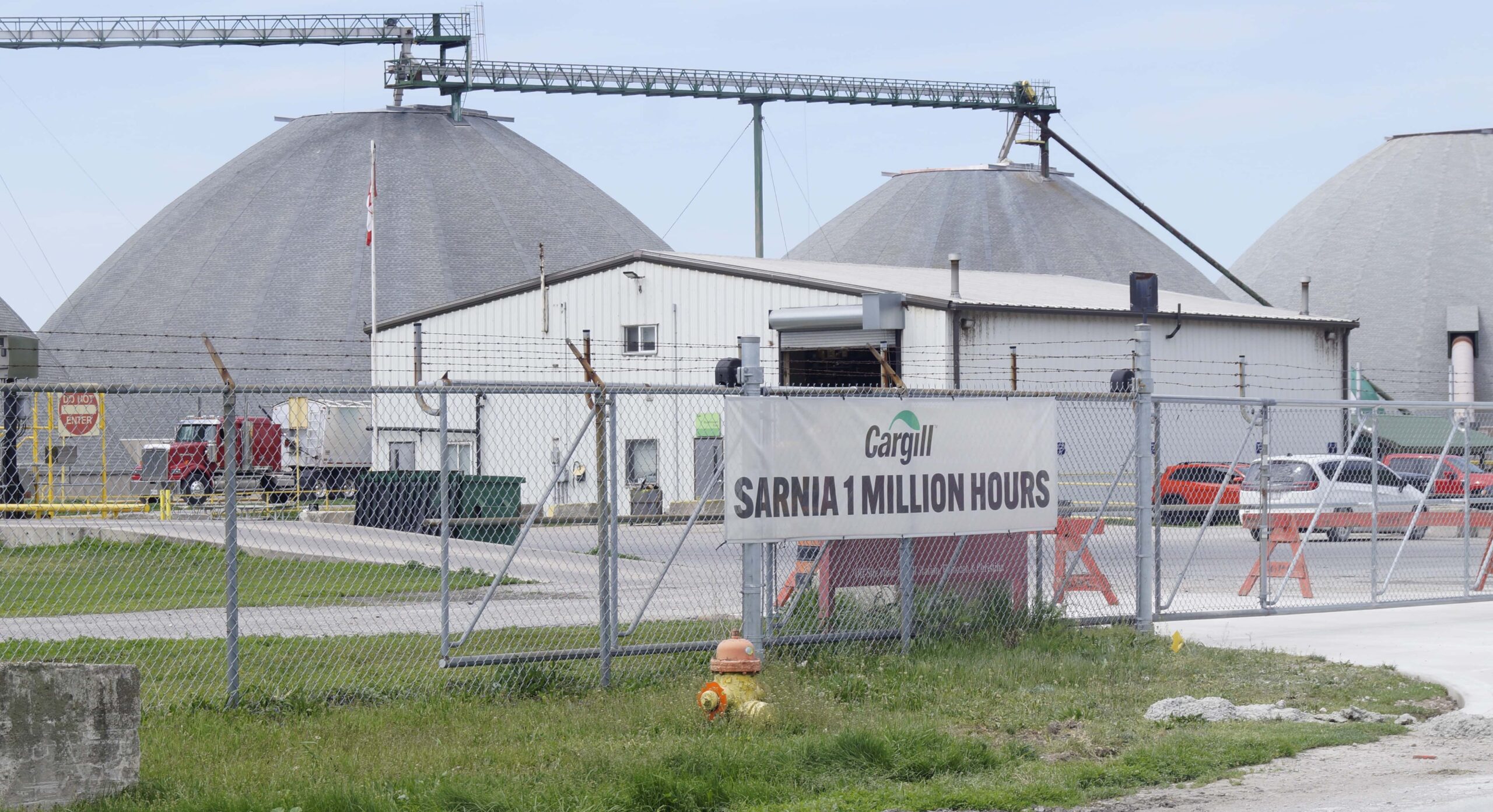
The Ontario Federation of Agriculture (OFA) is showing its support for Cargill Limited’s request for a Minister’s Zoning Order (MZO) aimed at safeguarding the long-term functioning of its Sarnia grain terminal.
Cargill submitted this application in late 2025, requesting a ban on sensitive land uses – like residential areas, hospitals, or daycares – within 300 metres of the Exmouth Street facility.
In a letter to Minister of Municipal Affairs and Housing Rob Flack, OFA President Drew Spoelstra described the terminal as “a critical component of Ontario’s agri-food network and export infrastructure.”
“As one of only a limited number of export grain terminals in southern Ontario, the facility plays a critical role in supporting Ontario farmers, food production, global trade and agricultural supply chain resilience,” said Spoelstra. “The terminal handles approximately 35 per cent of Ontario’s export grain capacity and supports the movement of millions of tonnes of wheat, soybeans, and corn annually, while also receiving fertilizer inputs essential to agricultural production across nearly 400,000 acres of farmland in southwestern Ontario.”
Spoelstra noted that this infrastructure is a strategically important provincial asset connecting farm production to local processors and export markets as well as livestock feed operations and transport networks crucial to the sector.
“Continued reliable operation of facilities such as the Cargill terminal ensures that Ontario farm products efficiently reach consumers and international markets while maintaining the competitiveness and viability of Ontario’s agricultural sector,” he stated.
“As seen in similar land use compatibility issues involving the Ontario Food Terminal in Toronto, incompatible residential development near vital agri-food infrastructure poses significant operational risks and long-term uncertainty,” Spoelstra added. “Supporters of the Ontario Food Terminal MZO rightly recognized that introducing sensitive land uses adjacent to essential food distribution infrastructure can lead to complaints about noise, traffic, odour, dust, and around-the-clock logistics activity which ultimately jeopardizes these facilities’ continued successful operation.”
Spoelstra mentioned that these same concerns are “directly applicable in Sarnia.”
“Cargill has indicated that residential development near the terminal would likely lead to more complaints and regulatory pressures regarding its grain handling activities, truck traffic, and dust emissions – despite substantial investments they have made in mitigation measures and operational improvements,” he explained. “Similar situations elsewhere in Ontario have shown that urban encroachment can lead to closures for industrial agricultural operations due to land-use conflicts which might eventually threaten crucial facilities’ viability.”
Spoelstra emphasized that it’s essential to protect the terminal through suitable land-use planning measures so as to maintain the integrity of Ontario’s agri-food supply chain while avoiding foreseeable conflicts between sensitive residential uses and commercial industrial agricultural operations.
He encourages Minister Flack to back the requested MZO.
You can read the OFA’s full letter here.
Despite this application being filed, Sarnia council approved official plan and zoning bylaw amendments for Tricar’s proposed 14-storey high-rise on Harbour Road on Monday.
A proposed residential project on Exmouth Street is currently uncertain as stakeholders await news on Cargill’s MZO application outcome.
Support for Cargill has also come from various groups and municipalities including the County of Lambton Agricultural Advisory Committee, Christian Farmers Federation of Ontario, Lambton Federation of Agriculture, St. Clair Township, Town of Plympton-Wyoming, and Township of Enniskillen.
Source link
Source link