





A small brown Swainson’s Thrush, a bright Northern Yellow Warbler and a chubby little Veery.
All were discovered lifeless on the same day in downtown Kitchener. They may have perished just minutes apart.
“She died shortly before I found her. Her body was still warm,” Meredith Blunt said, flipping over a nearly weightless thrush in her hands.
Blunt, who heads a local group called Bird Friendly Kitchener, began tracking window collision bird deaths back in August 2025. She often strolls through the downtown area, gathering the remains of various migratory birds that have traveled thousands of kilometers.
A member of Bird Friendly Kitchener found this Swainson’s Thrush dead on the ground on Monday after it hit a window in downtown Kitchener. (Meredith Blunt)
To date, Blunt has collected 234 birds. Seven were alive when found, but only two out of those seven made it through rehabilitation.
“There are definitely hotspots, very problematic buildings,” Blunt stated while sharing her observations on CBC K-W’s The Morning Edition.
“Google, Oracle, Hall’s Lane and all those glass buildings that back onto it, and the Galleria itself. Even both new and old courthouses.”
WATCH | Birds are hitting windows and dying in Waterloo region: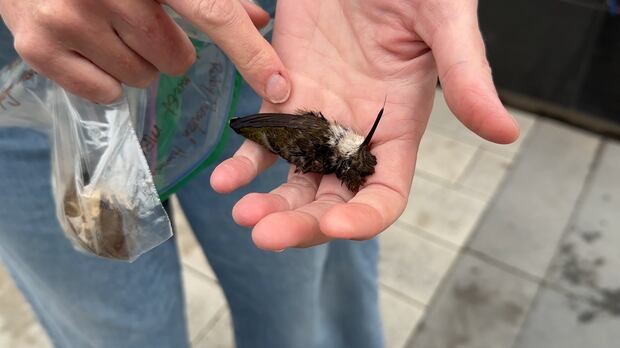
Birds are hitting windows and dying in Waterloo region. This advocate is trying to help them
It’s migration season for birds, which means many newcomers are passing through Waterloo region. The local cities are just one stop along their long journey across the continent. That journey can be dangerous too; many birds lose their lives due to human-made barriers like large windows on buildings in downtown Kitchener. A local bird advocacy group hopes its findings will help prevent unnecessary bird deaths.
Once her team spots a hotspot, she says they reach out to property managers or caretakers to inform them about the issue.
“We have reached out to set up meetings that have not been shown up to,” Blunt mentioned.
They contacted Perimeter, which co-owns the Google building in Kitchener. In an email response, Craig Beattie, Perimeter’s CEO, acknowledged Blunt’s concerns and shared that he’s currently working with his operations team to tackle the problem.
Infrastructure Ontario also provided an emailed statement saying they “work with our partners to determine where and how bird safety may be integrated into infrastructure projects.”
A member of Bird Friendly Kitchener found this dead Northern Yellow Warbler on Monday. It is one of over 230 dead birds found in the downtown Kitchener area since August. (Meredith Blunt)
Glass Buildings and Plants: ‘a Dangerous Combination’
Blunt says her project was inspired by FLAP Canada, a charity based in the GTA that gathers data about how many birds die after colliding with windows across Canada and around the world.
FLAP Canada runs an ongoing project called the Global Bird Collision Mapper that collects information from users regarding any birds found-alive or dead-after crashing into windows.
The data from FLAP shows over 3,200 birds have died from window collisions throughout Canada since early 2026.
Michael Mesure, executive director of FLAP Canada noted some cities like Toronto can be especially hazardous for birds.
“Toronto sits up against Lake Ontario’s shoreline. It’s packed with vegetation-lots of parks and ravines-and during migration seasons these birds depend heavily on these stopover areas,” Mesure explained.
“The area’s landscape impacts how severe these collisions are along with how many human-built glass structures exist there. When you combine those factors together you get a deadly mix like what we see in Toronto.”
This dead Veery bird was found in downtown Kitchener on Monday by Meredith Blunt from Bird Friendly Kitchener. She’s monitoring the number of migratory birds that are dying after striking a window. (Meredith Blunt)
Mesure added FLAP’s data indicates this problem isn’t limited to tall commercial buildings; residential homes contribute significantly as well.
“Low-rise homes and single-family houses pose serious threats too.”
Ryan Norris, an ecologist at the University of Guelph emphasized this is an issue faced all across Canada during this time of year.
“We lose millions of birds every year during spring migration,” Norris stated.
“The more reflective surfaces there are along with bright lights increase danger for these birds.” P >Some injured birds collide with windows but survive initially; however their recovery isn’t guaranteed.
This Eastern Warbling Vireo hit a window in downtown Kitchener on May 18. It received initial care but sadly didn’t make it afterwards.(Meredith Blunt)
How You Can Help h2 > Blunt urges residents who want to assist wildlife should begin at home.
“Single-family detached houses between two stories or more up to five stories tend to be particularly dangerous for our feathered friends. People can break up reflections coming off their windows ,” she advised , encouraging residents think about putting anti-collision stickers onto their glass surfaces. P >
Anti-collision stickers are specially designed decals aimed at preventing bird collisions with windows.
Mesure points out there’s also room for advocacy efforts focused on integrating bird safety into national building codes.
“This relates directly to sustainable building practices. Birds need consideration as part of that discussion ,” he stressed , insisting authorities must ensure new constructions moving forward protect avian life.” p >
“We’re calling upon provincial governments alongside federal ones as well regarding including regulations such as specific markers placed onto glazing systems so they remain safe for our winged neighbors.” p >LISTEN | More than 230 Birds Found Dead In Downtown Kitchener:
The Morning Edition -K-W5:09More than 230 Birds Found Dead In Downtown Kitchener p >A local advocate alerts others following hundreds upon hundreds being discovered deceased due entirely towards smashing against solid panes within urban settings. Meredith discusses initiatives created promoting awareness surrounding avoiding window impact accidents involving aviary species inside communities everywhere!
Norris believes persuading commercial property managers might prove challenging at this point.
You can place [stickers] internally-but aesthetically some folks aren’t fans,” he remarked further explaining changing laws would adapt alongside advancements where less visible options become available soon enough!
The community should consider bylaws addressing challenges faced concerning collision risk rather than solely relying upon individual efforts alone! P >
Source link


