



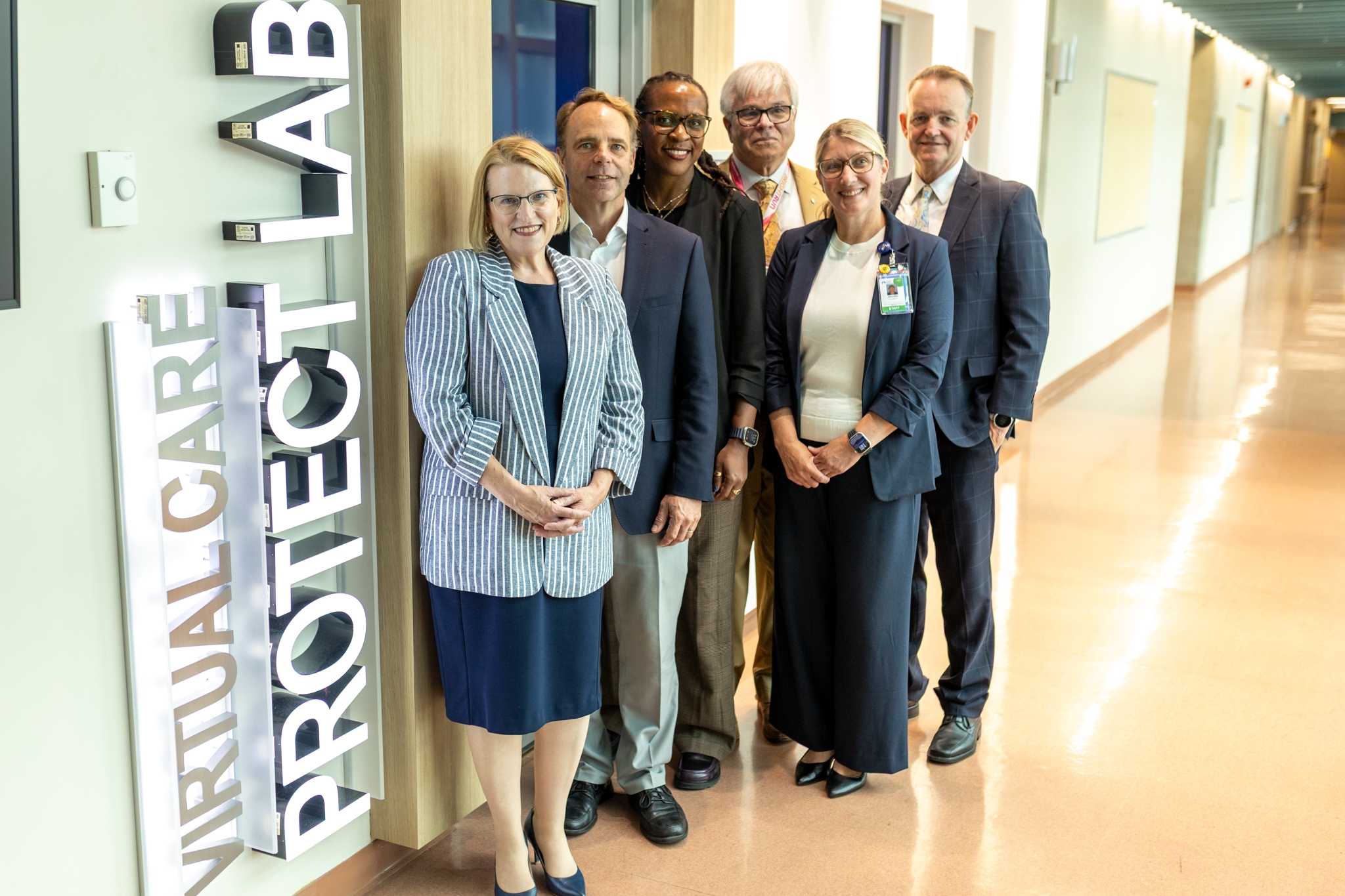
Ontario’s Deputy Premier and Health Minister Sylvia Jones, front left, visited the PROTECT Lab at HHS Juravinski Hospital and Cancer Centre. Here, patients are monitored remotely after they return home. From left to right: Jones, Anthony Kaul, Dr. Sandra Ofori, Dr. Mark Levine, Jennifer Lounsbury, Ted Scott.
The PROTECT Lab is a collaboration between the Population Health Research Institute (PHRI), Mc Master University, and Hamilton Health Sciences (HHS). On July 22, it welcomed Ontario’s Deputy Premier and Health Minister Sylvia Jones along with Minister of Sport and MPP for Hamilton East-Stoney Creek Neil Lumsden and Hamilton Mountain MPP Monica Ciriello. The visit featured a tour of the lab that highlighted how virtual care and remote monitoring assist patients in recovering safely at home after being hospitalized.
During their visit, the group met with key figures from the lab and partner organizations such as Mark Levine, a principal investigator at the lab and professor emeritus in Mc Master University’s Department of Oncology; Sandra Ofori, co-lead of the lab’s postoperative virtual care research program; Ted Scott, chief innovation officer at HHS; Aaron Levo, vice president of people and culture at HHS; and Jennifer Lounsbury, chief nursing information officer at HHS. They were also joined by Anthony Kaul from Cloud DX and Jaide Kassam of Amir Remtulla & Associates.
The visitors discovered how the lab employs virtual care along with remote monitoring to aid patients recovering at home post-surgery. This approach helps shorten hospital stays while minimizing avoidable readmissions and enhances capacity within the healthcare system.
Helping patients outside hospital walls
The PROTECT Lab – which stands for Improving Perioperative and cance R Outcomes Through Excellence and appli Cation of Virtual Technologies – aids healthcare teams in studying and delivering virtual care solutions. Situated within HHS’ Juravinski Hospital and Cancer Centre, it is managed by Michael Mc Gillion from PHRI; P. J. Devereaux from PHRI; alongside Levine who is a medical oncologist.
Dr. PJ Devereaux
“As physicians and researchers, we’re always looking for ways to support patients beyond the hospital walls. At the PROTECT Lab through remote monitoring technology and direct access to the care team, we can better support patients during recovery and intervene earlier when concerns arise,” says Devereaux.
The PROTECT model could have significant effects on cancer treatment where ongoing support is often needed during systemic therapy or radiation therapy along with follow-up care.

Dr. Mark Levine
“Cancer treatment can be a long journey for patients and families. Virtual care allows us to stay connected, answer questions, address concerns, and provide ongoing support between clinic visits helping patients feel more confident throughout their care,” says Levine.
Monitoring vital signs remotely
Patients taking part in this program use tablets along with monitoring devices to track how they feel as well as health metrics like blood pressure or heart rate from home. The technology provided by Canadian health tech company Cloud DX enables nurses in the lab to view this data live while communicating directly with patients when necessary-and if needed-connect them with perioperative physicians right away. The nurse-physician partnership model plays a crucial role in this virtual care setup while also allowing researchers to understand how this kind of attention affects recovery rates.
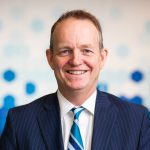
Ted Scott, chief innovation officer at HHS
“The future of health care isn’t just about more virtual visits-it’s about continuous data-informed care that follows patients wherever they are,” says Scott. “Through the PROTECT Lab we’re demonstrating how remote monitoring combined with digital health technologies can enhance patient outcomes while easing demands on hospitals.”
“By transitioning from reactive to proactive approaches-from being hospital-centric towards patient-focused-this model helps maintain Ontario’s healthcare capacity while developing a more sustainable responsive network,” adds Scott.
Aiming to lower readmission rates
This visit emphasized how adopting the PROTECT model assists in spotting health issues early on leading toward timely interventions that reduce hospital readmissions aiding quicker recoveries after surgery-and freeing up beds for those who need them most urgently.
There was also discussion regarding close collaboration between nurses alongside doctors showcasing how frequent communication channels help alleviate concerns swiftly improving access whenever necessary.
Dr. Sandra Ofori p >
“We were pleasedto welcome Minister Jones tothe PROTECTLabandhighlighttheimpactofthisprogramnotonlyonpatientsandfamiliesbutalsoonourunderstandingofnewapproachestocare,”says Ofori.
Thelab’spostoperativevirtualcareresearchprogramisledby Mc Gillion, de Vereauxand Oforiwhoisalsoanassistantprofessorat Mc Master Universityandcardiologistat HHS. Togethertheyareleadingseveral PHRIclinicaltrialsincluding PVC-RAM – 2and PVC-RAM -3. These studiesarelookingatwhetherremotemonitoringcanhelppatientsrecovermoreefficientlyaftersurgerybyidentifyingcomplicationsearly, reducingrepeathospitalvisits, andimprovingrecoveryathome.
Laterthisyear, twocancerstudieswillexaminewhethervirtualcareandhome-basedmonitoringcanshortenhospitalstaysforpatientsundergoing CAR-Ttherapyandreducetheclinicvisitsforbreastcancerpatientsreceivingsystemictreatment.
The future looks bright for patient-centred healthcarein Canada h2 >
Mike Mc Gillion P >
“There’salotofinterestinvirtualcare, butit’simportantthatweunderstanditsimpactthroughhigh-qualityresearch,”says Mc Gillion.”Atthe PROTECTLab, we’restudyingwhatdifference thismodelofcaremakesforpatients Throughourresearch, we’relearninghowthese technologiesandcaremodels can workalongsidetraditionalcaret osupportrecoveryandimprovethefutureofpatient-centredcarein Canada.”
Today, manythousandswhoundergonesurgery arebenefittingfromvirtualcarewithremotemonitoringthroughthe PROTECTLab. Atthesame time, researcherscontinuebuilding evidenceonhowtechnologycanhelpmorepeople recover safelyandconfidentlyathome.