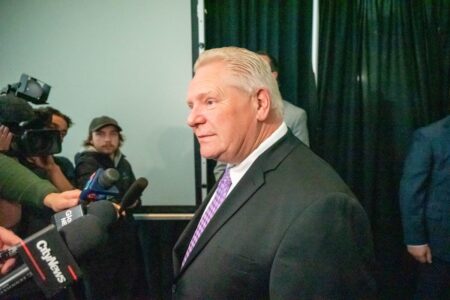






Ontario Premier Doug Ford mentioned he might consider using the notwithstanding clause to clear out an encampment in downtown Kitchener.
This comes after a decision last week from an Ontario Superior Court judge that stops the Region of Waterloo from relocating residents from the property where the encampment exists. The region has claimed it needs the lot as a staging area for constructing a significant transit hub project.
During a news conference in Toronto on Monday, Ford stated his government is prepared to “intervene.”
“Another crazy decision by the courts. We’re going to deal with it, hopefully, the region is going to appeal it. We’ll intervene and stay tuned because that’s the reason they have section 33 of the notwithstanding clause,” he said.
WATCH | Premier Ford considers notwithstanding clause: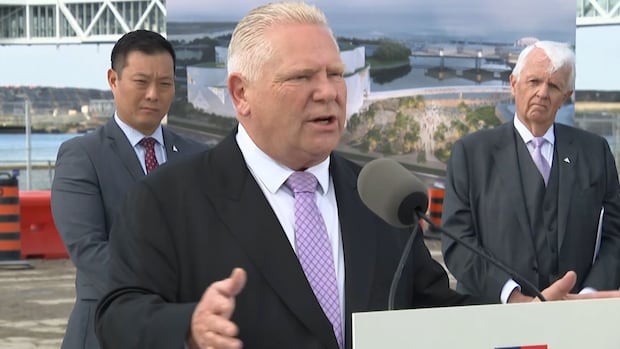 Ford mulls using notwithstanding clause to clear Kitchener encampment
Ontario Premier Doug Ford is contemplating utilizing the notwithstanding clause after an Ontario Superior Court judge’s ruling stopped the Region of Waterloo from moving residents from a downtown Kitchener encampment. The region indicated that they require this land for building a major transportation hub in the vicinity.
The notwithstanding clause, found in section 33 of the Charter of Rights and Freedoms, allows federal and provincial governments in Canada to override certain parts of the charter related to fundamental freedoms, legal rights, and equality rights for terms of five years.
Ford has invoked this clause twice: first in 2021 regarding a court ruling on third-party election financing laws and again in 2022 during an attempt to prohibit a CUPE education workers’ strike. The latter use was later repealed.
On Monday, Ford did not firmly commit to using the notwithstanding clause but instead suggested “let’s go through the proper process.”
“I’m going to give the courts another shot here,” he stated. “Hopefully, the region is going to appeal. We’ll be right there with them.”
Ford’s remarks also followed his initial reaction last week when he labeled the decision as “ridiculous,” adding, “I’ll send 15 encampments in [the judge’s] backyard and see how he likes it.”
reached out to the region for comments regarding Ford’s statements and whether they would appeal this judgment.
In a statement provided to , a spokesperson remarked, “We are reviewing Justice Gibson’s ruling and will determine next steps in the coming days.”
Ford mulls using notwithstanding clause to clear Kitchener encampment
Ontario Premier Doug Ford is contemplating utilizing the notwithstanding clause after an Ontario Superior Court judge’s ruling stopped the Region of Waterloo from moving residents from a downtown Kitchener encampment. The region indicated that they require this land for building a major transportation hub in the vicinity.
The notwithstanding clause, found in section 33 of the Charter of Rights and Freedoms, allows federal and provincial governments in Canada to override certain parts of the charter related to fundamental freedoms, legal rights, and equality rights for terms of five years.
Ford has invoked this clause twice: first in 2021 regarding a court ruling on third-party election financing laws and again in 2022 during an attempt to prohibit a CUPE education workers’ strike. The latter use was later repealed.
On Monday, Ford did not firmly commit to using the notwithstanding clause but instead suggested “let’s go through the proper process.”
“I’m going to give the courts another shot here,” he stated. “Hopefully, the region is going to appeal. We’ll be right there with them.”
Ford’s remarks also followed his initial reaction last week when he labeled the decision as “ridiculous,” adding, “I’ll send 15 encampments in [the judge’s] backyard and see how he likes it.”
reached out to the region for comments regarding Ford’s statements and whether they would appeal this judgment.
In a statement provided to , a spokesperson remarked, “We are reviewing Justice Gibson’s ruling and will determine next steps in the coming days.”
Source link
Ford mulls using notwithstanding clause to clear Kitchener encampment
Ontario Premier Doug Ford is contemplating utilizing the notwithstanding clause after an Ontario Superior Court judge’s ruling stopped the Region of Waterloo from moving residents from a downtown Kitchener encampment. The region indicated that they require this land for building a major transportation hub in the vicinity.
The notwithstanding clause, found in section 33 of the Charter of Rights and Freedoms, allows federal and provincial governments in Canada to override certain parts of the charter related to fundamental freedoms, legal rights, and equality rights for terms of five years.
Ford has invoked this clause twice: first in 2021 regarding a court ruling on third-party election financing laws and again in 2022 during an attempt to prohibit a CUPE education workers’ strike. The latter use was later repealed.
On Monday, Ford did not firmly commit to using the notwithstanding clause but instead suggested “let’s go through the proper process.”
“I’m going to give the courts another shot here,” he stated. “Hopefully, the region is going to appeal. We’ll be right there with them.”
Ford’s remarks also followed his initial reaction last week when he labeled the decision as “ridiculous,” adding, “I’ll send 15 encampments in [the judge’s] backyard and see how he likes it.”
reached out to the region for comments regarding Ford’s statements and whether they would appeal this judgment.
In a statement provided to , a spokesperson remarked, “We are reviewing Justice Gibson’s ruling and will determine next steps in the coming days.”
Ruling gives region options
Last week, Ontario Superior Court Justice Michael R. Gibson ruled that while at 100 Victoria St. N., downtown Kitchener, residents could not be removed unless alternative accommodations were offered or a tenting protocol was established. In his extensive 88-page ruling, Gibson noted that this encampment remains one of very few places where those experiencing homelessness can legally set up tents or structures; thus serving as a refuge when all else fails. The regional bylaw permitting eviction was determined by him as violating sections seven and fifteen of the Charter. Presents estimates show there are between 30 to 35 tents at this site currently. The region contends that Metrolinx-the provincial transit agency-needs access to this land soon due to upcoming construction work linked with preparing for developing Kitchener Central Transit Hub project. Kitchener encampment residents expressed their satisfaction about last week’s court decision during conversations with on Friday since being situated at this site has provided them some stability in their lives.<img src="https://ontariochronicle. ca/wp-content/uploads/2026/05/1779475455_127_default. jpg" alt="" class="thumbnail" loading="lazy"/’A good feeling’: Kitchener encampment residents react after court rules they can stayResidents along with advocates shared their thoughts following an Ontario judge’s determination allowing those living at a Kitchener encampment permission to remain there-a judgment issued Thursday at Ontario Superior Court declared removal unconstitutional under their Charter rights according CBC’s Carmen Groleau who gathered feedback from residents on Friday.Caution advised on invoking clause says lawyer
Ashley Schuitema serves as legal counsel representing individuals within that camp commented Tuesday when interviewed by stressing that invoking such clauses ought only happen sparingly; she believes it shouldn’t be employed simply whenever leaders disagree with judicial outcomes. “I think we’re at risk of being part society I wouldn’t want if officials could disregard people’s rights whenever desired through usage these provisions,” she emphasized. “Furthermore,” continued Schuitema “should authorities seek challenge against Judge ruling then my office must obtain directives directly from affected parties.” No notifications indicating intentions toward filing appeals have been received thus far according Schuitema who added uncertainty surrounding potential responses should province decide assert aforementioned clauses remains present regarding possible options available her team pertaining either case.”An open letter directed towards AG emerges
Saying disappointment towards premier’s comments surfacing post-judgment voiced concerns over implications affecting both integrity judiciary independence administration justice echoed sentiments therein led her sign open correspondence penned University Ottawa law professor emerita Martha Jackman targeted specifically addressed Deputy General Downey dated Tuesday morning stating “Ford’s utterances mere hours shortly thereafter represent serious threats constitutional principles particularly surrounding autonomy judges”. ”Jackman noted cause behind motivations stemmed interactions characterized crossing lines akin tactics seen nationally previously employing similar rhetoric attempting undermine confidence processes societies depend upon” succinctly articulating viewpoints raised events now unfolding too concerning overall conduct displayed asserting positions occupied crucial roles ensuring fairness prevail both procedurally substantively especially given delicate matters involving marginalized populations.”Source link