



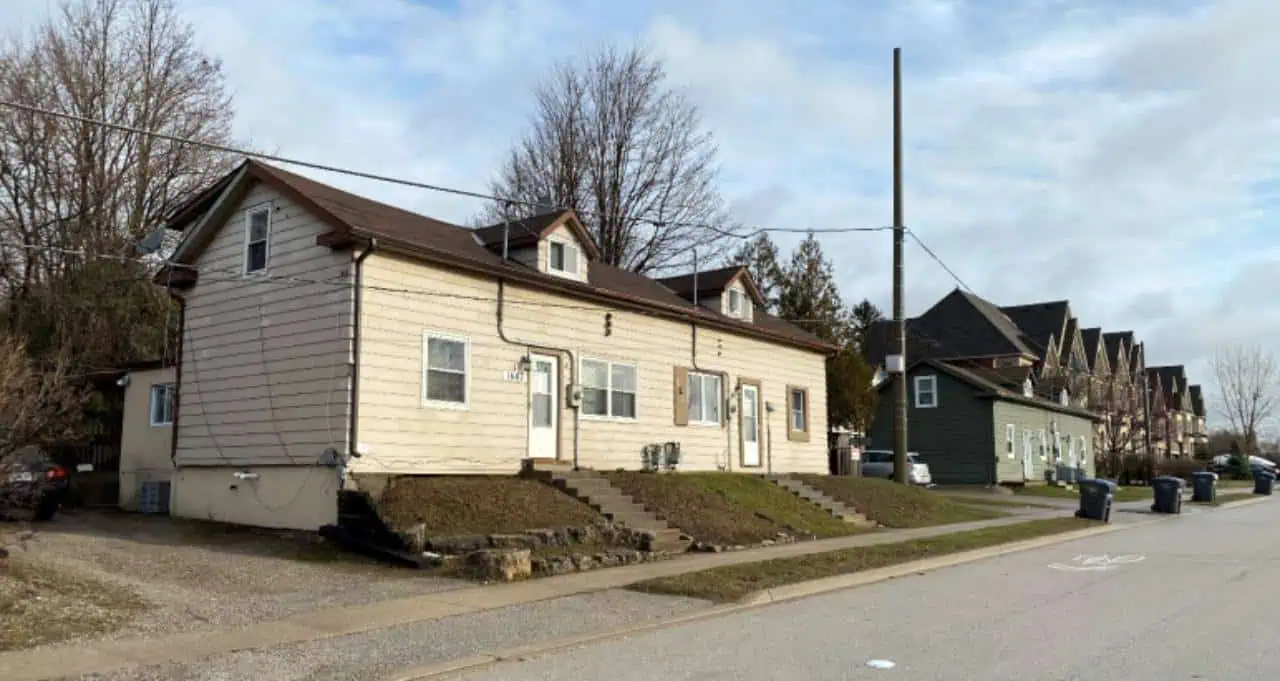
Mississauga’s Heritage Advisory Committee recognizes the historical importance of these simple homes on Eglinton Avenue.
Long before Mississauga transformed into a city filled with subdivisions, office buildings, and highways, workers from one of Ontario’s biggest textile mills returned to humble cottages by the Credit River each day. Today, only two of those cottages remain, serving as a rare connection to the city’s industrial roots.
The City of Mississauga’s Heritage Advisory Committee is suggesting that the duplexes at 1595-7 and 1605-7 Eglinton Avenue West be designated under the Ontario Heritage Act. This would acknowledge them as the last surviving millworkers’ homes linked to the once-bustling Barberton industrial community near Streetsville.
Although these one-and-a-half-storey houses might not catch most people’s eyes while driving down Eglinton, city heritage staff believe they represent a significant part of Mississauga’s history and provide one of the few remaining insights into the lives of working families who contributed to the city’s early industrial growth.
If approved, this heritage designation would officially recognize these properties for their historical, architectural, and contextual significance. It would also require city approval before any alterations or demolitions that could impact their recognized heritage characteristics are made.
A report from the city states that these homes were constructed in 1860 by the Barber Brothers, influential industrialists who established the Toronto Woollen Mills along the Credit River after acquiring land south of Streetsville in the 1840s.
The mill quickly emerged as one of Ontario’s manufacturing success stories.
By the 1860s, Toronto Woollen Mills was producing about 1,000 yards of cloth daily and employed roughly 100 workers. At its height, it grew to employ as many as 200 people and became Ontario’s fourth-largest textile mill by 1870.
This success resulted in an entire company community called Barberton springing up around what is now Barbertown Road.
The Barber Brothers constructed 43 buildings to accommodate workers and their families alongside shops, a boarding house, recreational areas, and other facilities that turned this area into a thriving industrial village.
A lot of employees lived within walking distance from work; in some instances, entire families were employed at the mill. Skilled weavers were brought over from Scotland while local businesses like blacksmith shops and general stores supported this growing community.
Todays’ landscape shows nearly all traces of Barberton have vanished.
The two duplexes being considered for heritage status are now the only remaining millworkers’ cottages from that original community. Heritage planners assert they hold just as much significance in understanding local history as does William Barber House on Mississauga Road-a structure built for one of the mill owners that is already designated under Ontario Heritage Act.
Together, these buildings narrate both sides-the owners behind one of Ontario’s largest textile enterprises and those workers whose efforts made it successful.
“The cottages are an important aspect of Mississauga’s socioeconomic and industrial history,” states the city report.
Even though textile production ended in the early 1880s at this site, it continued operating under various ownerships before shifting to flour production. Today it stands as ADM milling operation on Barbertown Road-one of Mississauga’s oldest continuously functioning industrial sites.
The city staff emphasize that maintaining these cottages helps keep connections with our past alive.
This proposed designation wouldn’t stop people from living in or renovating these homes but would protect key heritage elements so any future changes affecting significant exterior aspects would need municipal consent first.
The identified heritage features include their duplex style, medium-pitched gable roofs with dormers and chimneys along with original doorways and window placements as pointed out by officials from cities involved here too!
No consensus exists regarding support for this plan among all parties involved yet!
The report mentions heritage staff had discussions with property owners throughout late ’25 & early ’26 about possible designations but unfortunately those conversations yielded negative responses concerning plans moving forward..
. Nevertheless despite differing opinions-city experts found enough criteria met overall which justify designating them under The Ontario act based upon physicality, historical context value shown through analysis conducted
. Almost170years since construction began back then -these unpretentiousduplexeshave lasted longer than anything else representing Barbertons former glory days when folks worked tirelessly helping shape Mississaugas richindustrialheritage
INsauga’s Editorial Standards and Policies
Total Votes Last30Days :49 ,446 Votes P >
Overall Total Votes :1 ,454 ,229 p > 1420 VOTES