



This past week, another significant milestone was achieved in the expansion of Toronto’s rapid transit network as the excavation of the tunnel launch shaft for the Yonge North Subway Extension was finished. Located just south of Langstaff Road East in Markham’s Thornhill area, this shaft will facilitate the insertion of tunnel boring machines (TBMs) to dig over 6 kilometres of twin tunnels, ultimately connecting with Line 1’s long-standing northern terminus at Finch station in Toronto.
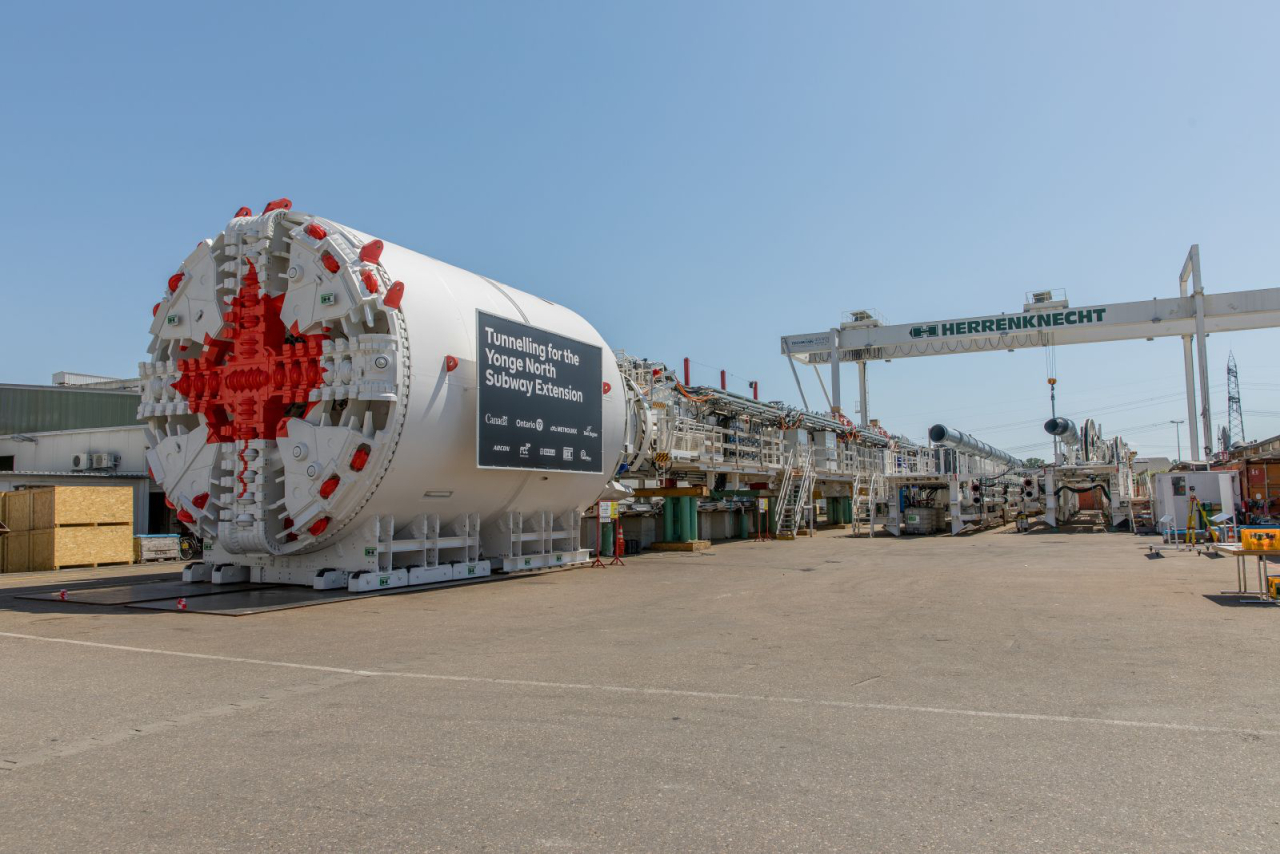
The cutting face of one of two tunnel boring machines that will excavate the YNSE extension to Richmond Hill, July 23, 2026, image courtesy of Infrastructure Ontario
Initially proposed in 2007, the Yonge North Subway Extension (YNSE) faced nearly two decades stuck in planning and political discussions. A major hurdle to extending Toronto’s first subway line was its already heavy ridership. Before the COVID-19 pandemic hit, southbound Line 1 trains going downtown during morning rush hour often reached full capacity before even getting to Eglinton station. This constant overcrowding made transit executives at Metrolinx and the TTC cautious about adding more stations and increasing commuter numbers on an already stretched system.
A map displaying the route of the under construction Yonge North Subway Extension, image courtesy of Metrolinx
Officials had long believed that opening such an extension would be impossible unless the anticipated ‘Downtown Relief Line’ was operational first to ease pressure on Yonge Line 1 south of Bloor-Yonge station. After years of stalled efforts by the TTC, Ontario’s government revived the Relief Line-renaming it as Ontario Line 3-while also committing $5.6 billion to fund the YNSE. Three years later, in 2023, with work progressing on the Ontario Line, preliminary construction officially kicked off on the YNSE project at Finch station – currently where Yonge Line 1 ends.
of Ontario’s Rapid Transit plan for the GTA, 2019, image courtesy of the Ministry of Transportation
Just under a year ago, major construction commenced on a surface-to-underground portal ramp for this extension-a substantial earthworks effort designed to launch twin TBMs deep underground. Located southeast of where Yonge Street meets Highway 407 interchange, this excavation site will transition from above ground within a rail corridor shared with CN Rail and GO Transit into a tunnel.
One of the two tunnel boring machines that will excavate the YNSE extension to Richmond Hill, July 23, 2026, image courtesy of Infrastructure Ontario
As it moves southward directly beneath Royal Orchard neighbourhoods, Metrolinx adjusted its design after community pushback to dig significantly deeper. To reduce noise and vibrations affecting single-family homes and schools above ground, TBMs will carve out their path at depths ranging from about 22 to 29 metres below surface level.
A diagram and cross section of the YNSE’s alignment between the East Don River and High Tech station, image courtesy of Metrolinx
In recent months since work began on this portal site large progress has been made at this expansive excavation area next to an active rail corridor. In a photo taken in June 2026 below shows shoring and material removal nearing completion.
Looking towards nearly complete YNSE tunnel portal in June 2026 from passing Richmond Hill line GO train; image courtesy Urban Toronto forum contributor yrt+viva=1system
Alongside advancements at this tunnel portal site prep work is progressing at intersection point for Yonge Street and Steeles Avenue as several expropriated properties await demolition. On southwest corner sits what used to be a busy Hudson’s Bay Company outlet located within Centerpoint Mall; now vacant and fenced off awaiting clearing for future subway development.
Looking west from Yonge Street towards former Hudson’s Bay Company location at Centerpoint Mall soon set for demolition due subway works June21 ,2026; Image credit Urban Toronto forum contributor Edward Skira
Across from here is strip plaza situated southeast corner which has already been leveled with barriers erected along traffic flow direction down onto yongestreet
. Looking toward southern corner Intersection point comprising both streets where prior plaza demolished supporting ongoing developments around stations ; June21 ,2026 ; Image source urban toronto forum member edward skira
The tearing down thus far completed establishment allows means enabling rerouting plans regarding yongestreet itself during building process concerning future steels’ stop amidst current road way conditions. During phased works , yongestreet swings Westward aligning just inside previous structure’s edge countering back toward steel avenue angling eastwards.
This rerouting is expected start by year-end continuing through until twenty-eight-with no specific timeline having been announced by metrolinx outlining completion dates either pertaining roadwork or overall project goals
A notice displaying temporary reroute measures taken surrounding roadway aimed facilitating constructions related steels station ! image credit metrolinx