





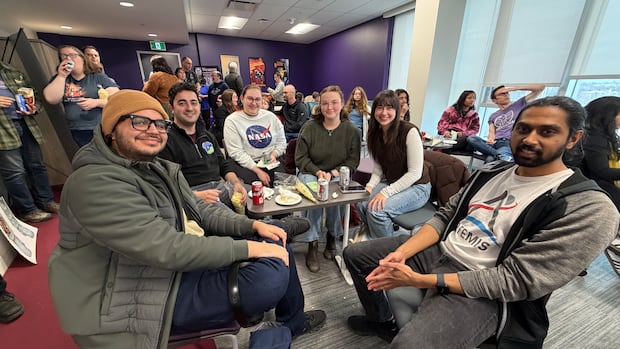
There was a buzz of excitement at Western University in London, Ontario on Wednesday as many teachers and students came together to witness Canadian astronaut Jeremy Hansen and his NASA team launch towards the moon on Artemis II.
Hansen, who hails from Ailsa Craig just outside London, is part of this historic mission that marks the first time humans will orbit the moon in over 50 years. For those watching from London, it was a touching moment that connected their hometown to outer space.
“It’s hard to believe, you think London’s just this kind of small town in southwestern Ontario and now we have this hometown astronaut going up to the moon. That’s something new for me,” said Catherine Neish, a professor in Western’s department of Earth Sciences.
Neish was among the crowd cheering on the astronauts at a watch party held at “Mission Control” within Western’s Institute for Earth and Space Exploration.
The audience anxiously awaited the launch, which took place shortly after 6:35 p. m. ET. Cheers erupted as soon as the rocket lifted off, leaving many spectators feeling astonished.
“There was a part of me that was not really truly convinced this was actually about to happen after waiting for so long so when the rockets led off, I just felt a shudder of excitement,” said Ph D candidate Jack Hostrawser.
“It was so cool that this is actually happening. We’re going back to the moon!”
Artemis II is a 10-day mission aimed at testing systems and equipment ahead of an anticipated lunar landing in future years. This initiative represents significant progress for NASA’s Artemis program, which seeks to return humans to the moon since the Apollo days.
For Hostrawser, it wasn’t just witnessing history; it also brought back memories of Canadian astronauts like Julie Payette, David Saint-Jacques, Chris Hadfield and others who sparked his interest in space exploration.
“I’m here today at Western because when I was a kid, I was inspired by astronauts who were Canadians who made it all the way up to the International Space Station, showing that that is something a Canadian can do,” he said.
Jack Hostrawser is a Ph D candidate at Western University. (Isha Bhargava/CBC)
“I can only imagine what it’s going to mean for kids today to see that there’s a Canadian going all the way to the moon and back,” Hostrawser added.
Neish noted she saw plenty of curiosity among her students and others at Western. She believes this mission will open doors for exploring new areas and gaining knowledge.
WATCH | NASA astronauts launch into space: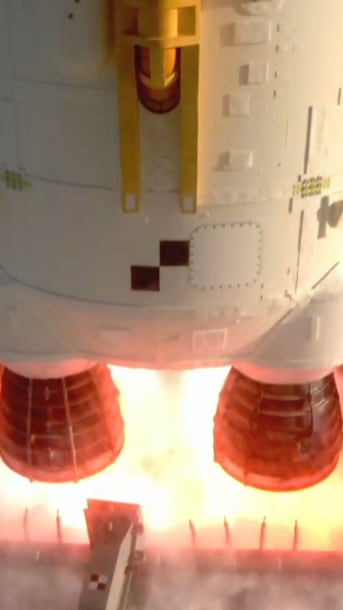
Watch as Artemis II departs Earth
Nasa’s Artemis II mission will take astronauts around the moon and back-further from Earth than any human has traveled before. Among those aboard is Canadian Jeremy Hansen set out to become Canada’s first astronaut reaching deep space.
Western University planetary geologist Gordon Osinski spent over ten years training Hansen. The two collaborated closely for about 15 years on geology training expeditions in Canada’s Arctic-a place he claims mimics some challenges astronauts will face.
“We’d fly into the middle of nowhere… working in small teams in a hostile environment,”Osinski told CBC’s London Morning on Tuesday.“That’s very much what the astronauts will be doing… on the surface of the moon.”
“It’s an incredibly important mission. This is our first time back to the moon since 1972. There’s a lot of pressure on all these astronauts along with engineers and scientists.”
LISTEN | Gordon Osinski on Jeremy Hansen preparingto launch on Artemis II:
London Morning8:05Artronaut Jeremy Hansen’s geology professor
Canadian astronaut Jeremy Hansen has dedicated years getting ready for his Artemis II journeyto themoon. Western University Professorofplanetarygeology Gordon Osinskiteached Hansenandtold London Morning Jeremyiswell-trainedandhastherightaptitudestostaycalmunderpressure.
Osinski describes Hansenascalm, capableandwell-preparedforthemission.
“He’s incredibly humble…an amazing ambassadorfor Canada,”Osinskisaid.“Butperhapsone thingthatstands himgoodsteadforhismissionishe’sincrediblycalmunderpressure.”
That calmwillbe criticalasastronautsfacebothmentalandphysicalstrain.
“Their bodieswillliterallybe under pressure , experiencingmultipletimestheforceofgravity,”Osinskisaid.“Thecombinationofmentalandphysicalchallengesisnotsomethingwecanunderstate.”
Source link