






Dr. Helen Chen
Professor, School of Public Health Sciences
Faculty of Health Developing new drugs is a tough job that can cost billions and take years or even decades. Whether researchers are figuring out how two drugs might interact or finding new uses for an existing medication, the path in pharmaceutical research is often filled with setbacks and obstacles. A team of researchers at the University of Waterloo is using machine learning to speed up drug development significantly. “We have a lot of existing data across a broad spectrum of medical domains, but it’s extremely complex, and often not as complete or extensive as we would like,” explains Dr. Helen Chen, professor of practice in Public Health Sciences. “It’s like a very shallow ocean.” Chen collaborated with Bing Hu, a Ph D candidate in Computer Science, to create a machine learning model that analyzes and synthesizes vast amounts of pharmaceutical research data to predict how drugs will behave and interact. To accurately depict how drugs affect the body, they brought in Dr. Anita Layton, an Applied Mathematics professor known for her international work on mathematical models related to the kidneys. “Often, when we use machine learning to train neural networks, we’re starting from scratch,” Hu says. “But by drawing on the enormous amount of domain specific knowledge coming from biology and medicine, we’re able to build more efficient, more accurate models whose predictions consistently match-up with existing data from the real world.” The team’s model can forecast how a drug may interact with specific protein targets and what its effects could be in terms of efficacy and safety. “Personalized treatment is the next frontier in medicine,” Chen says. “Machine learning research like this is putting that treatment in the hands of everyone.” The research team’s collaboration extends beyond campus boundaries. They are working with experts worldwide to gather data, develop hypotheses and make laboratory as well as clinical trials more effective.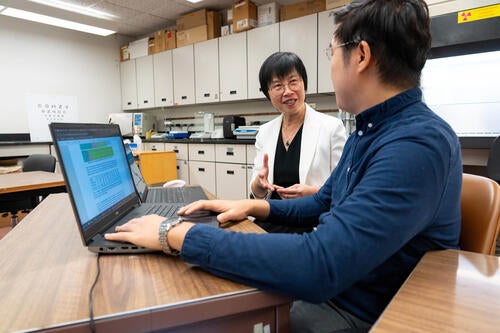 In Ontario, they are partnering with medical researchers at the Princess Margaret Cancer Centre to understand how best to apply their technology strategically. They’re also collaborating with researchers from the Advanced Data Science Lab at Yonsei University in South Korea to explore its potential global impact.
“AI is powerful and exciting, but we need to focus on using it to build tools that will actually benefit people,” Hu says. “That development needs to be a collaborative process where you work with experts to create the tools they need to make the next world-changing breakthrough.”
“One of the most exciting things about this work is that we’re bringing together perspectives from so many disciplines,” Chen says. “That convergence combined with the power of AI makes discovery so much faster. It’s like before we were riding a horse from A to B; now we’re riding high-speed trains.”
In Ontario, they are partnering with medical researchers at the Princess Margaret Cancer Centre to understand how best to apply their technology strategically. They’re also collaborating with researchers from the Advanced Data Science Lab at Yonsei University in South Korea to explore its potential global impact.
“AI is powerful and exciting, but we need to focus on using it to build tools that will actually benefit people,” Hu says. “That development needs to be a collaborative process where you work with experts to create the tools they need to make the next world-changing breakthrough.”
“One of the most exciting things about this work is that we’re bringing together perspectives from so many disciplines,” Chen says. “That convergence combined with the power of AI makes discovery so much faster. It’s like before we were riding a horse from A to B; now we’re riding high-speed trains.”
Source link
Professor, School of Public Health Sciences
Faculty of Health Developing new drugs is a tough job that can cost billions and take years or even decades. Whether researchers are figuring out how two drugs might interact or finding new uses for an existing medication, the path in pharmaceutical research is often filled with setbacks and obstacles. A team of researchers at the University of Waterloo is using machine learning to speed up drug development significantly. “We have a lot of existing data across a broad spectrum of medical domains, but it’s extremely complex, and often not as complete or extensive as we would like,” explains Dr. Helen Chen, professor of practice in Public Health Sciences. “It’s like a very shallow ocean.” Chen collaborated with Bing Hu, a Ph D candidate in Computer Science, to create a machine learning model that analyzes and synthesizes vast amounts of pharmaceutical research data to predict how drugs will behave and interact. To accurately depict how drugs affect the body, they brought in Dr. Anita Layton, an Applied Mathematics professor known for her international work on mathematical models related to the kidneys. “Often, when we use machine learning to train neural networks, we’re starting from scratch,” Hu says. “But by drawing on the enormous amount of domain specific knowledge coming from biology and medicine, we’re able to build more efficient, more accurate models whose predictions consistently match-up with existing data from the real world.” The team’s model can forecast how a drug may interact with specific protein targets and what its effects could be in terms of efficacy and safety. “Personalized treatment is the next frontier in medicine,” Chen says. “Machine learning research like this is putting that treatment in the hands of everyone.” The research team’s collaboration extends beyond campus boundaries. They are working with experts worldwide to gather data, develop hypotheses and make laboratory as well as clinical trials more effective.
In Ontario, they are partnering with medical researchers at the Princess Margaret Cancer Centre to understand how best to apply their technology strategically. They’re also collaborating with researchers from the Advanced Data Science Lab at Yonsei University in South Korea to explore its potential global impact.
“AI is powerful and exciting, but we need to focus on using it to build tools that will actually benefit people,” Hu says. “That development needs to be a collaborative process where you work with experts to create the tools they need to make the next world-changing breakthrough.”
“One of the most exciting things about this work is that we’re bringing together perspectives from so many disciplines,” Chen says. “That convergence combined with the power of AI makes discovery so much faster. It’s like before we were riding a horse from A to B; now we’re riding high-speed trains.”
Source link