


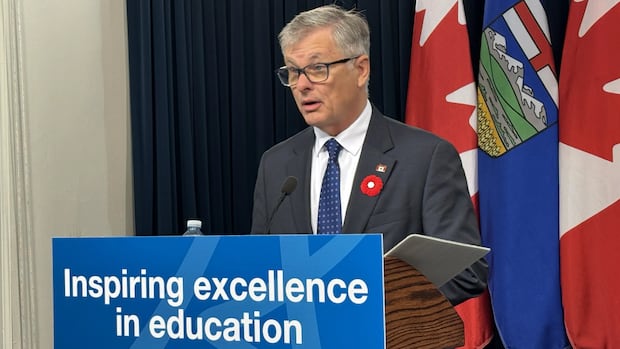
If the Alberta Legislature approves a new bill introduced by the United Conservative government on Tuesday, universities will be required to maintain neutrality and uphold freedom of expression.
Bill 38, known as the Advanced Education Statutes Amendment Act, 2026, suggests amendments to the Post-secondary Learning Act.
Myles Mc Dougall, Alberta’s minister of advanced education, mentioned that while institutions must remain neutral, individuals within those institutions won’t be subject to the same rule.
“The underlying political reasons why things are happening and the position as to who’s right or wrong, et cetera, that is not the role of the institution to take,” Mc Dougall stated during a news conference at the Alberta legislature.
“But certainly the people within the post-secondary system – students, faculty [and] administrators – are free to express their opinions.”
This legislation comes after a notable incident where the University of Lethbridge canceled an on-campus lecture by former Mount Royal University professor Frances Widdowson in 2023.
Widdowson has been vocal about her controversial views. In 2020, she attracted attention for claiming that residential schools offered educational advantages to First Nations children.
In September, a Court of King’s Bench justice decided that canceling Widdowson’s lecture was incorrect on behalf of the university.
Bill 38 also aims to limit tuition fee hikes for Canadian students attending post-secondary institutions in Alberta to two percent in 2027-28. Mc Dougall did not provide details about what might happen afterward.
Additionally, this bill sets minimum standards for student codes of conduct which will be detailed in regulations released later on.
Mc Dougall announced that Alberta would stop factoring parental income into student loan eligibility assessments.
He noted this change could free up around $118 million in extra loans from within the existing student loan budget.
Expert panel
In 2025, an expert panel led by economist Jack Mintz proposed 11 recommendations for universities, colleges and polytechnics across the province.
The panel suggested that all public post-secondary institutions should be required to stay neutral and promote freedom of expression. They also recommended updating Alberta’s funding model for these schools based on enrollment numbers, performance metrics and base funding levels.
MLA David Eggen, who critiques advanced education for NDP, said Mc Dougall seems to have selectively chosen parts of Mintz’s report without addressing funding issues directly.
Eggen pointed out that many students struggle with tuition costs alongside rising living expenses and argued that Bill 38 doesn’t assist them with these challenges.
“Instead, it’s looking for some diversions around culture wars, around code of conduct for students and institutional neutrality – things that mean very little when our advanced education system is already under serious stress from a lack of funding from this government,” Eggen remarked.
Concerns about future tuition rates beyond the 2027-28 academic year have been raised by members of the Alberta Students’ Executive Council (ASEC).
ASEC chair Rylee Mae, a student at the University of Lethbridge, expressed worries stating even if tuition increases are capped; it can still be unaffordable for many students.
“A tuition ceiling still needs safeguards on how quickly tuition can rise so students need to be able to plan for completing their education,” she explained.
Source link