




The Hoover Institution (Stanford, CA) – Many of the remarks about the current state of the American Republic, the presidency, and America’s future made recently are exaggerated and not based on a solid grasp of similar times in US history.
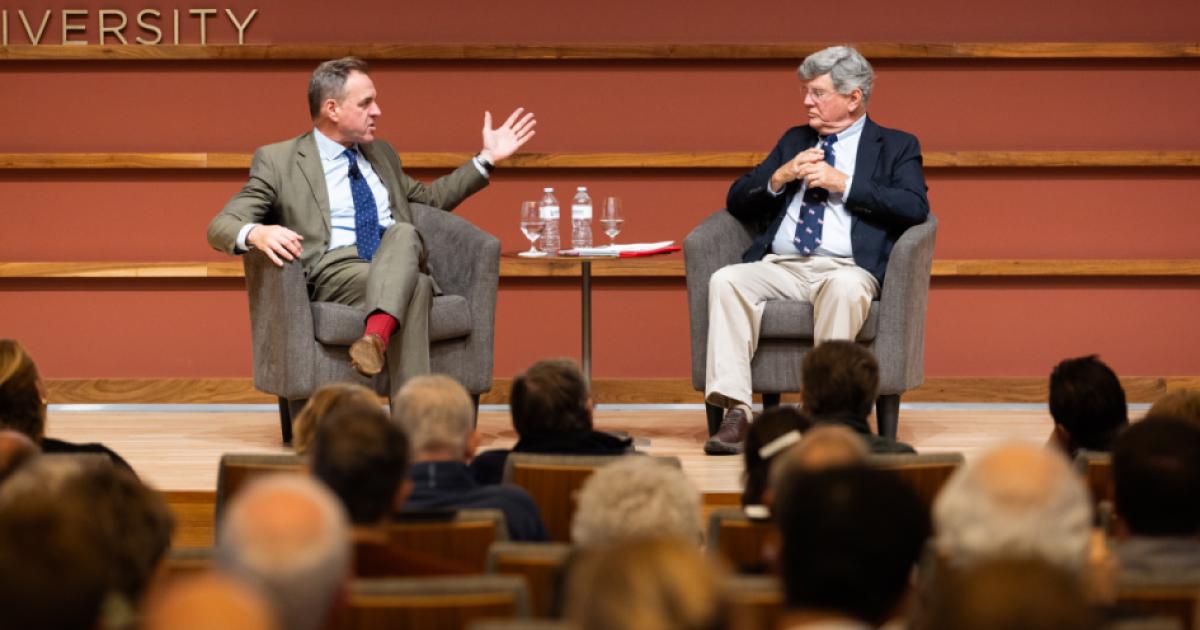
During the latest event in the Ideas That Made U. S.: Dialogues on Freedom speaker series titled “The American Presidency: A 250-Year Perspective,” held on October 20, Hoover fellows Sir Niall Ferguson and David M. Kennedy thoughtfully discussed whether exaggeration fully accounts for today’s concerns regarding US politics.
The Hoover Institution initiated this yearlong series to commemorate America’s 250th anniversary. Kennedy and Ferguson examined trends that have surfaced in US democracy over the last decade, using insights from 250 years of American history as context.
They explored contemporary observations about today’s presidency with an emphasis on recent events while sharing their insights about past administrations. They illustrated that much of what is happening now stems from larger societal shifts and can be compared to actions taken by presidents in earlier periods.
Ferguson encouraged attendees to reflect on whether recent events suggest any risk of America moving towards tyranny.
“The big question, and it’s been looming over us for more than ten years, is ‘Are we at some existential moment of risk for the American Republic?’” he stated.
“Republics tend to transform into tyrannies. That was a lesson learned from ancient history. It was a concern for the founders as they worked to create a constitution for a lasting republic. Two hundred and fifty years is quite an achievement for a republic.”
Ferguson mentioned that modern comparisons of President Donald Trump to today’s or historical autocrats are often overreactions, failing to recognize a period in American history that provides a clearer understanding of Trump.
“Trump is a quintessentially American figure. It’s just that he refers back to an earlier era of American history than most people are familiar with,” Ferguson explained, referencing presidents like Andrew Jackson, William Mc Kinley, or Theodore Roosevelt – mixed with some elements reminiscent of P. T. Barnum.
“Trump embodies traits typical of late-nineteenth-century and early-twentieth-century figures [based on] topics he discusses: tariffs, immigration limits, easy money, [or] his Corollary defining US policy in the Western Hemisphere.”
If these policies-like global tariffs and immigration restrictions-are viewed unfavorably by citizens according to recent polls, Ferguson noted this reaction mirrors how second-term presidents’ initiatives generally fare during most modern administrations.
“He’s merely another second-term president facing what all second-term presidents encounter as midterms approach. Everyone gets tired around this point; there are hardly any exceptions.”
Building on Ferguson’s viewpoint, Kennedy highlighted that besides the presidency itself, Congress isn’t adequately holding the executive branch accountable-a sentiment echoed by then-graduate student Woodrow Wilson in his thesis in 1885.
Wilson pointed out back then that no one stood responsible for government policy within Congress: “A dozen men originated. A dozen compromises twist and alter it. A dozen offices whose names are scarcely known out of Washington put it into execution. Policy can be neither prompt nor straightforward when it must serve so many masters.”
Kennedy asked if we couldn’t make similar observations about Congress today.
“You have to pinch yourself to realize those words were written almost 150 years ago,” he remarked.
Kennedy also addressed today’s stark urban-rural divide between wealthy urban areas leaning Democrat versus poorer rural regions favoring Republicans.
“We’ve sorted ourselves into increasingly isolated geographical areas where we express our political opinions,” he noted.
A prime example comes from jurisdictions supporting Democrats in the 2024 US presidential election which accounted for nearly two-thirds of economic output across America.
“Of approximately 430 counties that voted for (Kamala) Harris-(Tim) Walz ticket in 2024, those counties represented 62 percent of gross domestic product,” Kennedy shared.
“Predominantly successful economic regions backed Harris/Walz while less prosperous areas overwhelmingly supported their opponents.”
He also added that currently half of America’s population lives within just 146 out of more than 3,100 counties nationwide.
In discussing each other’s presentations further along , Ferguson reflected upon how Kennedy’s trends might have unfolded regardless who occupied The White House every four years.
“These significant trends within our society , alongside governance systems , exist somewhat independently from who actually wins elections ,” he stated.
However , later Kennedy expressed his belief regarding this particular moment might be seen down-the-line as something greater than just another usual slump experienced by second-term leaders.
“My instinct suggests we’re facing a crisis deeper than typical ones. This feels worse than mere ‘snafu.’ It feels like ‘snafu’ squared,” he said humorously employing an old World War Two-era term. Low trust among institutions coupled with polarization creates quite an explosive mix.
Both Kennedy and Ferguson reiterated numerous times throughout their discussion emphasizing that essential fact influencing any dialogue surrounding today’s presidency versus past ones lies within founders’ intention behind designing checks-and-balances meant restraining executive power significantly making radical changes consistently challenging.
“It’s established system difficulties persistently present challenges faced historically. That concern concerning concentrated powers shaped founders’ designs which ultimately led toward federalized systems difficult navigating quickly through issues requiring rapid responses.” said Kennedy.
“Their apprehensions surrounding concentrated authorities created limitations evident across our governmental framework presenting substantial hurdles its use amidst fluctuating circumstances remains unresolved regarding adequacy aligning broader challenges encountered across time.”
Check out or learn more about additional Ideas That Made U. S. lectures here.
Source link