



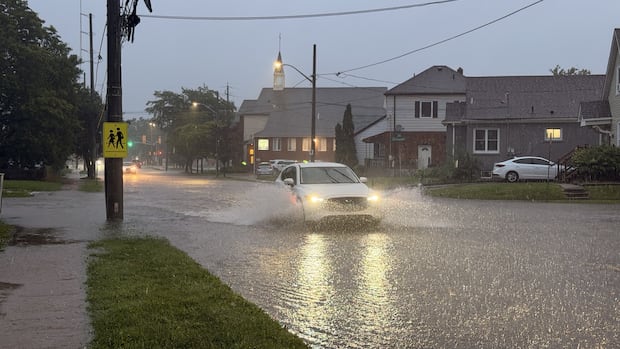
In St. Catharines, Ont., the aftermath of recent flooding is still visible along the streets.
Discarded couches, mattresses, and drywall are piled up outside homes, serving as a reminder of the destruction caused by several major storms in just under two weeks.
“We had three major storm events,” Mayor Mat Siscoe mentioned on Tuesday. “These storms are the largest this city has ever experienced in such quick succession over 11 or 12 days.”
Siscoe explained that while the first storm was mostly managed by the stormwater system, the ground was already saturated when the second and third storms arrived, leaving the system unable to cope with the excess volume.
This resulted in widespread overland flooding and sewage backups into residences.
“In many cases, it was sewage that was coming into the home,” Siscoe said.
‘They’re back under water again’
Dave White runs White Orchard Farms near St. David’s where he grows garlic on nearly nine hectares close to Niagara Escarpment.
His fields were entirely flooded during the latest storms; however, he managed not to lose any crops.
“Fortunately, we harvested our garlic a week before the floods,” White stated.
He took preventive measures based on last year’s experience when heavy rains hindered his ability to harvest all his crop and led to losses due to what he’s observed over recent years.
“We’ve been ensuring our ditches are clear and our fields can manage excess water,” White noted. “We created some trenches in our field to help redirect some of that water away because of what we’ve seen over the last four or five years.”
WATCH | How grape growers from Niagara-on-the-Lake are dealing with rainstorms:
How grape growers from Niagara-on-the-Lake are dealing with back-to-back rainstorms
Grape farmers in Niagara are racing against time to save their crops after two intense rainstorms flooded thousands of homes and businesses within days.
White also runs a restoration company. He shared that he’s been overwhelmed these past few weeks with calls from homeowners whose properties have been affected by flooding.
“It’s disheartening because I’m getting calls about jobs I did three or four years ago that are now underwater again.”
Sometimes cleanup efforts were completed just before another storm hit.
“These folks have been pumping out their basements,” White said. “Then two days later, we get hit by a storm that’s even worse.”
“People are desperate for help and they just want to rebuild.” p >
White fears that unless there’s genuine investment in updating drainage sewage infrastructure- which he says is being stressed partly by new housing developments-flooding will only worsen over time.
“We’re operating old sewage plants that have existed for 150 years while tripling their intake capacity.”
System built 150 years ago
Siscoe mentioned that no blockages or specific infrastructure failures causing flooding have been identified by city officials.
Instead, he clarified that it’s simply an overwhelmed system.
“What failed was 150 years of history.”
This reflects challenges faced across Canada. p >
The latest data from Statistics Canada indicates that more than 11 percent of Canada’s water and wastewater systems are reported to be either poor or very poor condition. P >
Much of older St. Catharines was constructed using combined sanitary and storm sewers. Newer areas do have more separation; however, only about 30 percent of the city features separate stormwater infrastructure according to Siscoe.
He stated expenditures on sewer systems have increased significantly-tripling investments into sanitary and storm sewers over ten years while doubling capital budgets in four years.
However replacing entire systems would amount to billions in costs since there aren’t enough contractors available for swift replacement work according mayor’s statements about insufficient labor resources alongside cost concerns too
Anke Smit director Center Cities University Windsor told CBC May “cash resource strapped municipalities struggle”
“It is discouraging see lack priority given climate mitigation,” she added emphasizing climate change should integrated land use infrastructure planning decisions
“Climate change needs run full gamut municipal governance but isn’t yet.”
P>The recent rainfall around Niagara surpassed levels used when designing much regional drainage setups
Adam Keane Engineering Manager Upper Canada Consultants statesP>Their Storms exceeded known thresholds considered hundred-year-events meaning one-percent chance happening year
Keane revealed St. Catharines received roughly102 mm rain twelve-hour timeframe while certain parts recorded140 mm less than hour
P>The issue worsened proximity between these storms
Their occurrence compounded effects each other
If either occurred alone would likely overload drain systems
P>Siscoe concluded saying “the system actually operated quite well under circumstances…”
Sewer treatment facilities endured flows averaging four-five times normal levels upon arrival massive rainfall volumes exceeding treatment capabilities leading state bypass processMack Lambert confirmed existing structures designed functionally efficient regarding beyond constraints presented new developments accountability rests among extreme weather events rather than projects themselves