




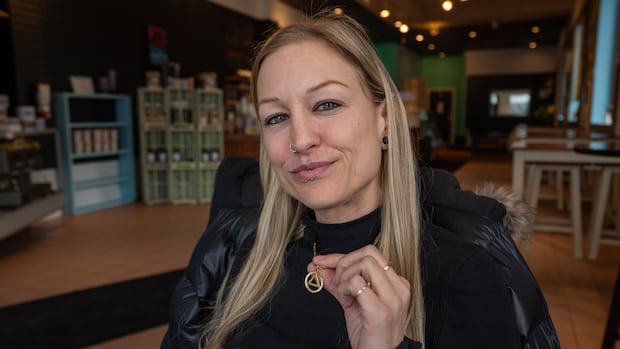
Tara Johansson shares that she spent years trapped in a “vicious cycle” of alcoholism and addiction, but now she’s helping others find recovery in Thunder Bay, a city with the highest opioid-related death rate in Ontario.
Born in Thunder Bay and raised in Peterborough, Johansson left home at 14 and has lived in the northwestern Ontario city ever since.
Every time she found herself in trouble, “I always ran,” said Johansson, a 41-year-old mother of two.
Eventually, her issues caught up with her.
“Nobody knew how bad my addictions were because I was a ‘high-functioning’ addict and I was a social drinker,” said Johansson. “But nobody drank like I did.”
I’m at peace. I’m happy. I get to come to work, and I get to tell my story and I get to be somebody – a light to somebody.- Tara Johansson
Today, Johansson has been sober for over 5½ years. She works as the membership and programming co-ordinator for People Advocating for Change Through Empowerment (PACE), which runs a drop-in centre on the city’s south side.
“I’m at peace. I’m happy,” she stated. “I get to come to work, and I get to tell my story and I get to be somebody – a light to somebody.”
As she reflected on her journey towards recovery, she remembered going to an emergency room with a subdural hematoma the size of a softball. The doctor informed her that her blood alcohol level was 0.45, which can be lethal.
“I wore that as a badge of armour,” said Johansson. “I would get blackout drunk and then I would go use [drugs]. For me to be alive today, it’s a miracle.”
‘Until they want it, you can’t help them’
She mentioned using alcohol and drugs – including opiates, cocaine and crack cocaine – as ways to deal with mental health struggles.
Though she experienced several short periods of sobriety, she had difficulty addressing the underlying trauma she faced.
Tara Johansson, seen at the waterfront in Thunder Bay in the spring, says walking and running has helped support her recovery journey. (Marc Doucette/CBC)
“I was not emotionally sober. I was a wreck. I was angry. I was what they call a dry drunk.”
After suffering abuse from her partner, she reached out to Faye Peterson House where she was encouraged to join Alcoholics Anonymous-a program she’d tried before.
“I didn’t want to do it because I was embarrassed; I was ashamed,” Johansson recalled.
However, after getting matched with a sponsor and finding housing, “we got down to the root of me.”
“I am the root of all my problems. Yes, these things were done to me; but I could have [sought out] help.”
Johansson works at People Advocating for Change Through Empowerment (PACE), an organization that runs a drop-in centre on Thunder Bay’s south side. (Marc Doucette/CBC)
The PACE staff have firsthand experience with challenges like homelessness, addiction or mental health issues faced by clients.
The clients receive food clothing along with access to washrooms showers laundry facilities as well as various programs offered by staff who can also connect them with other health services.
“Until they want it you can’t help them. You can love them – that’s all we can do,” said Johansson. “And that’s my job. I love them.”
Calls for more detox beds treatment centres
The opioid-related death rate in Thunder Bay exceeds five times the provincial average-52.72 per 100000 population compared with 8.96 per 100000 across Ontario according to data from the Office of the Chief Coroner.
Johansson states that reaching recovery required addressing why she started using drugs or alcohol initially.(Sarah Law/CBC)
Johansson expressed wanting more treatment centers available locally so people won’t wait too long when they’re ready for help because there’s only limited time before they change their minds.
“If they’re truly ready they need immediate access into detox; those beds must be available,”she pointed out.
“There aren’t enough options available right now! We could refer people elsewhere but having more resources here would make such an impact.”
Simplifying barriers towards seeking assistance
Kandace Belanger oversees street outreach harm reduction sexual health initiatives at Thunder Bay District Health Unit(TBDHU).
Accordingly, she mentions access concerning recovery beds along similar resources remains significantly restricted across northern Ontariocomparedto other parts within this province.
Furthermore, she identified stigma surrounding substance abuse especially within healthcare systems serves one major obstacle preventing individuals from pursuing assistance.
Other considerations such stable housing income security transport medications alongside mental health care play significant roles too added Belanger.Kandace Belanger manages street outreach harm reduction sexual health programs within Thunder Bay District Health Unitstatededucatingeveryoneonwhat Harm Reduction actually involves is vital.(Sarah Law/CBC)
“Recovery isn’t something achieved through linear paths; it often appears nuanced individualistic showcasing ups downs sometimes relapses observed aren’t failures rather steps made towards progress,”she noted.
Belanger echoed famous quote originated from British journalist Johann Hari:” ‘The oppositeofaddictionisconnection.'”
“It falls upon entire communities’ shoulders supporting recoveries tackling stigma while ensuring evidence based treatments accessible supplyingharmreductionservices.”
“We know this serves great opportunity connecting tackling poverty housing issues keeping individuals entrenchedaddictions reducingbarriersagainstrecovery.”
*Johansson’s message directed toward those struggling indicates nobody’s beyond hope.*
*“Recovery remains achievable-it lies within reachfor anyone,”*she proclaimed.
*”No matter where you’ve been or actions taken.. someone awaits your return.”*
Source link