





Local News
Jun 28, 2019 • Last updated 7 years ago •
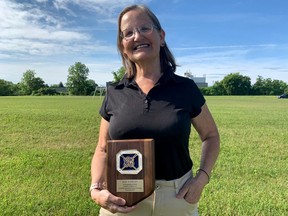
Sue Fairley of Port Dover was presented a 2019 Award of Excellence from the Canadian Secondary School Rowing Association in early June. Ashley Taylor/Delhi News Record
A woman from Norfolk County has been recognized for her dedication to high school rowing.
This has not loaded yet, but your article continues below.
Sue Fairley from Port Dover received an award of excellence from the Canadian Secondary School Rowing Association. The award was given during a ceremony in St. Catharines on June 2.
Fairley was one of the founding members of the Silver Lake Rowing Club in Port Dover back in 1998. She then established the Port Dover Composite School rowing club in 1999, and within five years, she was coaching top performers from Simcoe Composite School and Holy Trinity Catholic High School.
While her husband worked, Fairley stayed home with their four children. They needed a babysitter to look after the kids during her early morning practices that started at 5:30 a. m.
“When my husband worked weekends the kids just got to come to a lot of regattas,” said Fairley.
The clubs had access to about 700 metres of rowable water on Silver Lake in Port Dover where they practiced for longer races of up to 2,000 metres.
During practice sessions, they would stop at the end of their designated stretch at the 700-metre mark, turn around, and start again. This became an issue when Fairley noticed her rowers slowing down around that same point during races since it was where they typically turned during practice.
This has not loaded yet, but your article continues below.
Rather than seeing this as a setback, Fairley viewed it as a chance for improvement.
She incorporated more cross-training on land into their routines to compensate for the cardio lost by having to turn around in practice.</t
This limited space also helped them prepare better for regattas since new teams often struggle with turning around and backing up into starting gates. For Fairley’s rowers, this wasn’t an issue due to their frequent practice on navigating turns in their training pond.</t
Their experience allowed them to sit comfortably at the starting gate while watching other teams navigate turning and backing up-a great confidence boost before competing.</t
“Sue’s focus was totally on the athlete,” said Jim Dover, president of the Silver Lake Rowing Club. “It didn’t matter if they were a high performer or not; she just wanted to get the best that they could do. That’s what she kept them focused on-just doing better.”</t
Fairley coached students from SCS, HT, and PDCS throughout the year; thus they’d have to face each other during competitions over the school year.<t
</tThis has not loaded yet, but your article continues below.<t
><t
>“I also coached summers so they’d all have to come together in one crew during summer,” said Fairley. “They developed a lot of respect.”<t
The season for competitive rowers kicks off in October when training begins on land five days per week for two hours each day. Competitions occur every other weekend starting January in cities like London or Toronto where coaches spend entire days supporting their athletes as they compete. After indoor events wrap up by April, outdoor competitions begin and continue until August.<t
>Fairley dedicated countless hours coaching and focusing on training programs throughout rowing season.<t
>“She’d be on water from April till August. They’d be out at Silver Lake at 5:30 every morning until about 8:30 a. m., seven days a week,” said Dover. “That’s just her time spent with athletes; then there’s preparation time for training regimens or registrations-it felt like a full-time job once she hit the water.”<t
>Two athletes that Fairley coached-Laura Fisher and Anna Ardiel-received full scholarships based on their rowing performance at Duke University and University of Louisville respectively. Many others went on to represent Canadian schools such as Mc Master University, Western University, and University of Guelph.<t
>Fairley learned she was receiving this award back in April.<t
“It was a peer from an opposing club that nominated me,” said Fairley.”I was kind of shocked because our club has been in limbo.”<t
Source link
Source link