





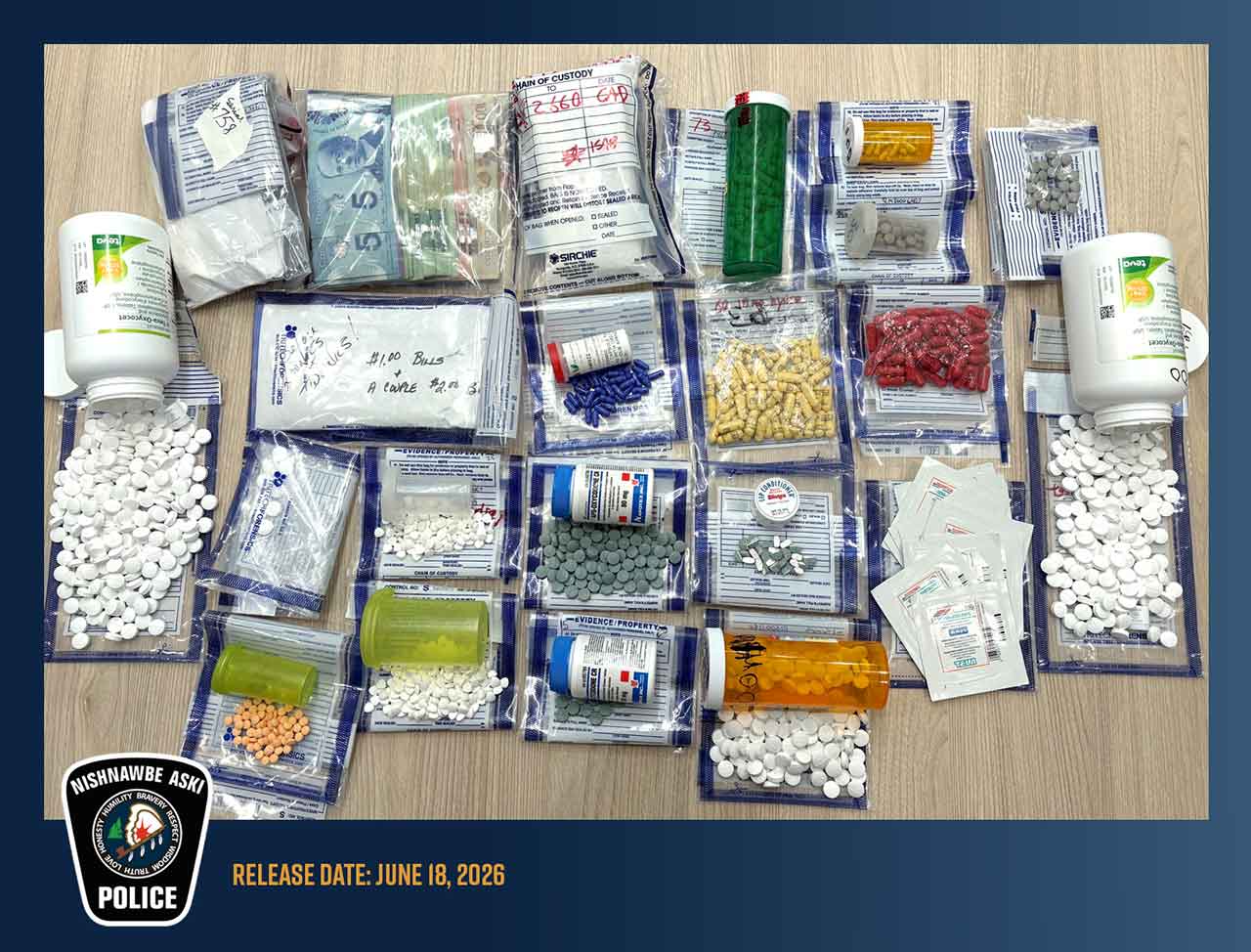
THUNDER BAY – A 72-year-old man from Thunder Bay has been taken into custody and charged after police reportedly seized suspected fentanyl, oxycodone, morphine, hydromorphone, cash, and drug trafficking tools during a search on Court Street South.
The Nishnawbe Aski Police Service mentioned that the search was part of an ongoing probe into drug trafficking activities believed to be starting in Thunder Bay and affecting Northern Ontario First Nation communities, including Aroland First Nation.
Police say the operation focused on trafficking routes into First Nation areas
Officers from the Nishnawbe Aski Police Service Intelligence Unit, with help from the OPP’s Thunder Bay Community Street Crime Unit, carried out a search warrant on Wednesday, June 17, at a home in the 200-block of Court Street South in Thunder Bay.
Authorities stated that the warrant was obtained as part of an investigation into suspected drug distribution from Thunder Bay to First Nation communities across Northern Ontario.
During the search of the residence, officers reported finding suspected hydromorphone pills, morphine, oxycodone pills, fentanyl, nearly $10,000 in cash and equipment related to drug trafficking.
The estimated street value of the confiscated drugs is over $107,000.
A male suspect was found inside the property and arrested without any issues.
Charges filed
A 72-year-old man from Thunder Bay faces charges including:
Possession of fentanyl for trafficking;
Possession of morphine for trafficking;
Possession of hydromorphone for trafficking;
Possession of oxycodone for trafficking; and
Possession of property obtained through crime over $5,000.
The accused has been released with conditions and is set to appear in court at a later date.
The name of the accused will remain private until formal charges have been sworn before the courts.
The investigation is still ongoing.
Legal context: drug distribution and illegally acquired property
The four drug-related charges are under section 5(2) of the Controlled Drugs and Substances Act. This law makes it illegal to possess a controlled substance with intent to traffic. Fentanyl, morphine, hydromorphone and oxycodone are all regulated substances listed under Schedule I of this Act.
The maximum penalty available for possession with intent to traffic for Schedule I substances can be life imprisonment. Actual sentences vary greatly depending on factors like how much drugs were involved, the role played by the accused person, their previous record, risks posed to community safety, aggravating or mitigating circumstances as well as evidence presented in court.
The charge regarding property falls under section 354(1) of Canada’s Criminal Code. This applies when someone is alleged to possess property or proceeds knowing it was gained through an indictable offence. If valued over $5,000 as stated in section 355 allows prosecution either as an indictable offence with up to ten years imprisonment or as a summary conviction based on Crown election.
Why this matters for Thunder Bay and Northwestern Ontario
Thunder Bay acts as a regional hub for services like transportation and justice within Northwestern Ontario. Police investigations into drug trafficking frequently focus on this city since it can act as a base point for drugs entering smaller or more isolated communities.
For First Nation communities affected by illegal opioid trade can experience serious consequences. Many lack sufficient access to addiction treatment services or mental health care resources along with emergency medical help and law enforcement support.
A shipment that may seem minor in an urban area can have significant impacts in remote locations where support services are already stretched thin.
Presumption of innocence
No allegations have been established in court yet.
All individuals facing accusations are considered innocent until proven guilty within a legal setting.
Source link