




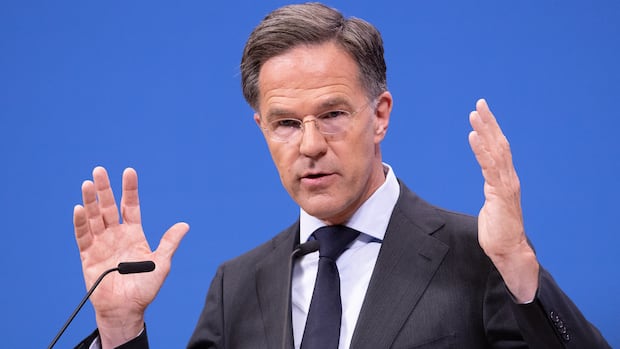
Canada and other NATO countries need to provide specific, “credible” plans for meeting the alliance’s new defense spending goals when leaders gather next month in Turkey, says NATO Secretary General Mark Rutte.
This request is important for Prime Minister Mark Carney’s government, which has faced recent criticism from high-ranking Pentagon officials who claimed Canada hasn’t shared these details with Washington.
Rutte talked with reporters in Brussels on Wednesday ahead of the upcoming meeting of NATO defense ministers, the final assembly before leaders meet in Ankara.
“I expect nations to present clear, concrete and credible plans to reach that goal, ideally well ahead of the agreed timeline,” Rutte stated. “Many are already showing that they are doing exactly that. The numbers are clear. We saw a massive increase in defense investment in 2025, with European allies and Canada boosting their core defense investments by over $90 billion US.”
WATCH | Canada hit NATO’s decade-old target this year: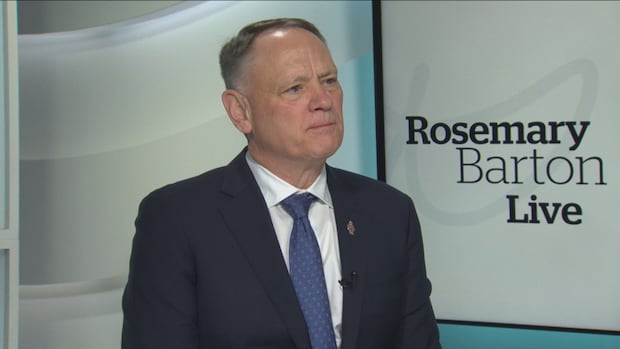
Canada’s met its NATO defence spending target. What’s next?
CBC’s Rosemary Barton speaks to Minister of National Defence David Mc Guinty about Canada recently reaching the NATO target of two per cent of GDP spending on defence, what this says about the current state of global security, and how challenging it might be to maintain this level of spending.
The U. S. Department of War officials last month suspended participation in the Permanent Joint Board on Defence (PJBD), a bilateral forum between Canada and the U. S. that goes back to World War II.
In stepping back, Pentagon officials pointed out Canada’s reluctance to outline a clear plan for increasing defense-related spending to five percent of gross domestic product by 2035 as mandated by NATO. They also expressed frustration that a classified document given to Canada regarding collective North American defense priorities did not provide what one U. S. official described as a “credible” response.
Carney mentioned that achieving the NATO five percent GDP goal (3.5 percent directly on military expenses and 1.5 percent on defense infrastructure) could cost up to $150 billion annually when fully implemented. Currently, Canada spends around $63 billion each year on defense.
The Department of National Defence didn’t include five-year spending projections in the last federal budget and hasn’t responded to multiple journalists’ requests for those figures.
<p. Last month, Elbridge Colby, director of policy planning at the Pentagon, remarked on social media that the United States "can no longer avoid the gaps between rhetoric and reality" concerning Canada's stance.
National security researcher Christy Somos also discovered that the United States Army National Guard has paused its involvement in an annual summit for Canadian-U. S. military officers. Canada’s Defence Department confirmed that meetings for Army Reserve General Officers Advisory Board have ceased.
President of the European Commission Ursula von der Leyen, front left to right, Prime Minister Mark Carney, Secretary General of NATO Mark Rutte and President of Ukraine Volodymyr Zelenskyy talk prior to a meeting in May. (Sean Kilpatrick/The Canadian Press)
On Wednesday, U. S. Homeland Security Secretary Markwayne Mullin expressed concern over the “fracturing” relationship between Canada and America and said it must be repaired for both nations’ security needs. Mullin made these comments during a fireside chat with Canada’s public safety minister Gary Anandasangaree in Washington.
Senior Canadian officials speaking anonymously recently regarding increased U. S pressure said plans for reaching five percent will be prepared and presented by Canada at July’s gathering with all NATO allies.
They dismissed Pentagon criticism as not coming from White House sources.
Defence Minister David Mc Guinty is set to participate in discussions with his fellow NATO members this week in Brussels.
Rutte downplayed concerns over U. S plans to significantly reduce conventional military forces allocated for rapid responses within NATO during crises.
While maintaining its nuclear deterrent umbrella over Europe, America is scaling back its contributions under what’s known as the NATO Force Model – which details what each country would contribute if war were declared.
The cuts include substantial reductions in fighter jets, strategic bombers, air-to-air refueling planes and drones; along with decreasing submarines-including those capable of launching cruise missiles-and halving destroyer availability for NATO purposes.
The Trump administration also announced plans to withdraw 5,000 soldiers stationed in Germany while canceling a planned rotation involving more than 4,000 American troops destined for Poland.
“European allies have already stepped up efforts,” Rutte noted concerning filling some gaps left behind by these reductions.
“Some portray this as an issue where America pulls away from its allies; but that’s not accurate,” Rutte clarified.
“The U. S has made it clear they remain committed towards supporting NATO-this commitment carries an expectation that allies share responsibilities more evenly regarding our security here within Europe…“They’ve indicated their nuclear deterrent remains strong while emphasizing it’s crucial Europe alongside Canada do more conventionally understanding America’s obligations globally.”
Source link