






What led University of Waterloo researchers to create a healing gel inspired by a sea creature? CTV’s Spencer Turcotte has the story.
A gelatin-based substance modeled after sea cucumbers might one day assist people in recovering from tendon injuries, serving as an alternative to standard surgical stitches.
The team at the University of Waterloo has created a gel aimed at fostering new tissue growth in injured tendons. This material imitates how marine creatures can alter their body stiffness and flexibility.
This stretchy slime-like substance could eventually act as a temporary scaffold for damaged tissues to regenerate, potentially enhancing healing and lowering the chances of re-injury.
“We get inspiration from sea cucumbers,” said Yimin Wu, a mechanical engineering professor at the University of Waterloo.
sea cucumber A person holding a sea cucumber. (Source: Kindel Media/Pexels)
He noted that conventional tendon repairs typically depend on sutures, which may lead to repeated injuries and hinder patients’ full recovery.
The research group is investigating an alternative method – utilizing gelatin.
“We can use it and mix with water to make it into a gel. After that we use salt solution to modify,” explained Youchao Teng, a postdoctoral researcher involved in the project.
The resulting gel is intended to provide temporary support that encourages cells to grow and organize while damaged tendons heal.
“The cells really like it because the mechanical properties really match the surrounding tissues,” clarified Wu.
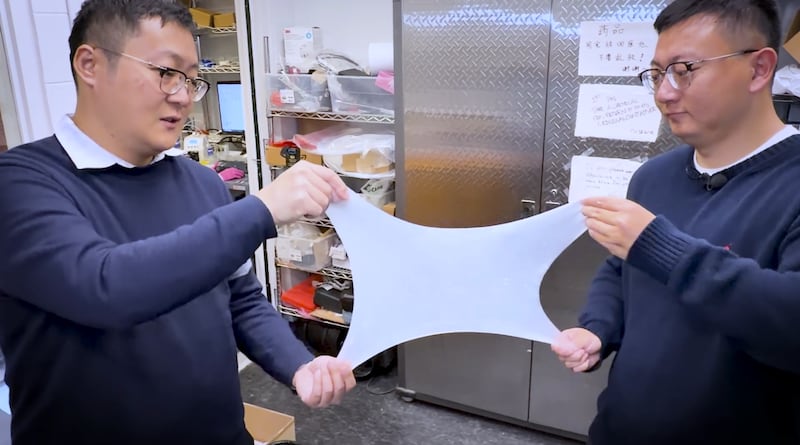
sea cucumber gelatin university of waterloo gel Yimin Wu and Youchao Teng, from the University of Waterloo, hold up the gel inspired by sea cucumbers on Oct. 21, 2026. (Spencer Turcotte/ )
In experiments with rats suffering from tendon injuries, researchers discovered that this gel promoted more organized tissue growth compared to using stitches alone.
Another potential benefit is that this material is designed to decompose naturally within the body over time.
“This can degrade in human bodies in eight weeks and we don’t need to do secondary surgeries to take it out,” said Wu.
However, this technology is still in its early development phase.
“The next step is doing big animals like pigs or horses and then after that, we will do clinical trials and then finally get FDA approval,” Wu stated.
Researchers think that the relatively low production cost of this gel could also make it an attractive option if it becomes available for human treatments down the line.
For now, more testing is required to see if this sea cucumber-inspired material can effectively enhance tendon healing in humans.
Source link