



The Kasabonika Lake First Nation in northwestern Ontario has temporarily halted an evacuation for its most at-risk members, as a group of five wildfires near the community have calmed down for now.
This remote Oji-Cree First Nation declared a state of emergency over the weekend due to increasing wildfire activity. The first group of evacuees was flown out Sunday evening, landing in Thunder Bay before continuing their journey south to Toronto.
Kasabonika Lake’s Chief Matthias Anderson stated that as of Thursday afternoon, there are 548 evacuees currently in Toronto and another 37 en route from Thunder Bay.
The evacuees represent nearly half of the First Nation’s population, primarily including elders, children, expectant mothers, and individuals with health issues. This marks the community’s first evacuation in two decades.
“It changes by the hour, this fire situation, so it’s been stressful for most of us,” Anderson said.
“Right now it has calmed down. I’m hoping things will be better.”
Fire and smoke captured by a resident of Kasabonika Lake First Nation earlier in the week. (Lloyd Lawson)
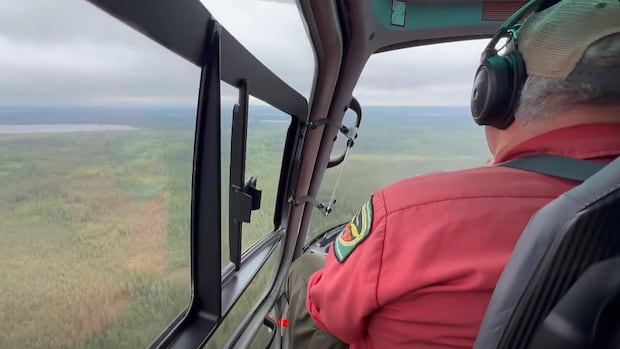
As of Thursday afternoon, there are more than seventy active wildfires in Ontario’s northwest region. Out of these, 21 fires are not contained, seven are being managed, four are under control, while others are still being monitored.
Some recent rainfall has provided some relief for firefighting teams in the far north; however, thunderstorms have introduced new challenges – generating thousands of lightning strikes across the area, according to Chris Marchand, fire information officer with Aviation, Forest Fire and Emergency Services in the northwest.
“Precipitation has been highly localized; some regions received significant rain while others remain quite dry,” Marchand said.
“We’re seeing many detection aircraft focusing on areas that experienced lightning activity to look for any new fires that may be smoldering underground.”
The forest fire hazard levels vary from low to high across the northwest region with an extreme hazard zone noted in the Thunder Bay-Ignace district.
“Wildland fire hazard levels change regularly based on weather and field conditions; we just ask that residents check local conditions before conducting any outdoor burning,” said Marchand.
Navigating changing conditions
The largest fire in northwestern Ontario is called Sioux Lookout 1 and spans more than 17,200 hectares since it ignited on May 30.
The biggest fire near Kasabonika Lake is Nipigon 16 which measures over 1,470 hectares.
A fire known as Sioux Lookout 21 is situated about nine kilometers south of Wunnumin Lake First Nation’s airport.
Chief Archie Wabasse of Wunnumin Lake First Nation is seen in Thunder Bay, Ont., in this June 2026 file photo. (Marc Doucette/CBC)
However, Chief Archie Wabasse told Thursday afternoon that this blaze is moving away from their community.
“The response we got from the MNR (Ministry of Natural Resources) was really good,” Wabasse said.
Back at Kasabonika Lake, Anderson mentioned he has gained valuable insights over these past days and appreciates support from both MNR and Emergency Management Ontario.
Community leaders continue monitoring developments to decide when evacuees might return home, he noted.
“I don’t think most personnel here were around for the last evacuation – we relied on older generations for guidance,” Anderson said.
Marchand encourages everyone who spots wildland fires to report them by calling 310-FIRE and checking out the Ontario Forest Fires website along with its interactive forest fire map for updates.
Source link