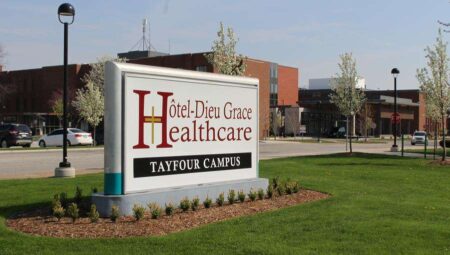






Heather Winterstein’s life might have been saved if she had received different and quicker treatment at the St. Catharines, Ont., hospital before she succumbed to sepsis, an infectious disease expert testified during the inquest into her 2021 death.
Dr. Dominik Mertz, a professor at Mc Master University’s medicine department, indicated that Winterstein had the best chance of survival on Dec. 9, the day she first visited the emergency department of what is now called Marotta Family Hospital.
Winterstein sought assistance for intense body pain, as revealed by testimonies during the inquest that began on March 30. However, the emergency room doctor who examined her dismissed any signs of infection and sent her home with Tylenol and advice to return if her symptoms worsened. The doctor concluded that “social issues” were behind her visit.
The following day, she returned to the hospital and was placed in a waiting area where she collapsed after spending 2½ hours there.
On Monday, Mertz stated that although Winterstein’s vital signs did not meet protocols under hospital screening criteria for treating sepsis during her visit on Dec. 9, he would likely have ordered blood tests and possibly additional lab work to check for infection signs like inflammation or organ failure.
“Those screening tools are not perfect,” he noted. “You miss 10 to 20 per cent of patients” with sepsis.
Sepsis results from a severe reaction to bacterial infections that can lead the immune system to damage healthy tissues and organs.
Since Winterstein’s passing, family members and community groups have raised concerns about whether addiction bias and anti-Indigenous racism influenced how she was treated. Winterstein is seen alongside her father, Mark Winterstein. (Submitted by Jill Lunn)
Earlier in the inquest, one witness who waited alongside Winterstein recounted thinking she appeared Indigenous; a triage nurse mentioned during testimony that they were unaware of Winterstein’s background.
Mertz is one of approximately 22 individuals expected to provide testimony over a span of 13 days before the coroner’s jury. Jurors are responsible for establishing facts in this case and may offer recommendations aimed at preventing similar deaths but do not assign blame or make judgments regarding guilt or innocence.
![]() Dr. Dominic Mertz, a professor at Mc Master University’s medicine department and infectious disease specialist, provided his testimony at Monday’s inquest regarding Winterstein. (Mc Master University)
Mertz remarked there was potential for saving her life through timely medical actions taken on both Dec. 9 and 10; however, he emphasized that “the first day was really our best chance.”
“If enough suspicion existed at that time or if further testing had occurred revealing any concerns then she’d likely stand a reasonable chance of surviving this,” even if necrotizing fasciitis were involved.
<
Necrotizing fasciitis is also referred to as flesh-eating disease-a rare but rapidly progressing bacterial infection capable of leading towards life-threatening emergencies including sepsis itself.
Sepsis can worsen significantly without proper treatment over time as every hour passes by according to Mertz; consequently diminishing chances for survival further by December 10 when Winterstein arrived back at hospital seeking help again.
Dr. Dominic Mertz, a professor at Mc Master University’s medicine department and infectious disease specialist, provided his testimony at Monday’s inquest regarding Winterstein. (Mc Master University)
Mertz remarked there was potential for saving her life through timely medical actions taken on both Dec. 9 and 10; however, he emphasized that “the first day was really our best chance.”
“If enough suspicion existed at that time or if further testing had occurred revealing any concerns then she’d likely stand a reasonable chance of surviving this,” even if necrotizing fasciitis were involved.
<
Necrotizing fasciitis is also referred to as flesh-eating disease-a rare but rapidly progressing bacterial infection capable of leading towards life-threatening emergencies including sepsis itself.
Sepsis can worsen significantly without proper treatment over time as every hour passes by according to Mertz; consequently diminishing chances for survival further by December 10 when Winterstein arrived back at hospital seeking help again.
The doctor who evaluated Winters t e i n ruled out an infection partly due its absence fever symptoms but according Mertz stated simply “We see patients presenting with sepsis even having normal temperatures.” The description given about Winters t e i n ‘s skin appearing gray while struggling walk along answering questions slowly during call made earlier December tenth should signal some severity underlying situation noted M e rtz. A swift blood test upon arrival established indicating multi-organ failure would’ve helped immensely suggested Dr. Mert z.<p. After collapsing around twenty forty-one PM ET doctors spent hours attempting revive unsuccessful unfortunately resulting ultimately declaring dead around eight forty-two PM. Lilles Jaan representing several doctors including physician treated Wins ters t e i n asked M e rtz whether bloodwork conducted possible shown lack organ dysfunction same day wouldn’t say impossible adding onset full blown septic shock generally observed within twenty-four forty-eight hour timeframe hence,”it’s more likely than not abnormalities existed ninth.” The initial step should’ve involved basic routine testing checking inflammation levels organ functions.” This inquiry continues today.
Source link
Infection ‘could have been identified’
An autopsy showed that Winterstein’s sepsis stemmed from two types of bacteria: streptococcus pyogenes and staphylococcus aureus. The fact that she used intravenous drugs-raising concerns about increased risk for blood infections due to contaminated needles-should also have served as a warning sign according to Mertz. If an infection had been confirmed or strongly suspected earlier on, then it’s possible she could have started antibiotic treatment which might have stopped her condition from escalating into septic shock. “You want to start antibiotics before that septic shock actually happens because that’s when mortality starts to increase quite significantly,” he said. “If there was any suspicion there that something infectious might have been going on-which I believe could have been identified looking back-then we could’ve had our best opportunity for successful intervention.”The doctor who evaluated Winters t e i n ruled out an infection partly due its absence fever symptoms but according Mertz stated simply “We see patients presenting with sepsis even having normal temperatures.” The description given about Winters t e i n ‘s skin appearing gray while struggling walk along answering questions slowly during call made earlier December tenth should signal some severity underlying situation noted M e rtz. A swift blood test upon arrival established indicating multi-organ failure would’ve helped immensely suggested Dr. Mert z.<p. After collapsing around twenty forty-one PM ET doctors spent hours attempting revive unsuccessful unfortunately resulting ultimately declaring dead around eight forty-two PM. Lilles Jaan representing several doctors including physician treated Wins ters t e i n asked M e rtz whether bloodwork conducted possible shown lack organ dysfunction same day wouldn’t say impossible adding onset full blown septic shock generally observed within twenty-four forty-eight hour timeframe hence,”it’s more likely than not abnormalities existed ninth.” The initial step should’ve involved basic routine testing checking inflammation levels organ functions.” This inquiry continues today.
Source link