





Robin Mc Pherson’s grandfather shared stories about his time as an electrician at the massive Thompson Products auto parts plant in St. Catharines, Ont., after he returned from fighting in World War II.
“I have many stories,” said the St. Catharines city councillor. “Especially the one where he fell off the ladder and broke both his elbows.”
However, like most locals in St. Catharines, Mc Pherson had never been inside the vast buildings now known as Rhythm Automotive Canada Ltd. – there are actually two plants connected by an underground tunnel on either side of Louth Road, covering a total area of about 450,000 square feet – until June 8.
She was present for a media tour of these historic structures, which date back 97 years and 72 years, to preview one of 19 locations around the city that will welcome visitors on Saturday, June 13 during the city’s 2026 Open Doors event.
A piece of history that few have seen up close
Paul Stever, North American director of operations for Rhythm Automotive – which operates around a dozen plants across Canada, the U. S., Europe and Asia – mentioned that this facility, previously known as TRW for many years, has been significant to the city over generations.
The company continued its operations during the Great Depression in what is now referred to as ‘The Forge,’ and shifted to making artillery shells for the Allied war effort during World War II, he explained.
“A lot of multi-generational families have worked here,” Stever said. “It’s got great heritage.”
Kathleen Powell, supervisor of historical services for the City of St. Catharines, noted during Tuesday’s tour that despite its importance in the city’s history, not many residents have had a chance to visit.
“People probably drive by all the time and just don’t realize the history that this particular site has in our community,” she mentioned.
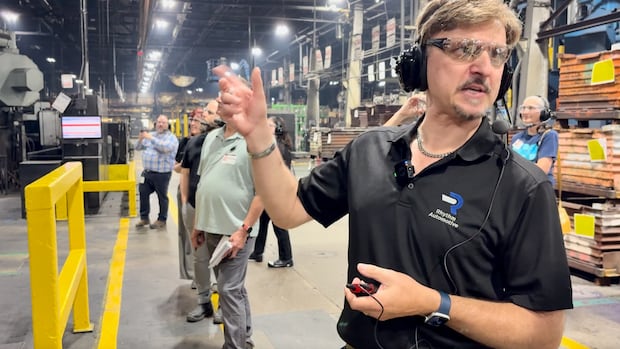
Paul Stever, North American director of operations for Rhythm Automotive Canada, leads a tour of the company’s plant in St. Catharines on June 8. An investment of nearly $80 million will go to two giant presses weighing 300 tonnes apiece, added to the company’s auto parts manufacturing capabilities. (Paul Forsyth/CBC)
In light of current political and economic challenges due to changing tariffs from the United States, Stever expressed optimism about Rhythm Automotive’s future in St. Catharines.
The parent company is pouring almost $80 million into upgrades at the plant including two enormous forge presses weighing 300 tonnes each that are being constructed in Italy to create a high-capacity aluminum forging line; they’re so large that part of one plant’s roof will need raising just to fit them inside.
“They’re massive presses,” Stever told . “It’s a major investment in this site. There’s a lot of confidence in this workforce to make it happen.”
Rhythm primarily produces suspension and steering components for clients such as Toyota’s truck plant in Texas along with Ford plants throughout Canada and America, Honda, Stellantis, Mercedes and BMW.
The company has recently changed ownership; its new parent company is Tokyo’s Advantage Partners as of June 1.
A good portion of what gets made at this plant ends up at automotive assembly lines across America and benefits from tariff exemptions under NAFTA-the Canada-U. S.-Mexico free trade agreement.
However, Stever noted they’ve faced challenges due to other U. S. tariffs like a steep 50 percent tariff on Canadian steel and aluminum exports.
“There’s some tariffs we can’t get around so there is an added expense to us. But it’s down to about one percent of our costs so it’s much more manageable.”
Even though there’s still uncertainty regarding how tariffs may affect Canada’s auto parts industry long-term, Stever believes investing locally makes solid business sense.
“This is a facility that’s been running for 97 years and we have confidence enough to make such a big investment and be here for many more years,” he stated.
Stever added that thanks to expanding product lines from these investments along with potential support from provincial and federal programs they aim to tap into could lead their current workforce-282 employees-growing by up to another 75 people over coming years.
Source link