



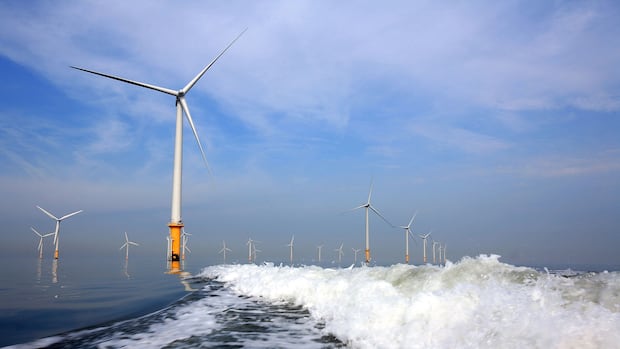
The federal government is investing $100 million in a Nova Scotia offshore wind energy project that could provide power to homes and businesses in Quebec, Ontario, and New England.
Federal Energy Minister Tim Hodgson, bundled up in a winter jacket, held onto his speaking notes tightly as he made an outdoor announcement on Thursday about Wind West, which has the potential to be Canada’s first offshore wind project.
If it gets the green light, the initial phase of the $60-billion project could produce five gigawatts of electricity by 2033-well above the 2.4 gigawatts needed to meet all of Nova Scotia’s demands.
“Even at this level of ambition, the project could provide electricity for up to 1.5 million homes here in Canada,” Hodgson said during a news conference at a wharf on Halifax harbour’s east side. “That’s three times the number of homes in Nova Scotia and creates an incredible export opportunity for Nova Scotian Power.”
Around $5 million will be allocated from federal funds to set up a network of floating light detection and ranging buoys that will measure offshore wind speeds and ocean conditions. An additional $3 million will help broaden modelling efforts to consider transmission lines to Quebec and Ontario as well as underwater surveys for possible cable routing.
WATCH | Houston government releases plan for Wind West:
Houston government releases plan for Wind West project
As Taryn Grant reports, this proposal is now shortlisted for potential support from Ottawa.
Hodgson mentioned that the rest of the funding will be directed toward subsea drilling over the next year to gather information about sea floor conditions.
“If we do this upfront and make it available to all the potential bidders, it’ll improve their knowledge of the subsea and what it will cost so we’ll get better bids,” he stated.
Nova Scotia Premier Tim Houston, who has consistently urged Ottawa for assistance with Wind West’s costs, noted that this funding cuts at least a year off development timelines and should boost developers’ confidence.
Provincial officials have indicated that if all phases are completed, Wind West could generate 60 gigawatts of electricity. Approximately $40 billion from the first five-gigawatt phase is designated for turbine infrastructure while another $20 billion is aimed at transmission projects.
“Before people start writing cheques for billions of dollars, they need more concrete data and we’re going to go get that and share it with them,” said Houston.
Houston has claimed that any surplus electricity produced could fulfill 27 percent of Canada’s total demand. Both Quebec and Massachusetts have already expressed interest in purchasing power from this proposed project.
Wind West forms part of the Atlantic Energy Strategy which has been referred to Ottawa’s Major Projects Office.
On Thursday, Hodgson stated that the federal government views Atlantic Canada as one energy ecosystem while working towards establishing a unified electricity system operator across the Maritimes.
This approach may enable high voltage transmission lines connecting Quebec and Prince Edward Island with Nova Scotia’s offshore energy initiative along with wind power from New Brunswick plus hydroelectricity from Newfoundland and Labrador.
“It lets provinces share those renewable resources so we don’t have to overbuild in each individual province,” said Hodgson. “It allows each province to utilize its unique natural resources while sharing them across regions.” p >The federal government claims more than 80 percent of Canada’s electricity already comes from renewables like solar , hydro , nuclear , and wind power. However , Ottawa has faced criticism from environmental groups regarding its prioritization of conventional oiland gas projects. p >For instance , Ottawa’s electricity strategy revealed in May aims at doubling Canada’s grid capacity , primarily leveraging natural gas expansion. p >Clean Energy Canada – a think tank associated with Simon Fraser University – commented previously stating “this strategy exaggerates natural gas’ role while downplaying clean energy benefits regarding long-term affordability & security.” p >MORE TOP STORIES p >
Source link