




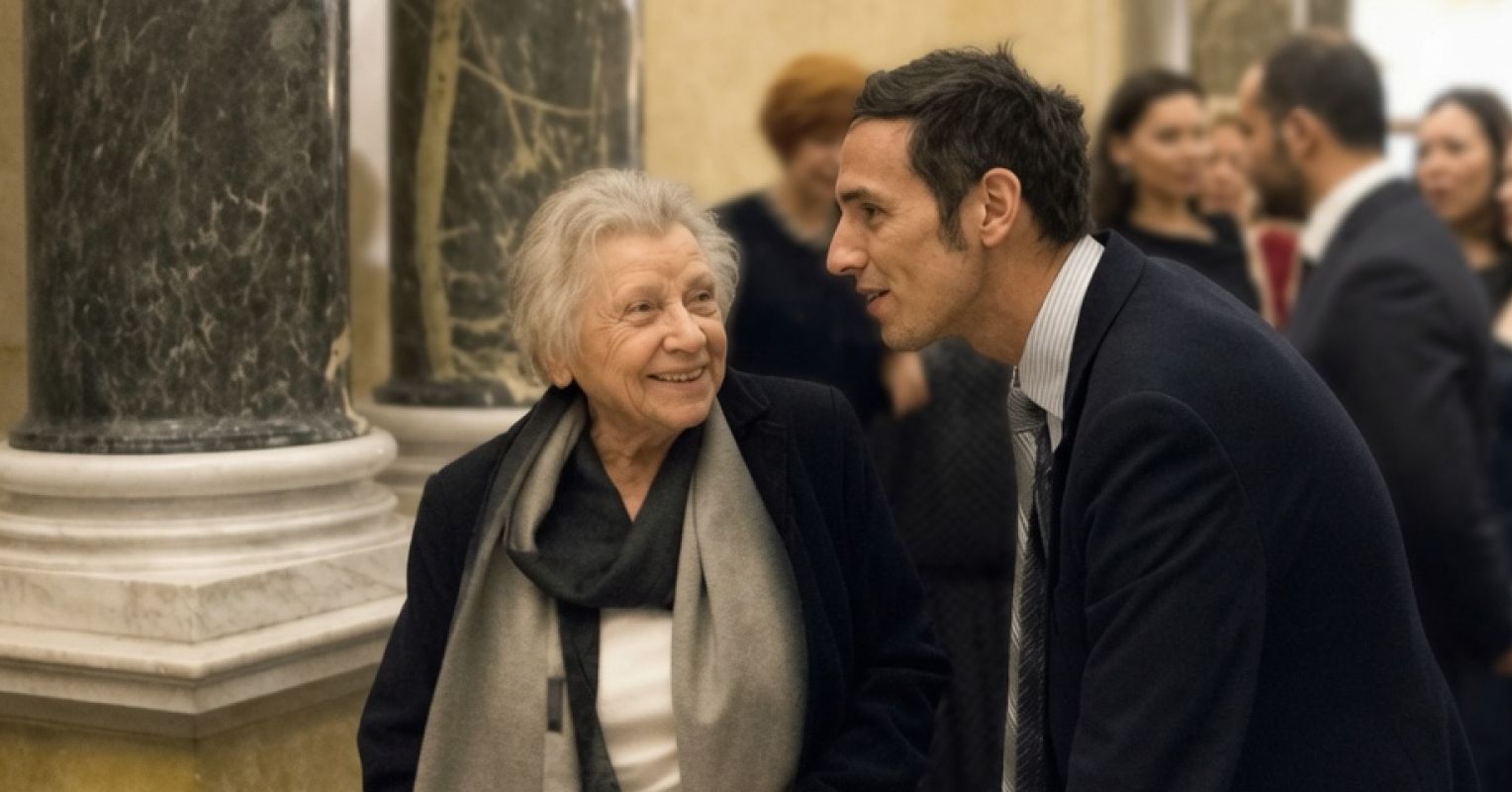
With the passing of Eleonore Frankl, née Schwindt, known to many as Elly, a significant life has come to a gentle close that can’t be defined only by the years from November 6, 1925, to June 10, 2026. For one hundred years she lived in and around Vienna; however, her influence extended well beyond her birthplace – particularly because she traveled the world alongside her husband, Viktor Frankl, supporting his groundbreaking work in the Third Viennese School of Psychotherapy, referred to as Logotherapy and Existential Analysis.
Born Eleonore Katharina Schwindt into humble beginnings in Kaisermühlen, a district of Vienna characterized more by its connection to daily life than by luxury (1). The challenges of her early life didn’t make her bitter. On the contrary, they seemed to foster in her that practical wisdom and genuine kindness which many later recalled about her: a woman without pretension or false seriousness who had no desire for dramatic flair – but above all with humor, sharpness, energy, and an open heart.
During World War II, she served as a nurse in the dental department at the Vienna Policlinic. It was there, soon after the Holocaust ended, that she met Viktor E. Frankl upon his return to Vienna after surviving concentration camps. Much has been discussed regarding Frankl’s survival story and his remarkable intellectual contributions. Yet far less can adequately express what it feels like for someone who endured such loss to rediscover life – not merely as hope in theory but through another living person.
In a letter addressed to a fellow survivor from Dachau in March 1946, Frankl shared his feelings of despair and isolation: family members and friends – most either murdered during the Holocaust or forced into exile far away. But just weeks later on May 19, 1946, he wrote something different (2): “What I wrote to you in my last letter – everything has changed. One human being has changed everything.” Elly Frankl.
The couple married in 1947 and welcomed their daughter Gabriele that same year. For fifty years until Viktor’s passing in 1997, Elly was his partner – wife , companion , assistant , witness , and home. To label her simply as “the wife of Viktor Frankl” is both accurate yet insufficient. She didn’t just accompany a renowned figure; she played an integral role in creating the environment needed for his work to flourish and spread across the globe. Throughout books , lectures , travels , meetings , letters , visitors , responsibilities , and countless everyday tasks-Elly was present just as much as Viktor Frankl.
Jacob Needleman (1) beautifully described her once as “the warmth that accompanies the light.” Viktor Frankl’s work illuminated countless lives-people caught up in grief , displacement , daily struggles or feeling lost; individuals stuck in monotony , indifference , reliance on others , depression , aggression or cynicism. Perhaps what Needleman meant was that Elly helped make this light approachable in her own distinct manner.
I had the great fortune of spending time with Elly between 1999 and 2007 and eventually came to cherish our friendship. During those years I worked at Viktor Frankl’s private estate-the Viktor Frankl Archive-in what was commonly called the Frankl apartment throughout Vienna. During this period I would sometimes visit Elly weekly or even more frequently; each time she’d have cookies ready along with coffee and juices. While I was supposed to be focusing on archiving materials officially; truthfully we often enjoyed hours filled with conversation-and laughter mattered immensely to her.
As time went on I managed fewer visits due to starting my own family; yet even then Elly contributed: it was within those very walls where I fell for my now-wife over nearly twenty years ago. At that time my wife was working as a photographer while we collaborated on an illustrated book about Viktor Frankl’s Vienna (3). It all began through this project: we discovered love together when neither realized it yet themselves until one day during photography sessions at the apartment when Elly observed us closely; after Juliane stepped out briefly for film rolls purchase she looked at me with maternal warmth mixed with playful amusement saying: “I think you two have found more than just a book project together.”
She was right.
These are just glimpses into how I’ve experienced Elly-a person who disarmed many others before me-with immediacy. She could laugh easily. She spoke plainly. She felt deeply. She remembered vividly. With freedom stemming from no need for impression management she could cut through exaggeration or sentimentality effortlessly.
Psychology Essential Reads
Throughout her lifetime she crossed paths with Eleanor Roosevelt , Martin Heidegger ، Sophie Freud ، Abraham Maslow ، Karl Jaspers ، Pope Paul VI ، Gorbachevs ، Konrad Lorenz و Hillary Clinton-all these figures among many others (1). However when discussing them it wasn’t primarily about their accomplishments-she viewed people not merely representative of institutions but rather unique individuals instead asking herself if they remained ordinary approachable humans-and whether they could share laughter too-that truly mattered most when recalling them. This perspective perhaps explains why so many felt encountering not solely widowhood tied toward significant thinkers but also an understanding developed uniquely grounded within authenticity itself while remaining true towards oneself
After Viktor’s death,for nearly three decades afterwards,she preserved memories,opened doors,corrected misconceptions ,welcomed scholars along students continued connections internationally related logotherapy even amidst older age stories were told surrounding patience listening dedicated individuals expressing inquiries distress admiration needs emerging regularly.
Her contributions received public acknowledgment through honorary doctorates including one awarded from North Park University Chicago another bestowed Moscow Institute Psychoanalysis though those honors deserved still capture only part significance surrounding legacy left behind
Elly represented bridges spanning generations between Judaism Christianity remembering futures knowledge merged common decency-a Catholic married Jewish survivor philosopher wherein respect transcended backgrounds defining sacred traditions coexisting marriage quietly embodied teachings essential recognizing love doesn’t erase differences instead nurturing environments fostering tenderness acceptance difference p >
A great body works cannot arise solely intellect alone often safeguarded nurtured grace affection p >
I remember fondly this remarkable woman known warmth strength independence humor fidelity honoring memory stands beside Viktor fully vividly lovingly embodying self p >
May memory remain blessed
Source link