



CANADA: A citizens’ group from Rideau Lakes has expanded its objections beyond one proposed Alto corridor to the entire high-speed rail initiative, while federal and Alto documents indicate that Kingston is still just a possible stop, and there hasn’t been a final alignment selected for the Peterborough-Ottawa route.
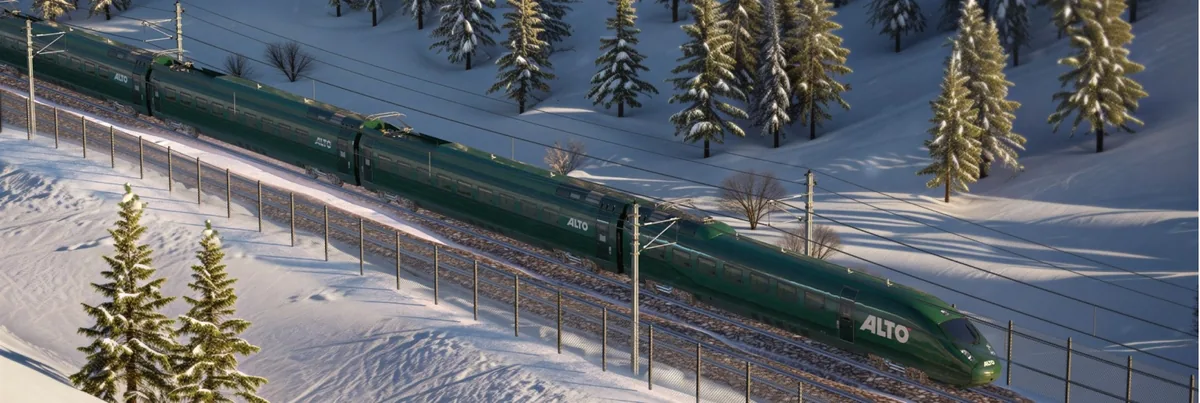
Official Alto project image illustrating high-speed rail in winter conditions. Photo: Alto
The immediate focus is on Kingston. On June 22, Transport Minister Steven Mac Kinnon instructed Alto to create a plan to evaluate a southern route option between Peterborough and Ottawa that would consider a potential stop in Kingston connecting with VIA Rail, depending on technical feasibility and project criteria. This directive included Kingston in the route study but did not finalize any specific route.
The Rideau Lakes Against Alto HSR Group responded by clarifying their stance: they oppose high-speed rail along any corridor, not just the previously discussed southern option. The Township of Rideau Lakes their statement on August 10, even though it’s dated June 30. The group advocates for high-frequency rail instead and points to costs, farmland concerns, environmental issues, and community impacts as reasons for their opposition.
Kingston is under study; it’s not a chosen route
Alto’s current project materials clearly differentiate between a study corridor and an actual finalized alignment. Their FAQ states no alignment has been decided upon between Peterborough and Ottawa and both northern and southern study corridors are being evaluated through technical analysis and public feedback.
The area currently being examined spans about 10 kilometers in width. Alto mentions that this planning area will be narrowed down before defining an eventual railway right-of-way of around 60 meters. Transport Canada also lists seven mandatory station cities-Toronto, Peterborough, Ottawa, Montréal, Laval, Trois-Rivières, and Québec City-while assessing Kingston as a potential additional stop.
This issue holds significance for Rideau Lakes because the municipality finds itself caught up in the political debate surrounding the southern option; however, the official documentation does not confirm that a final line will pass through the township. The municipality’s own page on Alto identifies concern over the southern study option while Alto continues to state that the route remains undecided.
Don’t miss…Dorval Hub Plan Would Link VIA Rail, exo and Airport Shuttle
The official local stance is more focused than “No Alto anywhere”
The position of the citizens’ group isn’t exactly aligned with what local elected officials have stated officially. In February, Rideau Lakes Council voted unanimously against the proposed southern corridor due to environmental impact concerns, community disruption issues, and lack of detailed studies or a completed business case.
On April 30th, mayors and reeves from twelve municipalities along the suggested southern corridor sent out a joint letter opposing this route through their areas while requesting development be paused until reassessment occurs. However, Rideau Lakes Mayor Arie Hoogenboom noted that these leaders weren’t against high-speed rail overall; their focus was primarily on this southern corridor while also suggesting evaluations of both Highway 401 options and high-frequency rail using existing routes.
This distinction matters significantly. There’s formal municipal opposition to both the southern corridor specifically as well as to Alto in its present form; however, calls for completely abandoning high-speed rail come from the Rideau Lakes Against Alto HSR Group rather than reflecting one unified regional government stance.
A decision on corridors by 2026 won’t guarantee construction approval
The ministerial letter from June 16 mentioned in earlier reports indicates that Alto is expected to submit refined details regarding corridors and suggested station locations for approval by 2026-with final railway alignment development anticipated prior to an expected investment decision by 2029. Federal project documents provide crucial context regarding these milestones.
Transport Canada notes that since March 2025 there has been co-development work with Cadence involving alignment determination along with segment sequencing efforts; advancing impact assessments; progressing designs; establishing target schedules along with costs; completing land-acquisition tasks; and securing regulatory approvals. Transitioning into execution is planned only on a segment-by-segment basis following Canada’s final investment decision.
Thus far this dispute unfolds before several key steps have been concluded. While instructions regarding Kingston expand upon studying routes southward-and opposition from Rideau Lakes intensifies-the federal process continues onward-but neither definitive Peterborough-Ottawa alignments nor construction authorization for this segment have been established according to available official records.
News on railway transport, industry updates , and railway technologies from Railway Supply you might have missed: