



As areas in Lambton and Middlesex counties recover from yet another winter storm, stories of people stepping up to help one another are coming to light.
However, these tales also serve as serious reminders – ones that a local tow truck driver who spent hours battling the snow says can mean life or death.
“You absolutely have to be prepared,” said Gary Vandenheuvel, co-owner of Preferred Towing in Sarnia, Ont.
The storm completely halted movement on the region’s roads Friday night into Saturday, prompting OPP to label it a “significant event.” Many roads were closed Sunday, including Hwy. 402 between London and Sarnia.
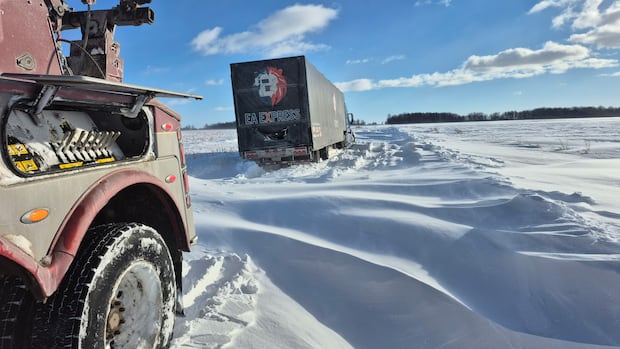
Strong winds piled snow into huge drifts, sometimes almost entirely covering stranded vehicles while their drivers remained inside.
Many passenger vehicles were partially buried by snow. (Submitted by Gary Vandenheuvel)
This weekend required all hands on deck for Vandenheuvel’s team of 12 and many other towing companies from across the area.
He mentioned that the closure of Hwy. 402 forced traffic onto smaller rural roads that are less frequently maintained.
“Once that wind kicks in and everything starts happening out there, the snow drifts start building up, making it impossible to move around on those routes,” Vandenheuvel said.
“Unfortunately, people leave not thinking that road conditions will be that bad. There were blizzard warnings out, but [they didn’t] heed those warnings.”
As chaos unfolded, Vandenheuvel shared he received hundreds of calls with tow truck operators working up to 30 hours trying to assist those stuck.
Tow trucks couldn’t reach them; snowmobilers stepped in
Despite these efforts, he noted most calls came from people who were simply unreachable.
“Tow trucks are vehicles just like everybody else’s. We’re not able to magically get through snow that everyone else can’t get through,” Vandenheuvel said.
(Ontario Provincial Police)
The impassable drifts and poor visibility led first responders and Good Samaritans to use snowmobiles and farm equipment to reach those in need.
Averaging citizens who wanted to help took it upon themselves according to Graham Snyder, spokesperson for the Ontario Federation of Snowmobile Clubs District 5.
“It’s just kind of a natural reaction during a crisis. People knew others were in danger; they put themselves in other people’s shoes,” Graham Snyder said.
“It wasn’t just snowmobiles either; folks used tractors and snow blowers too.”
Police say preparation made a difference
Derek Rogers from Ontario Provincial Police’s West Region media relations noted that police responses during this storm benefitted from groundwork laid over ten years ago after a major storm left over 1,500 individuals stranded on highways in Lambton County back in 2010.
Following that storm, police along with local governments worked on better planning for future storms he said.
“The OPP initiated what we call regional mobilization which is essentially all hands on deck. Warming centres were set up for folks caught in bad weather then began checking all these vehicles meticulously ensuring everyone was okay,” Rogers explained.
He added authorities were aware of around 150 abandoned cars on Highway 402 while OPP previously stated they received about 400 calls related at the time due to weather conditions.
Pursuing safety advice goes beyond just being aware when driving under such circumstances.
You know travel is necessary but check road conditions before leaving then decide if it’s worth risking it,” Rogers advised.
Tips from OPP include: p >
Checking road conditions prior departing. Having plenty gas , charged cell phone, snacks , and warm clothing. Staying inside your vehicle. Making sure tailpipe stays clear if running car warmth since failing cause carbon monoxide poisoning.
Source link