



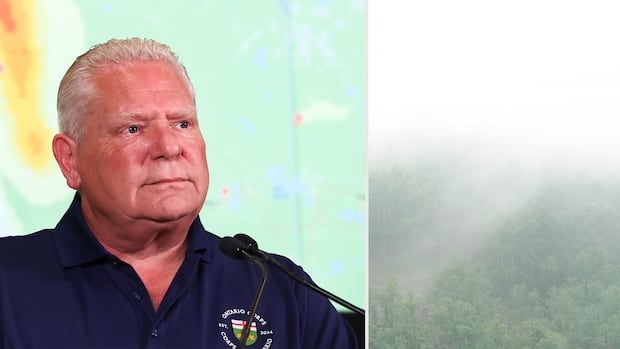
During a press conference in Thunder Bay on Saturday, Ontario Premier Doug Ford expressed his frustration towards U. S. politicians who have criticized Canada’s efforts to tackle wildfires, stating that many in the current government seem to have “a very short memory.”
“I think it’s a shame that the administration in the U. S. and Congress people [are] writing these letters and blaming us,” Ford said. “We had the water bombers and everyone going over to California. It was last year.. That’s what neighbours do.”
As of Saturday afternoon, there are 191 active wildfires across northern Ontario, with 73 still not under control, according to the provincial Aviation, Forest Fire and Emergency Services (AFFES) agency.
The largest fire in the province, Thunder Bay 36, has consumed nearly 319,000 hectares as of Saturday afternoon. The premier noted that 155 fire crews and about 80 water bombers are currently deployed to combat fires in the area.
So far, over a dozen communities have been ordered to evacuate, including Namaygoosisagagun First Nation in northwestern Ontario. This community completely burned down earlier this week while residents had to evacuate on their own.
WATCH | Premier Doug Ford urges people to heed evacuation orders:
Ford warns people refusing to evacuate are hindering wildfire response
A new evacuation centre has opened in Thunder Bay for those displaced by northern Ontario wildfires. Premier Doug Ford cautioned that individuals ignoring evacuation orders are obstructing firefighting operations.
The quick spread of wildfires has also sparked criticism within Ontario from opposition members of the legislature and First Nations leaders who have called for more funding for wildfire prevention and suppression.
Namaygoosisagagun First Nation “burnt to the ground because of a failure of the province for their monitoring,” said Anishinabek Nation Grand Council Chief Linda Debassige. “And further to that, the emergency management arm of the province also ought to be held accountable for this disaster.”
Supporting Neighbours Rather than Criticizing
This week, U. S. President Donald Trump joined other Republican politicians in blaming Canada for wildfire smoke affecting American cities.
Four Republican House members from Michigan sent a letter to Prime Minister Mark Carney urging him to take action regarding the fires. Trump even threatened higher tariffs on Canadian goods.
On Saturday, Ford described comments from Trump’s administration as “absolutely unacceptable.”
“You don’t get on and start threatening and criticizing because guess what? One day it’s going to be your turn and we’re going to be down there without hesitation supporting our neighbours when we should be,” Ford stated.
He acknowledged not all Americans share this viewpoint; he recently spoke with Massachusetts Gov. Maura Healey who offered extra personnel for wildfire prevention assistance.
Internal Criticism within Ontario
Up until now, around 10 First Nations across Ontario have been ordered to evacuate with most receiving help from both federal and provincial governments.
Diving into details at Friday’s news conference, Thunder Bay-Superior North MP Patty Hajdu-who is also federal minister of jobs and families-commended this collaboration as it allows safer evacuations.
“Canada is working very efficiently with Ontario since fire season began,” Hajdu remarked. “We’ll support Ontario; we’ll work hand in glove with them ensuring we protect our people and region.”
Members of Namaygoosisagagun First Nation are seen in Thunder Bay, Ont., following an evacuation of the entire community on Monday due to a wildfire. (Sarah Law/CBC)
Despite this teamwork though, Debassige pointed out perceived shortcomings by both levels of government regarding resources for Namaygoosisagagun First Nation.
“This community burned to ash,” Debassige noted. “When we reached out.. to MNR [Ontario’s Ministry of Natural Resources], we were told ‘we didn’t know there was a fire there.’
When reporters asked about provincial efforts against fires Mike Harris Jr., Ontario’s minister of natural resources said that the blaze began near the First Nation but spread faster than local teams could react. p >
“We did our best obviously trying survey what was happening but there was so much smoke making it almost impossible for our teams assess how close fire was,” Harris Jr said adding “the community decided self-evacuate.” p >