




A recent report suggests that Canadians need to brace for a future that may be 5 C warmer, based on the latest findings regarding climate change.
The second edition of Canada’s Changing Climate Report offers a comprehensive look at how a warming planet affects Canadians, confirming more strongly that human activities, particularly fossil fuel use, are driving climate change.
This past Thursday, the federal government shared a summary of the key findings from the report.
The report looks ahead, examining what Canada might experience under various scenarios depending on whether nations keep their climate commitments.
“We do still have some agency,” said Nathan Gillett, one of the authors and a research scientist with Environment and Climate Change Canada. “Where emissions go from here will affect how temperatures evolve through the century and whether we can stabilize temperature or whether it just keeps increasing.”
The report indicates that if global governments continue with their current climate strategies, Canada will still face significant warming, which “corresponds to a future climate for Canada that is far from benign,” according to the document.
Glaciers may ‘largely disappear’
If this scenario unfolds, Canada is projected to see an average temperature increase of 5 C throughout this century. In Nunavut, winter temperatures could rise by over 10 C.
Western Canadian glaciers are expected to lose more than 75 percent of their ice mass; moreover, there’s over a 60 percent chance that most Septembers will find the central Arctic Ocean mostly free of ice.
“Iconic landscapes are changing across Canada as snow and ice disappear,” the report mentions. “Glaciers in western Canada will largely disappear by the end of this century.”
WATCH | Glacier collapse that led to flooding at Nepal-China border: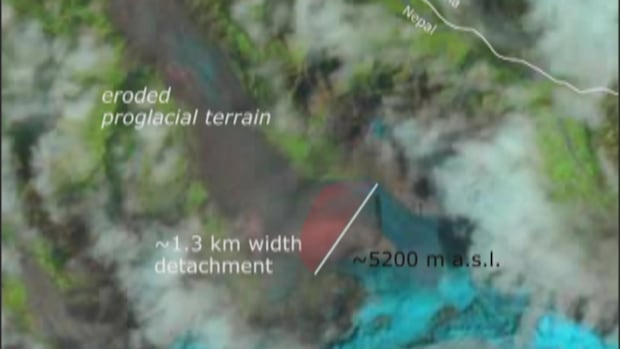
Satellite images show glacier collapse that triggered flooding at Nepal-China border
Jakob Steiner, a geoscientist at the University of Graz in Australia, states that satellite images reveal ‘the lower part of a tongue of a glacier completely sheered off across a width of 1,300 metres’ and fell off a cliff into a lake situated 2,000 metres below. Steiner noted that climate change played a part in this event as the area was already considered at high risk for collapse.
In addition to severe warming up north, southern Canada faces challenging prospects since that’s where most Canadians live.
The report predicts longer-lasting summer droughts becoming more intense and frequent in central and southern regions.
Canadians should also expect an uptick in both flash floods and atmospheric rivers occurring more often.
“Multiple lines of evidence support the finding that the length of the fire season has increased in most parts of Canada and is projected to continue to lengthen as global temperature rises,” says the report.
If countries were to abandon their climate policies altogether, things would worsen for Canada with average temperatures likely rising by about 6.9 C within this century.
If global efforts lead to significant cuts in greenhouse gas emissions and achieve net-zero around 2075 instead, Canada’s climate might stabilize with an average increase estimated at around 3.5 C.
Report represents ‘physics not fate’
Even though it’s easy to feel discouraged after reading such forecasts from this report, achieving an increase of only 5 C isn’t inevitable-there’s still time for Canada to sidestep such outcomes according to independent policy research group Canadian Climate Institute.
“This report describes physics not fate,” they expressed in an official statement.
The institute stresses cutting emissions both locally and globally will dictate “whether Canadians have to live with the consequences of more than 5 C warming or just settle for around 3.5 C.”
Avoiding each additional degree could save lives while preventing damage done to homes and communities-it also stands to protect billions worth from being lost economically according to their statement.
A truck drives through a flooded road in Toronto on Wednesday after heavy rains led to flash floods throughout the city.(Paul Smith/CBC)
A response from one advocacy group called for bolder actions aimed at lowering emissions following Toronto’s recent flash floods linking them directly back onto climate change impacts.
“As climatic conditions worsen increasingly , over 65 ,000 Torontonians lost power during yesterday’s severe storm lasting several hours,” remarked Dianne Saxe who serves as City Councillor writing on behalf of Climate Caucus-a network gathering municipal leaders nationwide.” Numerous interruptions affected traffic along transit routes too; costly damages ensued owing floodwaters coupled alongside wind gusts threatening residences.”
“Our communities cannot handle repeated hits-be they human or financial consequences stemming from oil & gas reliance.”
In reply concerning reported findings-Canada’s Environment Minister stated nation remains dedicated towards reducing carbon outputs aiming towards net-zero targets set forth by year2050.
“Our government acts swiftly addressing needs against climatic challenges meanwhile collaborating jointly establishing energy security enhancing industrial capacity required ensuring strategic autonomy defining future generations onward,” stated Chris Zhou who handles communications related environment/climate matters.
Source link