





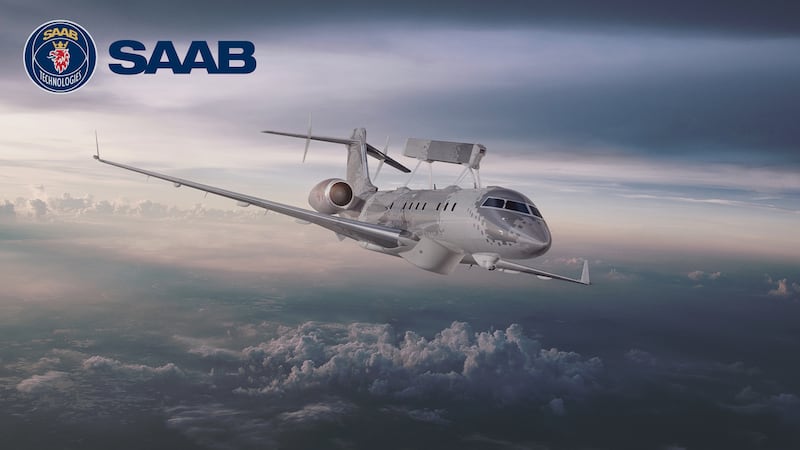
OTTAWA – In a room filled with Canadian defence and security industry leaders, Prime Minister Mark Carney revealed that Canada has started talks to acquire Global Eye, a state-of-the-art aerial surveillance system developed in Sweden that utilizes Canadian-made jets.
The Global Eye is an airborne warning and control system (AEW& C) created by the Swedish defence company Saab. The radar technology is embedded into Bombardier’s Global 6500, turning the corporate jet into a high-tech surveillance aircraft.
Global Eye Saab-Bombardier
The federal government is working on a deal that would see at least one third of the planned fleet of Global Eye aircraft built in Canada over the next 15 years.
Source link
Supporting Canadian Jobs
Once everything is finalized, Bombardier could produce at least 40 aircraft in its facilities located in Montreal and Toronto. This number also includes orders from allied countries. Carney shared these details during his keynote address at CANSEC, which is Canada’s largest defence and security trade show. According to a news release from the government, this agreement could support more than 3,000 jobs within Canada’s aerospace and defence industries, spanning skilled trades to engineering roles. Reports from CBC indicate that the Department of National Defence aims to buy six Global Eye systems for over $5 billion. Once operational, the Global Eye will play a crucial role in enhancing North American security by identifying and addressing threats in the Arctic region. Additionally, European media outlets have reported that NATO’s Support and Procurement Agency (NSPA) has chosen the joint Saab-Bombardier Global Eye to replace its aging fleet of 14 Boeing E-3A Sentries. Countries like France, Germany, Denmark, and Finland are also expressing interest in acquiring these specialized radar planes.Reducing Dependence on U. S. Suppliers
The announcement regarding these negotiations aligns with Carney’s government’s Defence Industrial Strategy aimed at decreasing dependence on U. S. suppliers while strengthening Canada’s domestic military industrial capabilities. This strategy seeks to double non-U. S. exports over the next decade and ensure Canadian companies secure 70 percent of defense contracts. By opting to negotiate with Saab, Canada is moving away from considering purchasing Boeing’s E-7A Wedgetail surveillance aircraft from the United States military. During April’s Liberal convention, Carney received enthusiastic applause when he stated that “the days of our military sending 70 cents of every dollar to the United States are over.”Additional Announcements Made
In his breakfast speech on Wednesday, Carney announced plans for a new 90-day approval process aimed at delivering “more predictable decisions.” He also mentioned: Encouraging foreign contractors to work with Canadian companies and invest in local supply chains. A new strategic partnership designed for companies to collaborate more closely with government on developing sovereign capabilities. A Defence Concierge Service intended to connect small and medium businesses with relevant programs, provincial partners, and export opportunities. The establishment of a Defence Advisory Forum meant to ensure alignment between government objectives and industry goals. This forum will be co-chaired by ministers from National Defence, Industry as well as the Secretary of State for Defence Procurement.Strengthening Ties with Europe Amid U. S. Friction
Recently, Canada has successfully become home to the global headquarters for the Defence, Security and Resilience Bank which comes along with an estimated 3,500 new jobs. Canada is also involved in Security Action for Europe (SAFE), an EU loan initiative aimed at enhancing military industrial capability. Being part of SAFE allows Canadian firms preferential access to European procurement projects. However, while connections grow stronger with Europe, tensions are rising with the United States.</P Earlier this month Elbridge Colby , the U. S. undersecretary for defence announced halting activities relatedto Permanent Joint Board on Defense.</P The advisory board was created backin1940 for U. S.-Canada bilateral defense collaboration.</P Tensions have heightened concerning Canada’s choiceto reassess procuring F-35sfrom Lockheed Martin basedin U. S., whilealso reevaluatingthe benefits of Gripen Fighter, a jet manufactured by Saab aswell.</P With reportsfrom ’ Annie Bergeron-OliverSource link