


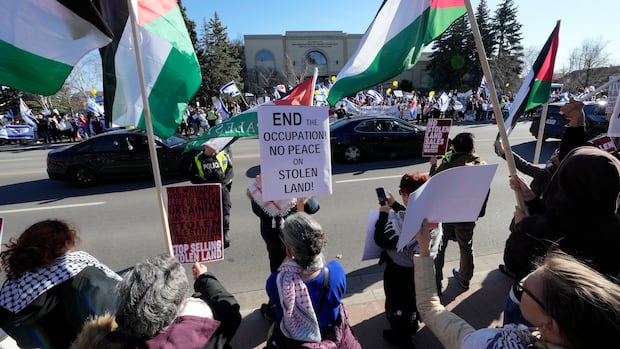
The Canadian Civil Liberties Association (CCLA) is filing a constitutional challenge against Vaughan’s bubble zone protest bylaw – one of several in Ontario that limits protests near places like churches, schools, and childcare centers.
This bylaw, which was approved in June last year, makes it illegal to organize or take part in a “nuisance demonstration” within 100 metres of any vulnerable social infrastructure, including hospitals and care facilities.
“Vaughan’s bylaw harshly restricts a very broad range of peaceful protests,” said Anaïs Bussières Mc Nicoll, director of the CCLA’s fundamental freedoms program, at a news conference on Tuesday.
“It significantly violates freedom of expression, peaceful assembly, and association in ways that can’t be justified in a free and democratic society.”
CBC Toronto has contacted the Vaughan mayor’s office for a statement.
According to the bylaw, a nuisance demonstration is defined as one or more people “protesting against something or expressing views on any issue … whether it is intended or not, that is likely, on an objective standard, to cause a reasonable person to be intimidated.”
This means that individuals may feel concerned for their safety or security or could struggle to access vulnerable social infrastructure as stated in the bylaw.
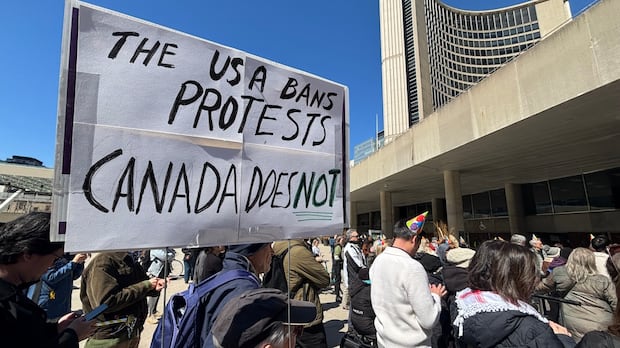 Toronto passes bylaw to restrict protests around places of worship and schools
Toronto city councillors have officially adopted a law limiting protests around institutions like schools and places of worship. CBC’s Lane Harrison explains the decision that followed intense discussion.
Under Toronto’s law, vulnerable institutions can request a buffer zone around them lasting for one year; this would apply within 50 metres of their property lines.
In contrast, Vaughan’s law does not include an application system and features double the buffer size.
Additionally, Vaughan imposes fines up to $100,000 for anyone found guilty under this law while Toronto sets maximum penalties at $5,000 for those who refuse to leave protected areas.
“This isn’t just a minor limit on free speech,” Goudge said.
He pointed out that Vaughan’s law grants enforcement officers-comprising municipal enforcement officers and police-the authority to determine what constitutes acceptable protest speech.
For instance,protests outside schools opposing cuts in education funding might now be banned, he noted.‘Bylaw passed after demonstrations outside synagogue’
The introduction of Vaughan’s bubble zone law followed multiple demonstrations outside a synagogue located in Thornhill.Protests were held against real estate events promoting occupied land in West Bank, which drew counter-protesters responding from leaders within the synagogue community.Vaughan Mayor Steven Del Duca suggested this measure back in March 2024,stating concerns about “large disruptive protests” occurring near synagogues and educational facilities had greatly unsettled local residents.Mc Nicoll emphasized that everyone should feel physically safe across Canada,and police should act when public safety is threatened. Yet she argued police already possess ample powers without needing additional regulations like this one.“History shows us how laws initially enacted under the guise of protecting vulnerable communities can quickly be misused against marginalized groups striving for change,” she mentioned.Stodge shared that CCLA submitted an application notice with the court on Monday,which will soon be formally issued. The City of Vaughan will receive notification regarding this matter on Tuesday.Richard Marceau, vice-president responsible for external affairs along with general counsel at Centre for Israel & Jewish Affairs expressed supportfor these types of bylaws arguing they are both legal*and necessary*.
Jewish communities throughout Canada “have faced increasing numbers concerning protests directed towards our synagogues , schools , and community centers,” he commented during his statement yesterday.
Toronto passes bylaw to restrict protests around places of worship and schools
Toronto city councillors have officially adopted a law limiting protests around institutions like schools and places of worship. CBC’s Lane Harrison explains the decision that followed intense discussion.
Under Toronto’s law, vulnerable institutions can request a buffer zone around them lasting for one year; this would apply within 50 metres of their property lines.
In contrast, Vaughan’s law does not include an application system and features double the buffer size.
Additionally, Vaughan imposes fines up to $100,000 for anyone found guilty under this law while Toronto sets maximum penalties at $5,000 for those who refuse to leave protected areas.
“This isn’t just a minor limit on free speech,” Goudge said.
He pointed out that Vaughan’s law grants enforcement officers-comprising municipal enforcement officers and police-the authority to determine what constitutes acceptable protest speech.
For instance,protests outside schools opposing cuts in education funding might now be banned, he noted.‘Bylaw passed after demonstrations outside synagogue’
The introduction of Vaughan’s bubble zone law followed multiple demonstrations outside a synagogue located in Thornhill.Protests were held against real estate events promoting occupied land in West Bank, which drew counter-protesters responding from leaders within the synagogue community.Vaughan Mayor Steven Del Duca suggested this measure back in March 2024,stating concerns about “large disruptive protests” occurring near synagogues and educational facilities had greatly unsettled local residents.Mc Nicoll emphasized that everyone should feel physically safe across Canada,and police should act when public safety is threatened. Yet she argued police already possess ample powers without needing additional regulations like this one.“History shows us how laws initially enacted under the guise of protecting vulnerable communities can quickly be misused against marginalized groups striving for change,” she mentioned.Stodge shared that CCLA submitted an application notice with the court on Monday,which will soon be formally issued. The City of Vaughan will receive notification regarding this matter on Tuesday.Richard Marceau, vice-president responsible for external affairs along with general counsel at Centre for Israel & Jewish Affairs expressed supportfor these types of bylaws arguing they are both legal*and necessary*.
Jewish communities throughout Canada “have faced increasing numbers concerning protests directed towards our synagogues , schools , and community centers,” he commented during his statement yesterday.
He believes these measures stay well within accepted limits set forth under constitutional rights. However , Louise Smith , representing Coalition for Charter Rights & Freedoms based out Toronto criticized these types laws claiming they “ stem from biased representations depicting individuals advocating Palestinian rights as hateful or violent.” “Such racism being formalized into municipal policy hurts all Canadians,” she remarked via email sent Wednesday.
Source link
‘This isn’t just a minor limit on free speech’
Recently, similar bylaws have been enacted in Toronto, Brampton, and Oakville. In May, Ottawa city council instructed its staff to create its own bubble zone bylaw. However, the CCLA opted to challenge Vaughan because it was the first municipality in Ontario to enact such legislation and also has “extremely broad prohibitions,” according to Daniel Goudge, lawyer at Stockwoods LLP representing the association. WATCH | Toronto passed bubble zone bylaw in May after hours of debate in city council:
Toronto passes bylaw to restrict protests around places of worship and schools
Toronto city councillors have officially adopted a law limiting protests around institutions like schools and places of worship. CBC’s Lane Harrison explains the decision that followed intense discussion.
Under Toronto’s law, vulnerable institutions can request a buffer zone around them lasting for one year; this would apply within 50 metres of their property lines.
In contrast, Vaughan’s law does not include an application system and features double the buffer size.
Additionally, Vaughan imposes fines up to $100,000 for anyone found guilty under this law while Toronto sets maximum penalties at $5,000 for those who refuse to leave protected areas.
“This isn’t just a minor limit on free speech,” Goudge said.
He pointed out that Vaughan’s law grants enforcement officers-comprising municipal enforcement officers and police-the authority to determine what constitutes acceptable protest speech.
For instance,protests outside schools opposing cuts in education funding might now be banned, he noted.‘Bylaw passed after demonstrations outside synagogue’
The introduction of Vaughan’s bubble zone law followed multiple demonstrations outside a synagogue located in Thornhill.Protests were held against real estate events promoting occupied land in West Bank, which drew counter-protesters responding from leaders within the synagogue community.Vaughan Mayor Steven Del Duca suggested this measure back in March 2024,stating concerns about “large disruptive protests” occurring near synagogues and educational facilities had greatly unsettled local residents.Mc Nicoll emphasized that everyone should feel physically safe across Canada,and police should act when public safety is threatened. Yet she argued police already possess ample powers without needing additional regulations like this one.“History shows us how laws initially enacted under the guise of protecting vulnerable communities can quickly be misused against marginalized groups striving for change,” she mentioned.Stodge shared that CCLA submitted an application notice with the court on Monday,which will soon be formally issued. The City of Vaughan will receive notification regarding this matter on Tuesday.Richard Marceau, vice-president responsible for external affairs along with general counsel at Centre for Israel & Jewish Affairs expressed supportfor these types of bylaws arguing they are both legal*and necessary*.
Jewish communities throughout Canada “have faced increasing numbers concerning protests directed towards our synagogues , schools , and community centers,” he commented during his statement yesterday.He believes these measures stay well within accepted limits set forth under constitutional rights. However , Louise Smith , representing Coalition for Charter Rights & Freedoms based out Toronto criticized these types laws claiming they “ stem from biased representations depicting individuals advocating Palestinian rights as hateful or violent.” “Such racism being formalized into municipal policy hurts all Canadians,” she remarked via email sent Wednesday.
Source link