




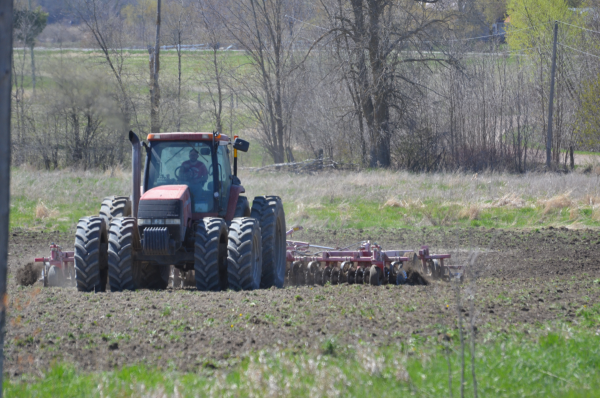
A farmer discs a field on May 12, between Pembroke and Arnprior. (Nelson Zandbergen photo)
Nelson Zandbergen
Farmers Forum
ARNPRIOR – On May 12, local farmers came together to discuss the challenges of the 2026 planting season, which is facing unusually low temperatures, slow heat accumulation, and a harsh reality for those relying on winter triticale to fill their feed shortages.
While winter triticale has become more popular in the southern U. S., experts at the meeting in Arnprior cautioned that Eastern Ontario isn’t as friendly to this wheat and rye hybrid crop. Many were finding that expectations for high yields were clashing with tough realities this year.
Certified crop advisor and dairy farmer Ashley Knapton noted that forage crop yields vary dramatically between 2 and 8 tonnes per acre among her clients, predicting that this spring’s triticale fields would likely fall “on the lower end of the scale.”
Knapton mentioned that some fields were “right on the edge” of being taken out but remained untouched because farmers need the forage.
“Hopes were up here with feed inventories being low, but reality is down,” said Laura Scott, cropping systems specialist from the Ontario Ministry of Agriculture, Food and Agribusiness.
Though triticale does well in southern U. S. when planted after August corn silage or soybean harvests, Knapton observed that Ontario growers really “need to manage their expectations” regarding overwintering this crop.
“Whether that means triticale is the right fit, lots of folks are still trying to figure that out…. It’s a nice option to have, but I just don’t know if we can fully incorporate it into our cropping systems with its inconsistency, in my personal opinion,” Knapton stated.
The chilly spring was a big topic during discussions. With corn needing about 175 heat units to germinate properly, Knapton estimated even early-planted corn (from late April) probably wouldn’t break through until at least May 18th.
The lack of warmth and rain also affected seedbed quality. Farmers reported heavy clay soils lacked sufficient top-down moisture needed to improve conditions, leaving hard ground that’s paradoxically holding too much moisture underneath. Additionally, corn stubble was particularly tough this spring.
Corn producers were encouraged to concentrate on the “critical weed-free period” for herbicide application. Trials shared at the meeting indicated that maintaining clean fields early could yield an advantage of up to 16 bushels per acre later on-even if post-emergent sprays make fields look cleaner down the line.
For those who end up planting corn while still needing to harvest forage rye, it’s advisable to pause with the corn planter and switch gears to cut rye instead. Missing that small window for cutting rye can be costly. “If you don’t stop to cut the rye, you’re going to have a problem to deal with,” Knapton warned.
Source link