


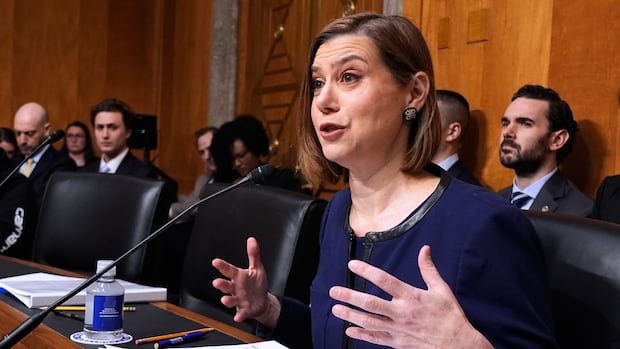
As Canada gets ready to bring in more electric vehicles from China, a U. S. senator is advising that even though relations between Canada and the U. S. are tense, Canadian officials should tread carefully when making agreements with the Chinese government.
“I understand that Canada is looking elsewhere and trying to diversify,” Michigan Democratic Sen. Elissa Slotkin mentioned in an interview on Rosemary Barton Live that aired Sunday morning.
“I think the point that I would make and did make to Canadian leaders is, just because we have become more difficult doesn’t mean the Chinese are always the straightest shooters when it comes to national security,” Slotkin told host Rosemary Barton.
Slotkin is in Toronto this weekend for the 2026 Global Progress Action Summit, which gathers world leaders to discuss “the world’s most pressing challenges and most inspiring opportunities,” according to its website.
The Michigan senator, who also worked as a CIA officer, shared her worries about a Chinese-made electric vehicle potentially sending back 3D video and geolocation data, which could be “hacked back to Beijing.”
WATCH | The privacy risks with Chinese-made vehicles: Will your Chinese-made EV spy on you?
Canada is about to allow Chinese-made electric vehicles into the market, leading some people to question cybersecurity concerns, but are they justified? For The National, CBC’s Jennifer Yoon highlights three key points regarding privacy risks.
“They’re national security issues, not just economic security issues,” Slotkin said. She and a Republican senator from Ohio have introduced a bill aimed at banning the importation, sale and operation of vehicles made in China.
Slotkin’s security worries resonate with those expressed by other Canadian officials - including Conservative Leader Pierre Poilievre and Ontario Premier Doug Ford – along with some experts in Canada.
In recent years, China has enacted several national security laws requiring Chinese companies to cooperate with government requests. A similar law in the U. S., known as the Cloud Act, mandates American tech companies share data collected abroad if requested by authorities.
In February, Public Safety Minister Gary Anandasangaree stated that Ottawa would implement “safeguards” designed to stop these vehicles from relaying information back to China.
The incoming Chinese-made electric vehicles are part of Canada’s agreement with the Chinese government.
Will your Chinese-made EV spy on you?
Canada is about to allow Chinese-made electric vehicles into the market, leading some people to question cybersecurity concerns, but are they justified? For The National, CBC’s Jennifer Yoon highlights three key points regarding privacy risks.
“They’re national security issues, not just economic security issues,” Slotkin said. She and a Republican senator from Ohio have introduced a bill aimed at banning the importation, sale and operation of vehicles made in China.
Slotkin’s security worries resonate with those expressed by other Canadian officials - including Conservative Leader Pierre Poilievre and Ontario Premier Doug Ford – along with some experts in Canada.
In recent years, China has enacted several national security laws requiring Chinese companies to cooperate with government requests. A similar law in the U. S., known as the Cloud Act, mandates American tech companies share data collected abroad if requested by authorities.
In February, Public Safety Minister Gary Anandasangaree stated that Ottawa would implement “safeguards” designed to stop these vehicles from relaying information back to China.
The incoming Chinese-made electric vehicles are part of Canada’s agreement with the Chinese government.
![]() A picture of Prime Minister Mark Carney shaking hands with Chinese President Xi Jinping is seen on the cover of the weekend edition of the China Daily newspaper in Beijing on Jan. 17. (Sean Kilpatrick/The Canadian Press)
In January, Prime Minister Mark Carney met with Chinese President Xi Jinping in Beijing and secured tariff relief for Canadian agricultural sectors in exchange for allowing 49,000 Chinese EVs into Canada at a reduced rate of 6.1 percent.
Although he initially seemed unfazed by this deal, U. S. President Donald Trump later warned about imposing 100 percent tariffs on all Canadian goods if Canada “makes a deal with China.” That threat hasn’t come true since it was made four months ago.
Slotkin mentioned that her state is observing how trade relations between Canada and the U. S. develop but added that “we don’t like watching a decision to let Chinese vehicles into Canada. That’s not something we want in the United States.”
“And so we’re struggling for the first time in a long time being on different pages on international trade issues,” she noted.
A picture of Prime Minister Mark Carney shaking hands with Chinese President Xi Jinping is seen on the cover of the weekend edition of the China Daily newspaper in Beijing on Jan. 17. (Sean Kilpatrick/The Canadian Press)
In January, Prime Minister Mark Carney met with Chinese President Xi Jinping in Beijing and secured tariff relief for Canadian agricultural sectors in exchange for allowing 49,000 Chinese EVs into Canada at a reduced rate of 6.1 percent.
Although he initially seemed unfazed by this deal, U. S. President Donald Trump later warned about imposing 100 percent tariffs on all Canadian goods if Canada “makes a deal with China.” That threat hasn’t come true since it was made four months ago.
Slotkin mentioned that her state is observing how trade relations between Canada and the U. S. develop but added that “we don’t like watching a decision to let Chinese vehicles into Canada. That’s not something we want in the United States.”
“And so we’re struggling for the first time in a long time being on different pages on international trade issues,” she noted.
![]() Then-U. S. trade representative Katherine Tai center, is seenin Washingtonin2023. Tai says Canada-U. S.-Mexico trade pact ‘doesn’tdisappear’ifthree countriesdonot comeanagreementbefore July1.(Andrew Harnik/The Associated Press)
This April, the chieftradenegotiatorfor Canada statedthat July1shouldnotbe seenasaharddeadline notingthatcertaintradeissueswon’tbe fullyresolvedbythatdate. P
The Americans have pointed out various ongoing irritantswith Canada, suchas Americanboozebansandthefederalgovernment’s”Buy Canadian”policyintendedtoensure Canadianproductsandworkersareprioritizedincontracts worth$25millionormore. P
Whenaskedwhat Canada’sbestleveragepointis, Taisaid”understandingyourleveragearoundsteelaluminumenergyisimportant”but Canadashouldalso keepitsightontangibletradeissueslike rulesapplicabletodigitalandtechnologycompanies. P
Slotkinalso acknowledgedthatthe Canada-U. S. relationshiphasbecome strained, but emphasizedtherearestillseveral senior Americanpoliticianswho value tiesbetweenbothcountries. P
“Thisisatoughmomentintime, butit’snotthelastmomentintime,”Slotkinsaid.
Then-U. S. trade representative Katherine Tai center, is seenin Washingtonin2023. Tai says Canada-U. S.-Mexico trade pact ‘doesn’tdisappear’ifthree countriesdonot comeanagreementbefore July1.(Andrew Harnik/The Associated Press)
This April, the chieftradenegotiatorfor Canada statedthat July1shouldnotbe seenasaharddeadline notingthatcertaintradeissueswon’tbe fullyresolvedbythatdate. P
The Americans have pointed out various ongoing irritantswith Canada, suchas Americanboozebansandthefederalgovernment’s”Buy Canadian”policyintendedtoensure Canadianproductsandworkersareprioritizedincontracts worth$25millionormore. P
Whenaskedwhat Canada’sbestleveragepointis, Taisaid”understandingyourleveragearoundsteelaluminumenergyisimportant”but Canadashouldalso keepitsightontangibletradeissueslike rulesapplicabletodigitalandtechnologycompanies. P
Slotkinalso acknowledgedthatthe Canada-U. S. relationshiphasbecome strained, but emphasizedtherearestillseveral senior Americanpoliticianswho value tiesbetweenbothcountries. P
“Thisisatoughmomentintime, butit’snotthelastmomentintime,”Slotkinsaid.
Source link
Will your Chinese-made EV spy on you?
Canada is about to allow Chinese-made electric vehicles into the market, leading some people to question cybersecurity concerns, but are they justified? For The National, CBC’s Jennifer Yoon highlights three key points regarding privacy risks.
“They’re national security issues, not just economic security issues,” Slotkin said. She and a Republican senator from Ohio have introduced a bill aimed at banning the importation, sale and operation of vehicles made in China.
Slotkin’s security worries resonate with those expressed by other Canadian officials - including Conservative Leader Pierre Poilievre and Ontario Premier Doug Ford – along with some experts in Canada.
In recent years, China has enacted several national security laws requiring Chinese companies to cooperate with government requests. A similar law in the U. S., known as the Cloud Act, mandates American tech companies share data collected abroad if requested by authorities.
In February, Public Safety Minister Gary Anandasangaree stated that Ottawa would implement “safeguards” designed to stop these vehicles from relaying information back to China.
The incoming Chinese-made electric vehicles are part of Canada’s agreement with the Chinese government.
The looming CUSMA review
Canadian, American and Mexican officials continue discussions regarding North America’s free trade agreement as they approach a deadline of July 1 – by which time all three countries must approve an extension or indicate their intention to withdraw from it. However, Katherine Tai, former U. S. trade representative under Joe Biden noted that if no agreement is reached by then “the pact doesn’t disappear.” “What happens is this agreement continues on its 16-year course,” Tai explained. “There’s another ten years left on this current authorization; if there’s no agreement by July 1st then these reviews will carry on annually.”Source link