



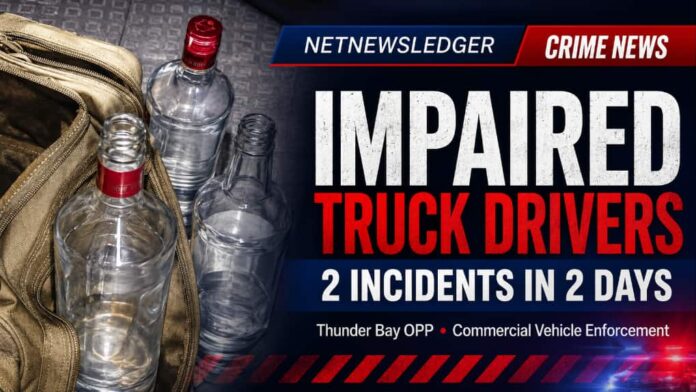
THUNDER BAY – Thunder Bay OPP reports that two incidents involving alcohol and tractor-trailers were documented in the area over the span of two days, which has led to increased worries about impaired driving and commercial vehicles on local roads.
These incidents are significant for Thunder Bay and Northwestern Ontario since tractor-trailers travel on major transport routes, designated truck paths, and urban streets where their size and weight can greatly elevate risks for other drivers, pedestrians, and roadside workers.
The driver received a 90-day suspension of his license and the vehicle was impounded for seven days. The charges have not yet been proven in court. All accused individuals are considered innocent until proven guilty in a court of law.
Source link
May 7 Incident Results in Impaired Driving Charges
According to OPP, a tractor-trailer was stopped on May 7 due to a supposed violation of designated truck route regulations. During required alcohol screening, police say they arrested the driver and charged him with impaired operation, driving with a blood alcohol concentration over 80, dangerous operation, failing to provide a breath sample, and having alcohol accessible in the cab. Officers reportedly found several open vodka bottles inside the truck cab.The driver received a 90-day suspension of his license and the vehicle was impounded for seven days. The charges have not yet been proven in court. All accused individuals are considered innocent until proven guilty in a court of law.
Second Driver Penalized on Dawson Road
OPP also indicates that on May 6, another tractor-trailer driver on Dawson Road faced a warn-range suspension along with a seven-day license suspension. In Ontario, drivers can face penalties if they fall within the warn range, which is defined as having a blood alcohol concentration between 0.05 and 0.079. The province also enforces a zero-tolerance policy for commercial drivers; this means anyone operating a vehicle requiring an A-F driver’s license or Commercial Vehicle Operator’s Registration cannot have any alcohol in their system while driving. OPP states that enforcement of commercial vehicle regulations will continue throughout the area.The Legal Context Surrounding These Charges
Impaired operation is addressed under section 320.14(1)(a) of the Criminal Code. This applies when someone operates any conveyance while their ability to do so is impaired by alcohol or drugs-or both-to any extent. Operation over 80 falls under section 320.14(1)(b), applying where an individual has had a blood alcohol concentration equal to or exceeding 80 milligrams per 100 millilitres of blood within two hours prior to driving. Failing or refusing to provide a breath sample pertains to section 320.15(1), which applies when someone fails or refuses to comply with an officer’s lawful demand without reasonable excuse. Mandatory alcohol screening is permitted under section 320.27(2) when an officer has an approved screening device and is properly exercising police authority. A dangerous operation charge corresponds with section 320.13(1) of the Criminal Code. It applies when someone operates any conveyance in such a way that it poses danger to public safety considering all circumstances involved.Possible Sentencing Outcomes
The maximum penalty for impaired operation, over-80 operation, or refusing compliance with breath demands is up to ten years imprisonment if pursued by indictment according to the Criminal Code. If addressed through summary conviction instead, penalties could include fines up to $5,000 or imprisonment for up to two years less one day-or both options combined. Minimum penalties start at $1,000 for first-time impaired or over-80 offenses-rising based on higher blood alcohol levels-with $2,000 minimum fines for first refusal offenses. A second offense typically incurs at least thirty days jail time; subsequent violations may result in at least one hundred twenty days imprisonment. A maximum sentence of up to ten years exists for dangerous operations if prosecuted by indictment; summary conviction penalties apply otherwise if handled summarily by Crown authorities. Courts may also implement driving prohibitions among other conditions based on case specifics. The Criminal Code instructs courts to consider certain aggravating factors during sentencing related specifically to driving offenses-including whether compensation was involved while operating the vehicle as well as whether it was large motor vehicle usage involved in the case at hand.The Public Safety Risks Posed by Commercial Vehicle Impairment
Commercial vehicles play an important role in Thunder Bay’s economy by transporting fuel, groceries, forestry products, construction materials-and more-across Northwestern Ontario. This makes it crucial since impaired driving behind these massive trucks can endanger many lives given that loaded transport trucks require greater distances and time needed for stopping; they come equipped with larger blind spots too-and collisions can cause serious injuries or worse outcomes altogether! This makes enforcement along Dawson Road-as well as designated truck routes plus regional highways-all essential because commercial traffic often shares road space alongside commuters including school buses plus pedestrians along with cyclists plus emergency responders too!If You See Suspected Impaired Driving
If you witness what appears like someone who might be impaired while driving please call911when it’s safe enough! Helpful information includes describingvehicle detailsalongside itslicense plate plus statingwhich directionit’s headedand itslocationontheroadalongwithany oddbehaviorsyou’ve noticedabouttheirdriving skills! Please don’t tailgateor putyourselfatrisk. Pull aside safely beforemakingthatcall!Source link