After an armed individual tried to enter the ballroom where Donald Trump was about to address White House reporters on Saturday, speculation quickly arose about whether the incident was staged.
Such rhetoric has become a frequent theme from both political parties in these times of divided politics and growing skepticism towards government institutions and media, including distrust towards the president himself.
The theories surrounding the gunman at the White House correspondents’ dinner came as some of Trump’s former supporters had been publicly discussing a conspiracy theory for weeks, suggesting that an earlier assassination attempt at a rally in Pennsylvania during his 2024 campaign was fabricated.
Scott Radnitz, a professor at the University of Washington who studies conspiracism as a form of power, stated that conspiracy theories often arise following major political incidents like assassination attempts. Online conspiracies tend to gain traction right after events occur when facts are murky and algorithms promote sensational content. Those who mistrust Trump will likely view any political event he’s involved in with suspicion, Radnitz noted.
“The administration does not have the best record of honesty and transparency when it comes to communicating with the public,” Radnitz said. “People who already believe the worst about what Trump is capable of can easily weave narratives about recent events that fit their existing beliefs.”
Trump’s swift assertion that this shooting incident highlights the need for better security measures in White House ballrooms, coupled with similar messaging from rightwing commentators shortly after, intensified this narrative of conspiracy.
The presence of major news organizations at the event and their subsequent reports should bolster confidence in what actually occurred, according to Radnitz.
“But individuals who have dismissed ‘legacy media’ will find plenty of alternative explanations available,” he added.
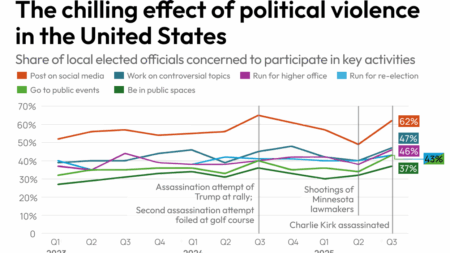
The use of extreme language often linked to conspiracy theories has become more common amid rising political violence, said Clionadh Raleigh, founder of Armed Conflict Location & Event Data, which tracks violent incidents globally. She pointed out that early on during the Iran war era, making “casual references to assassinating political leaders” became mainstream discourse which diminished barriers against violence.
“The US is experiencing a particularly unstable mix: widespread access to firearms, ongoing threats from lone actors, and an increasingly radicalized political climate,” Raleigh remarked. “Disorder in America is decentralized and unpredictable. And this risk spans across all sides of politics affecting anyone in public office.”
While many initial conspiracy theories regarding the incident at the White House correspondents’ dinner originated from left-wing circles, neither party is free from such theories in this age of eroding trust in government. A You Gov poll conducted in December 2025 found that most Republicans did not believe Joe Biden won the 2020 election; however, around half of Democrats also doubted Trump’s legitimacy as winner in 2024-though false claims about elections on the left haven’t been endorsed by Democratic leaders or elected officials.
Trump has faced a wave of conspiracy theories recently even from some loudest voices among his former supporters.
This backlash from key Maga figures arises as Trump’s grip on the Republican party loosens and others seek attention through financial incentives after he leaves office by crafting stories around him.
Some right-wing voices have hinted or outright claimed that Trump exhibits traits associated with being an antichrist. They’ve suggested he should confess to staging his own assassination attempt in Butler, Pennsylvania where one attendee lost their life. Claims also emerged linking him with Israel under dubious circumstances potentially tied to Jeffrey Epstein files while dragging America into conflict with Iran.
Tucker Carlson, formerly with Fox News now hosting his podcast expressed regret over supporting Trump and convincing others too. His split was partly due to opposition against war in Iran but he also insinuated lately that Trump-after sharing an expletive-filled Easter post featuring an AI-generated image portraying himself as Jesus along with conflicts involving Pope-is attacking Christian faith itself.
“Could there be a spiritual component to what we’re watching?” Carlson pondered during one episode. “Could this be the antichrist? Well, who knows? At least that’s my conclusion. Who knows?” he mentioned later on another episode.
Carlson further propagated thoughts claiming FBI misled information regarding Butler’s shooter while rumors suggesting potential staging gained momentum recently according to Wired’s report. Tim Dillon-a comedian and podcaster previously supportive towards Trump-stated this month people might not know “the full story” behind assassination attempts claiming “Maybe it was staged. Maybe it was faked. I think now is time just come out say we staged assassination attempt at Butler,” he asserted.
Joseph Uscinski-a political science professor studying conspiracy theories at Miami University-noted how for years presidents could maintain authority portraying themselves victims caught up within power struggles orchestrated by deep state forces alongside opposing politicians plus media narratives
“That can only work so long,” Uscinski remarked days before Saturday’s assassination attempt.”So eventually like moths drawn flames these conspiratorial minds within coalition are bound turn anger toward him which reflects current situation unfolding should raise no surprise since coalition formed consists various cantankerous characters unlikely get along forever.”
However Uscinski emphasized focusing specifically upon subjects discussed isn’t essential aspect here.”We shouldn’t emphasize solely upon specific conspiracy ideas,” Uscinski pointed out.” We possess coalition consisting entire body focused believing conspiracies hence astonishment shouldn’t exist observing them accept such notions.”
Adding onto statements made earlier Radnitz reinforced notion individuals motivated primarily through conspiratorial thinking consistently interpret reality using lens thereof.”In their worldview only explanation available why Trump failed fulfill promises ties back affiliation system effectively representing establishment instead.”
Source link