



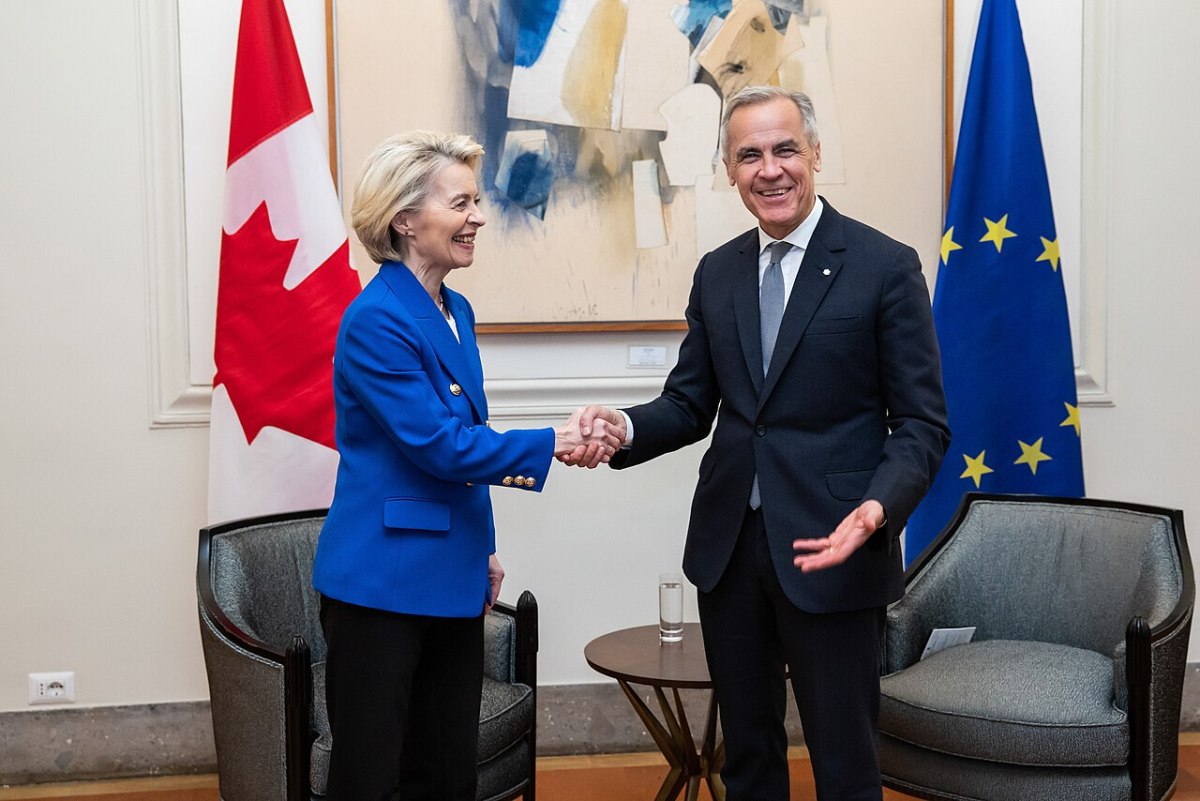
European Commission President Ursula von der Leyen with Prime Minister Mark Carney. (Image: © European Union, 2026, CC BY 4.0, via Wikimedia Commons)
By PETRA DOLATA
University of Calgary
THIS WEEK, OFFICIALS ARE GATHERING for the 21st Canada-European Union Leaders’ summit.
This meeting comes just a month after European Commission President Ursula von der Leyen extended an offer for Canada to join as an associate member; however, Politico has reported that this offer was pulled back due to pushback from countries like Germany, Greece, and France.
In response, Prime Minister Mark Carney suggested strengthening and integrating ties between Canada and the EU.
Now, all attention is on Carney, von der Leyen, and EU Council President António Costa as they meet in Montréal to discuss enhancing their partnership.
The discussions follow several key moments in the relationship between these transatlantic partners, including the announcement last July that Canada would participate in the Eurovision song contest. This marks Canada’s first entry since Australia joined in 2015.
Eurovision takes place annually in May, where member nations submit one original song. Over time, the format has evolved from solely jury voting to viewer voting and now incorporates both methods.
At times, voting can lean political as viewers may cast their votes based on geopolitical allegiances or diaspora communities supporting their home countries regardless of performance quality.
This could work to Canada’s advantage as it currently enjoys positive sentiment from Europe. The ongoing geopolitical connection between Canada and the EU might help a Canadian entry secure victory. It wouldn’t be a first for Canada; Céline Dion won in 1988 while representing Switzerland.
Nuclear Concerns in the 1950s
The EU and Canada seem to be growing closer together. But will future historians view Eurovision and other events as pivotal moments leading to deeper integration between Canada and the EU? Probably not – history provides insight into why this is so.
A look at past relations reveals a mutual interest in closer ties that often hasn’t translated into concrete actions.
Over fifty years ago, shortly after the Treaty of Rome established both the European Economic Community and the European Atomic Energy Community in 1957, Canada became the first industrialized nation to sign an agreement with this latter group. In October 1959, Canada signed on for Peaceful Uses of Atomic Energy deal.
Back then, there were concerns about losing access to U. S. markets for uranium exports because America had only committed to a supply contract until 1962 while anticipating lower demand thereafter.
Prime Minister John Diefenbaker aimed to diversify trade relationships by reviving ties with the United Kingdom but also looking towards Europe for potential uranium markets.
He added Germany and Italy as new customers for Canadian uranium while ensuring they would use it solely for peaceful purposes.
This led Canada to consider agreements with the European Atomic Energy Community since both West Germany and Italy were members. From their perspective, collaborating with Canada offered not just access to Canadian uranium but also increased international recognition.
However, looking back now shows that aside from some scientific collaboration efforts, little else came out of those discussions. The U. S., with its aggressive export strategy ultimately captured Western Europe’s nuclear technology market instead of Canada succeeding there.
Tensions Between Nixon and Trudeau
The desire to lessen reliance on America also drove Canada’s framework agreement signed in 1976 focused on commercial cooperation with what was then called the European Community-later known as the European Union-making it Canada’s first such pact with an industrialized partner.
The surprise announcement by U. S. President Richard Nixon’s new economic measures eliminating gold conversions into dollars along with fixed exchange rates caught many off guard-including Canadians who faced an unexpected unilateral import surcharge of ten percent without any exemptions given.
In response fueled by longstanding concerns over national independence under Pierre Trudeau’s Liberal government sought out alternatives beyond American partnerships primarily leaning toward Europe instead.
As was seen during prior decades when energy needs prompted interest among Europeans eager enough pursuing energy resources available within borders post oil crisis era-which raised stakes significantly further bolstering requirements around nuclear power initiatives overall across regions alike.
But again full potential never really materialized following framework agreement signing-instead turning focus inward deepening relations firmly rooted alongside USA establishing free-trade agreements throughout 1980s timeframe too!