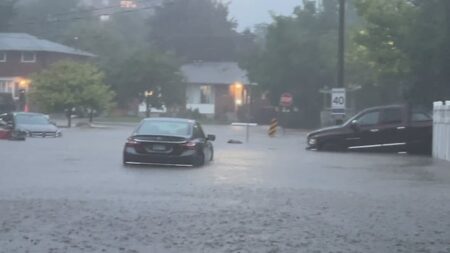




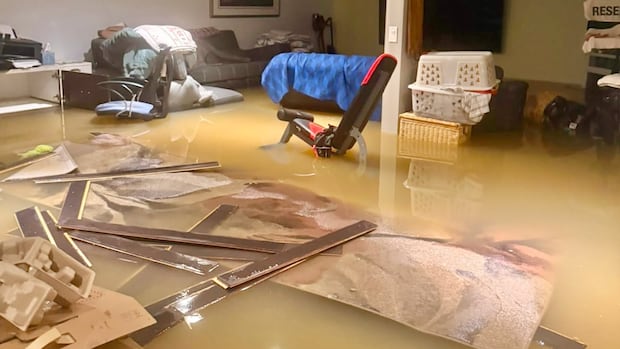
Two major storms in July and August caused extensive flooding in north Niagara, affecting thousands of homes with sewage, leading to an estimated $360 million in damages across the region and parts of Ontario, as stated in a recent report.
The preliminary figures come from Catastrophe Indices and Quantification Inc. (Cat IQ), a company that provides data analysis and weather insights on disasters. These findings led the Insurance Bureau of Canada (IBC) to urge governments to move away from recovery-focused policies towards solutions aimed at preventing floods.
“Catastrophic flooding events are no longer unexpected,” said Amanda Dean, vice-president of Ontario and Atlantic Canada for the IBC. “They are becoming more frequent, and each one seems to be more severe than the last.”
Toronto-based Cat IQ estimates that insured losses from the storms that struck overnight on July 27 and 28, followed by another storm on Aug. 2, totaled at least $360 million.
The IBC reported that these storms brought “intense rainfall and flash flooding” to areas including St. Catharines, Lincoln, Niagara-on-the-Lake, and Grimsby. Heavy rain was also noted further north in North Bay.
While Niagara Falls wasn’t mentioned specifically in a news release by the IBC, many homes there also experienced sewage flooding.
“Water related damage has increased more than 300 per cent in the last 20 years,” said Thomas. “The way a lot of municipal infrastructure was built [was] not built to handle severe weather we’ve experienced over roughly the last decade.” The insurance bureau pointed out that an estimated $60 billion will be required for such infrastructure improvements-funding which will need support from senior government levels.“If governments are serious about reducing flood losses, investing in water infrastructure has to become a national priority,” said Thomas. The IBC urged shifting focus away from merely recovering post-flooding towards preventative measures instead-these could include home retrofits like backwater valves or sump pumps along with stronger building codes and improved land-use planning measures.< “Every dollar spent on reducing risk … can save millions potentially down the line,” said Thomas.<
Source link
Calculating Damage Estimates
In communication with through a public relations firm, Cat IQ explained that it gathers data from primary insurers before aggregating and extrapolating it for industry loss estimations. Currently, specific data for Niagara isn’t available since estimates are only categorized by province rather than regionally. Anne Marie Thomas, director of consumer and industry relations for the IBC, visited St. Catharines after the storms to hear firsthand accounts from residents about their experiences. “Some of the stories were heart-breaking,” she told . “It is heart-breaking when we hear about residents who are put in a financial bind because of these severe weather events.” Both St. Catharines and Lincoln declared states of emergency after the Aug. 2 storm; preceding storms had already exceeded typical rainfall totals for July during earlier events on July 21 and again on July 27-28. Those emergency declarations have now been lifted; however, both municipalities indicated there’s still much work ahead regarding recovery efforts. Meteorologist Geoff Coulson with Environment and Climate Change Canada informed CBC that each storm event resulted in multiple systems hitting north Niagara consecutively-a rare occurrence that overwhelmed local stormwater sewers. This situation left sewage-laden water bubbling up through basement drains due to inadequate drainage options. Water-drying blowers are shown in this north Niagara home following the Aug. 2 storm that caused widespread flooding. (Paul Forsyth/CBC) The IBC emphasized it’s essential for Canada to invest in water infrastructure capable of handling severe weather conditions.“Water related damage has increased more than 300 per cent in the last 20 years,” said Thomas. “The way a lot of municipal infrastructure was built [was] not built to handle severe weather we’ve experienced over roughly the last decade.” The insurance bureau pointed out that an estimated $60 billion will be required for such infrastructure improvements-funding which will need support from senior government levels.“If governments are serious about reducing flood losses, investing in water infrastructure has to become a national priority,” said Thomas. The IBC urged shifting focus away from merely recovering post-flooding towards preventative measures instead-these could include home retrofits like backwater valves or sump pumps along with stronger building codes and improved land-use planning measures.< “Every dollar spent on reducing risk … can save millions potentially down the line,” said Thomas.<
St. Catharines Flood Prevention Program
Since those storms hit hard earlier this summer , the City Of St. Catharines has received over3 ,500 applications via its flood alleviation program. Previously , the city would assist around30 applicants annually , with an annual budget totaling150 ,000 dollars.< Toward late August , city officials moved20 million dollars from reserve accounts into a new Emergency Flood Alleviation Program intendedto reimburse eligible homeowners90 percent (upwards of5 thousand)for approved flood protection devices.< Councilman Mat Siscoe also utilized his authority as mayor directing staff members toward reporting back recommendations across seven crucial areas including assemblingan independent team consistingof engineers , infrastructure experts , environmental specialistsand community leaders taskedwith probing recent floods identifying causes while establishingaction plans alongside funding strategiesaimed atbetter safeguardingagainst future inundations.<. Siscoe insisted thoughthat provincialand federal authorities must pitchin helping municipalities bolster resilient wastewatersystems.<. Thomas reiteratedit isn’t realistic expecting insurers alonecould cover all costs linkedto recurringfloods.<. “If you pay$500for water damage coverage but your lossis$60 ,000every year insurance companiescan’t sustainthat ,” shesaid.<. During hervisitto St. Catharines Thomas met numerousflood victims holdinglimitedcoverage options. “It’s reallyimportant residents understandtheir policylimitsif they don’t thinkit’s adequate they shouldseekoutanother provideroffering betterprotection.”Source link